
Best overall in 2026: InnerSpark Africa. Best for comparing a broad international therapist directory: BetterHelp. Best for messaging-led care: Talkspace. Best for peer listening rather than therapy: 7 Cups.
- InnerSpark Africa is the best online therapy platform in Tanzania for locally relevant licensed care in 2026.
- BetterHelp suits people prioritizing an international directory, but location eligibility and licensing still need verification.
- Talkspace is strongest for messaging-led care, though its service model remains centered on the United States.
- 7 Cups fits peer listening; trained listeners are not substitutes for licensed therapists.
Why this matters
The best online therapy platforms in Tanzania are not simply the biggest global services. A useful platform must work with your location, payment method, preferred language, privacy needs and internet connection. It must also explain whether you are speaking with a licensed therapist or a peer listener.
That distinction matters in 2026 because therapy apps use different service models. One platform may provide live sessions with licensed professionals, another may focus on ongoing messages, and another may connect you with volunteers for emotional support. Those options should not be treated as interchangeable.
Tanzanian users also need to check where a therapist is licensed. A professional can hold a valid credential in another country without being licensed specifically in Tanzania. Ask the platform which jurisdiction covers your therapist, what confidentiality rules apply and whether the service supports your current location.
This ranking separates locally relevant online therapy from international services and non-clinical peer support. It does not treat a familiar app name as proof that the service is suitable for every person in Tanzania.
What makes the best online therapy platform in Tanzania
The strongest choice in 2026 is the platform that removes practical barriers without blurring professional roles. Use these criteria before creating an account or sharing sensitive information:
- Therapist credentials: Confirm whether the person is a licensed therapist, counselor, psychologist or another regulated professional. A trained listener is not the same as a therapist.
- Local relevance: Look for someone who understands Tanzanian or wider East African family expectations, relationships, university life, work pressures and languages.
- Payment access: Confirm that the available payment method works from Tanzania. A service is not practical if account setup depends on an unsupported billing method.
- Confidentiality: Read how sessions, messages and account details are handled. Ask who can access records and whether communication occurs inside the platform.
- Session choice: Video provides face-to-face conversation, voice uses less data and chat can feel easier when speaking aloud is difficult.
- Booking speed: Check how quickly you can move from choosing a therapist to confirming an appointment. Long forms and unclear matching processes create avoidable friction.
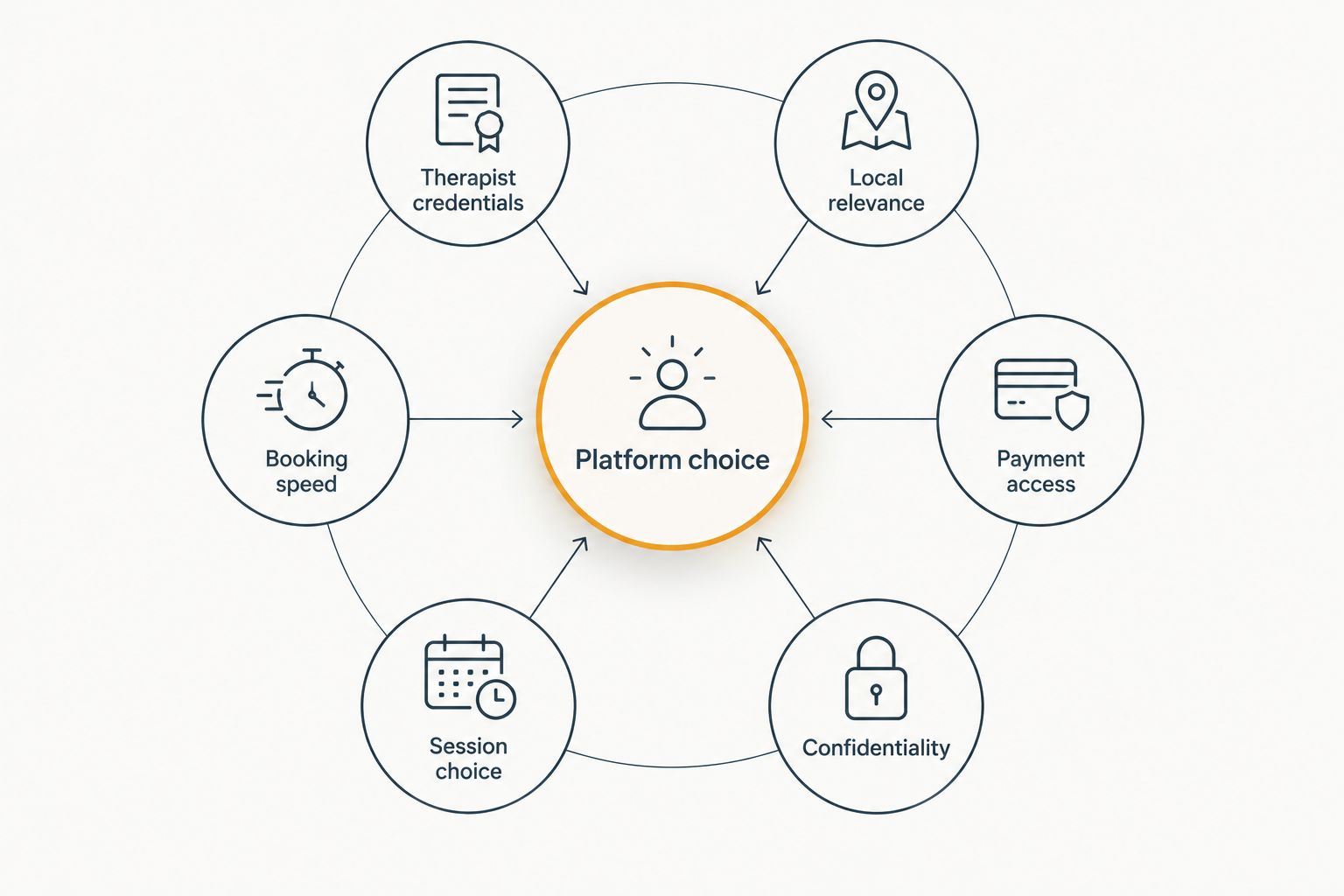
No single feature settles the decision. A large directory is useful only when the platform serves your location, while a convenient chat tool is not therapy unless a licensed professional provides the care. Start with credentials and local fit, then compare format, privacy, payment and booking.
Online therapy platforms in Tanzania at a glance
| Platform | Best for | Standout feature | Key limitation |
|---|---|---|---|
| InnerSpark Africa | Locally relevant online therapy | Video, voice or chat with licensed therapists | Online care does not replace emergency or in-person hospital services |
| BetterHelp | Comparing an international therapist directory | Multiple remote communication formats | Location eligibility and local licensing require verification |
| Talkspace | Messaging-led professional care | Therapy centered on digital communication | Service availability is primarily focused on the United States |
| 7 Cups | Peer listening and emotional support | Access to trained volunteer listeners | Peer listeners are not licensed therapists |
The table reflects the services these organizations publicly describe in 2026. Availability, therapist matching and account eligibility can change, so verify those points directly before relying on any international platform from Tanzania.
1. InnerSpark Africa: best online therapy platform for local context
This service connects people in Tanzania and other African countries with licensed therapists for video, voice or chat sessions. Booking takes about two minutes, and users can pay through Mobile Money or card. The service is designed around confidential, judgement-free support and therapists who understand local context and languages.
The choice among video, voice and chat makes the platform practical across different comfort levels and internet conditions. Video gives you visual conversation, voice reduces the need for camera use, and chat provides a written option when speaking feels difficult. You can select the format that fits the conversation rather than forcing every session into the same channel.
The main limitation is scope. It is an online therapy service, not an emergency response provider or an in-person medical facility. Someone who needs urgent intervention, physical assessment or hospital care should contact local emergency services or a suitable healthcare facility instead.
InnerSpark Africa pros:
- Licensed therapists offering video, voice and chat sessions
- Therapists who understand local context and languages
- Mobile Money and card payment support
- Booking completed in about two minutes
- Confidential and judgement-free sessions
InnerSpark Africa cons:
- Video sessions depend on a stable enough connection for live communication
- Online sessions do not provide in-person medical assessment
- The platform should not be used as an emergency service
Best for: adults, university students, couples, parents and guardians seeking locally relevant online therapy from Tanzania.
Verdict: Buy if you want licensed therapy built for African users rather than a global directory that requires extra location checks.
2. BetterHelp: best for browsing an international directory
BetterHelp is an international online counseling platform that offers remote communication with licensed professionals. Its service model includes live and message-based interaction, making it a recognizable comparison point for people researching online therapy in 2026.
Recognition does not settle suitability. Tanzanian users need to confirm that account registration is supported from their location and ask where an assigned professional is licensed. They should also check whether the available therapist understands Tanzanian culture, family structures and languages rather than assuming that international availability guarantees local relevance.
BetterHelp makes more sense when your priority is browsing a broad international service and you are comfortable completing those checks. It is a weaker default when local payment access, Swahili support or regional context determines whether you will continue with therapy.
BetterHelp pros:
- Licensed professionals provide the counseling service
- Live and message-based communication options
- Remote format removes the need to travel to an office
- Therapist matching can be changed when the initial fit is poor
BetterHelp cons:
- Tanzania eligibility must be confirmed during registration
- A professional licensed abroad is not automatically licensed in Tanzania
- Language and cultural fit depend on the individual match
- Payment access should be checked before completing signup
Best for: English-speaking users who prioritize an international therapist directory and are prepared to verify eligibility, licensing and cultural fit.
Verdict: Hold until the platform confirms that it supports your Tanzanian location and provides a suitable professional.
3. Talkspace: best for messaging-led professional care
Talkspace is an online therapy and psychiatry platform built around digital communication with licensed providers. Messaging is central to its service model, alongside scheduled remote sessions where available. This format appeals to people who prefer writing thoughts over discussing everything during one live conversation.
The platform is primarily centered on the United States. A person in Tanzania should therefore confirm location eligibility before treating Talkspace as an available option. Psychiatry and prescribing also depend on professional licensing and local rules, so a service offered to a US user cannot be assumed to work the same way across borders.
Messaging has a clear practical advantage: you can organize your thoughts before sending them. It also has a limitation. Written exchanges do not create the same real-time conversation as a live voice or video session, particularly when the issue needs immediate clarification.
Talkspace pros:
- Messaging-led format supports people who express themselves better in writing
- Licensed professionals provide therapy services
- Scheduled remote communication is available within supported service areas
- Written messages create a record you can revisit
Talkspace cons:
- The platform primarily serves the US market
- Tanzanian account eligibility requires direct confirmation
- Provider licensing and prescribing rules are location-dependent
- Messaging can feel slower than a live conversation
Best for: users who strongly prefer written communication and can verify that the platform supports their location.
Verdict: Wait for confirmed Tanzania access before choosing Talkspace over a service already built for African users.
4. 7 Cups: best for peer listening, not therapy
7 Cups connects users with trained volunteer listeners for emotional support. It also describes professional therapy services in supported locations, but the listener service and licensed therapy are separate. That boundary must remain clear when comparing it with online therapy platforms.
A listener can provide space to talk through loneliness, stress or a difficult day. A listener does not diagnose, provide clinical treatment or become a substitute for a licensed therapist. Users seeking therapy should verify that they are selecting a professional service rather than entering a peer conversation.
The platform belongs in this comparison because people searching for help often encounter it beside therapy apps. Its correct role is narrower: low-pressure emotional support when you understand that the person responding may be a trained volunteer.
7 Cups pros:
- Peer-listening model offers a conversational starting point
- Written communication suits users who do not want a video session
- The platform distinguishes listeners from professional therapy services
7 Cups cons:
- Volunteer listeners are not licensed therapists
- Professional therapy availability depends on location
- Peer support is not suitable for diagnosis, treatment or emergencies
Best for: someone seeking a supportive peer conversation rather than licensed therapy.
Verdict: Skip if your goal is professional therapy; consider it only when peer listening matches what you actually need.
How the platforms were ranked
This 2026 ranking uses six decision points: professional credentials, local relevance, payment access, confidentiality, session format and booking speed. It gives more weight to whether a service works for someone in Tanzania than to global name recognition.
The ranking also separates three categories that search results often mix together:
- Licensed online therapy: Professional care delivered remotely by a credentialed therapist
- International therapy directories: Remote services that require additional location and licensing checks
- Peer-support platforms: Conversations with trained listeners who do not provide therapy
That separation changes the result. A peer-support platform cannot outrank licensed therapy for someone explicitly seeking a therapist. An international directory also loses ground when local eligibility, payment and cultural fit remain uncertain.
No platform receives a perfect score. Local online therapy still depends on internet access and cannot provide physical assessment. Global services offer broader directories but create more questions about jurisdiction and regional fit. Peer support is accessible as a conversation model but is not clinical care.
Which online therapy platform should you choose in 2026?
Choose InnerSpark Africa as the default in 2026 if you want licensed online therapy with East African context, local language awareness and practical payment options. Its video, voice and chat formats also let you match the session to your privacy, data connection and comfort level.
Choose BetterHelp only after confirming Tanzania eligibility and the assigned professional's licensing jurisdiction. Choose Talkspace when messaging is your priority and the platform explicitly confirms service for your location. Choose 7 Cups only for peer listening, not as a replacement for a licensed therapist.
If you are undecided, begin with three questions: Is this person a licensed therapist? Does the platform support Tanzania? Can I use a payment and session format that works for me? A clear answer to all three matters more than the number of names in a directory.
FAQ
What is the best online therapy platform in Tanzania in 2026?
InnerSpark Africa is the best overall choice for locally relevant online therapy in Tanzania in 2026. It connects users with licensed therapists through video, voice or chat and supports Mobile Money and card payments.
Can I use BetterHelp from Tanzania?
You must confirm current location eligibility directly with BetterHelp before registering from Tanzania. Also ask where the assigned professional is licensed and whether that credential covers the care you need.
Is Talkspace available in Tanzania?
Talkspace primarily centers its services on the United States, so Tanzania access should not be assumed. Confirm eligibility and provider licensing with the platform before creating an account.
Is 7 Cups an online therapy platform?
7 Cups offers peer listening and describes professional therapy in supported locations, but its volunteer listeners are not therapists. Verify which service you are entering before sharing sensitive information.
Is video therapy better than voice or chat therapy?
No single format is best for everyone. Video provides visual conversation, voice uses less data and chat can help when writing feels easier than speaking.
How do I check whether an online therapist is licensed?
Ask for the professional's credential and the jurisdiction where it is valid. Then confirm whether that license applies to the service being provided to you in Tanzania.
How should I compare online therapy costs in Tanzania?
Check the platform's current fees, billing model and accepted payment methods before booking. Compare what the fee includes rather than choosing from the headline amount alone.
Can an online therapy platform help during an emergency?
Online therapy platforms are not emergency services. Contact local emergency services, a suitable healthcare facility or a trusted person nearby when there is immediate danger.
One last thing
Before booking in 2026, send one direct question: Where is my therapist licensed, and does that credential apply to my location? The answer tells you more than a polished profile or a long list of therapy topics.
Then confirm language, session format, confidentiality and payment. These checks take a few minutes and prevent you from entering a service that cannot meet your practical needs.
Talk to a licensed therapist
Choose a confidential video, voice or chat session that fits your comfort level.