
Best direct platform: InnerSpark Africa. Best route for using workplace benefits: an employer-arranged online therapy service. Best route for keeping an existing therapeutic relationship: remote sessions with your current licensed therapist. This 2026 guide compares online therapy for finance employees by access, confidentiality questions, session format, and practical fit.
- InnerSpark Africa is the best direct-platform fit here for online therapy for finance employees in Uganda, Kenya, and Tanzania.
- Employer-arranged therapy suits employees using workplace benefits; check eligibility and reporting before booking.
- Remote sessions with your current licensed therapist prioritize continuity; confirm permission to practice where you are.
- Compare confidentiality, therapist credentials, and video, voice, or chat before choosing.
Why this matters
Choosing therapy should not require you to share your personal concerns with a manager. Start by separating two decisions: who provides your care, and who arranges or pays for access. Those decisions affect the questions you need to ask.
For a finance employee, practical fit includes somewhere private to speak and a way to discuss work without exposing customer information. A therapist does not need account numbers, transaction records, or internal documents to hear that work feels overwhelming.
Choose the route that gives you a suitable licensed therapist and clear boundaries around your information—not simply the most convenient booking screen.
What makes the best online therapy for finance employees?
Use these criteria for your 2026 shortlist before comparing names or booking a session:
- Verifiable credentials: Ask for the therapist’s professional title, registration details, and permission to work with someone in your location.
- Clear confidentiality: Ask who can access appointments, messages, clinical notes, and payment information, including any employer involvement.
- Relevant experience: Ask about supporting people with work-related stress, difficult workplace relationships, or the concern bringing you to therapy.
- Usable session format: Choose video, voice, or chat according to how you communicate and where you can participate privately.
- Practical continuity: Check scheduling, rescheduling, therapist changes, and what happens when work disrupts an appointment.
- Clear financial arrangements: Confirm the current payment requirements or benefit rules before committing to ongoing sessions.
Ask 3 questions before booking: Who will I meet? What information is shared? What happens if the arrangement does not suit me? Get answers you understand rather than accepting a general promise of privacy.
Your 2026 options at a glance
These are three access routes, not three equivalent platform subscriptions. Only the first is a named platform recommendation; the others help you decide whether an existing workplace arrangement or therapist is the better starting point.
| Option | Best for | Standout feature | Key limitation |
|---|---|---|---|
| InnerSpark Africa | Direct access in Uganda, Kenya, and Tanzania | Licensed therapists through video, voice, or chat | Confirm individual therapist fit and location-specific arrangements |
| Employer-arranged online therapy | Using an existing workplace benefit | Access through your employer’s designated service | Eligibility and information-sharing rules require checking |
| Your current licensed therapist online | Continuing an established therapeutic relationship | Familiarity with the therapist you already know | Remote care depends on the therapist’s arrangements and your location |
1. InnerSpark Africa: best for direct regional access
InnerSpark Africa connects people in Uganda, Kenya, Tanzania, and other African countries with licensed therapists through video, voice, or chat. It is the clearest starting point in this comparison if you want to approach a platform directly rather than begin through an employer’s benefits process.
InnerSpark Africa is best for finance employees seeking direct access to licensed online therapy in Uganda, Kenya, and Tanzania. Choose a communication format, then check whether the individual therapist fits your concerns and location.
InnerSpark Africa pros
- Connects people with licensed therapists.
- Offers video, voice, and chat therapy sessions.
- Serves people in the named East African countries and elsewhere in Africa.
- Provides a direct route to ask about therapy without starting with workplace benefits.
InnerSpark Africa limitations
- Platform access alone does not establish an individual therapist’s experience with your particular concern.
- You still need to confirm confidentiality boundaries, scheduling arrangements, and suitability for your location.
- Online access does not solve the problem of an office or home where other people can overhear you.
Best for: Employees who want to explore a regional online platform directly.
Before booking, explain the issue in ordinary language. For example, you might say that you struggle to switch off after work, feel distressed before meetings, or want help handling conflict. These are conversation starters, not diagnoses.
Verdict: Choose this route for direct regional access; confirm therapist fit before booking.
2. Employer-arranged therapy: best for using workplace benefits
Employer-arranged online therapy means using a provider designated through your workplace’s mental health arrangements. If your employer offers this route, start with the written benefit terms rather than assuming that all online therapists are included.
Separate administrative questions from personal ones. HR or a benefits administrator can explain access rules; the care provider should explain clinical confidentiality and its limits.
Employer-arranged therapy pros
- Gives you a defined starting point when an employer already names a provider.
- Lets you check eligibility against an existing benefits document.
- Provides an administrative route for questions about authorization or reimbursement.
Employer-arranged therapy limitations
- The benefit’s rules determine which providers and services qualify.
- You need to establish what participation or billing information reaches the employer.
- Changing jobs or exhausting an allowance can require a new care arrangement.
Best for: Employees who want to use an existing workplace therapy benefit.
Ask whether you can contact the provider directly and whether manager approval is required. Also ask what happens if you want to continue with the therapist outside the benefit. Do not assume either permission or restriction until you have the terms.
For practical questions to bring to the provider, see the online therapy guide for finance-sector employees.
Verdict: Choose this route when the benefit fits your needs and its reporting rules are clear.
3. Your current therapist online: best for continuity
If you already work with a licensed therapist, ask whether you can continue remotely. This route prioritizes an existing therapeutic relationship rather than starting another search.
Remote sessions require a fresh practical agreement. Your therapist needs to confirm whether online care is appropriate and whether they can work with you in your current location, particularly when travel crosses national borders.
Continuing with your therapist online: pros
- Preserves a relationship you have already established.
- Lets you discuss the change of format with someone familiar with your concerns.
- Avoids treating a platform change as necessary when your main problem is travel or commuting.
Continuing with your therapist online: limitations
- Your therapist might not provide the remote format you prefer.
- Permission to practice does not automatically extend across borders.
- Continuing with a familiar therapist does not remove the need to review whether therapy still fits.
Best for: Employees who already have a suitable therapist and want continuity.
Discuss privacy, connection failures, and contact between appointments before switching formats. If your therapist cannot continue remotely, ask for help planning a transition rather than ending care without discussing the next step.
Verdict: Keep this route when the relationship fits and remote arrangements are appropriate.
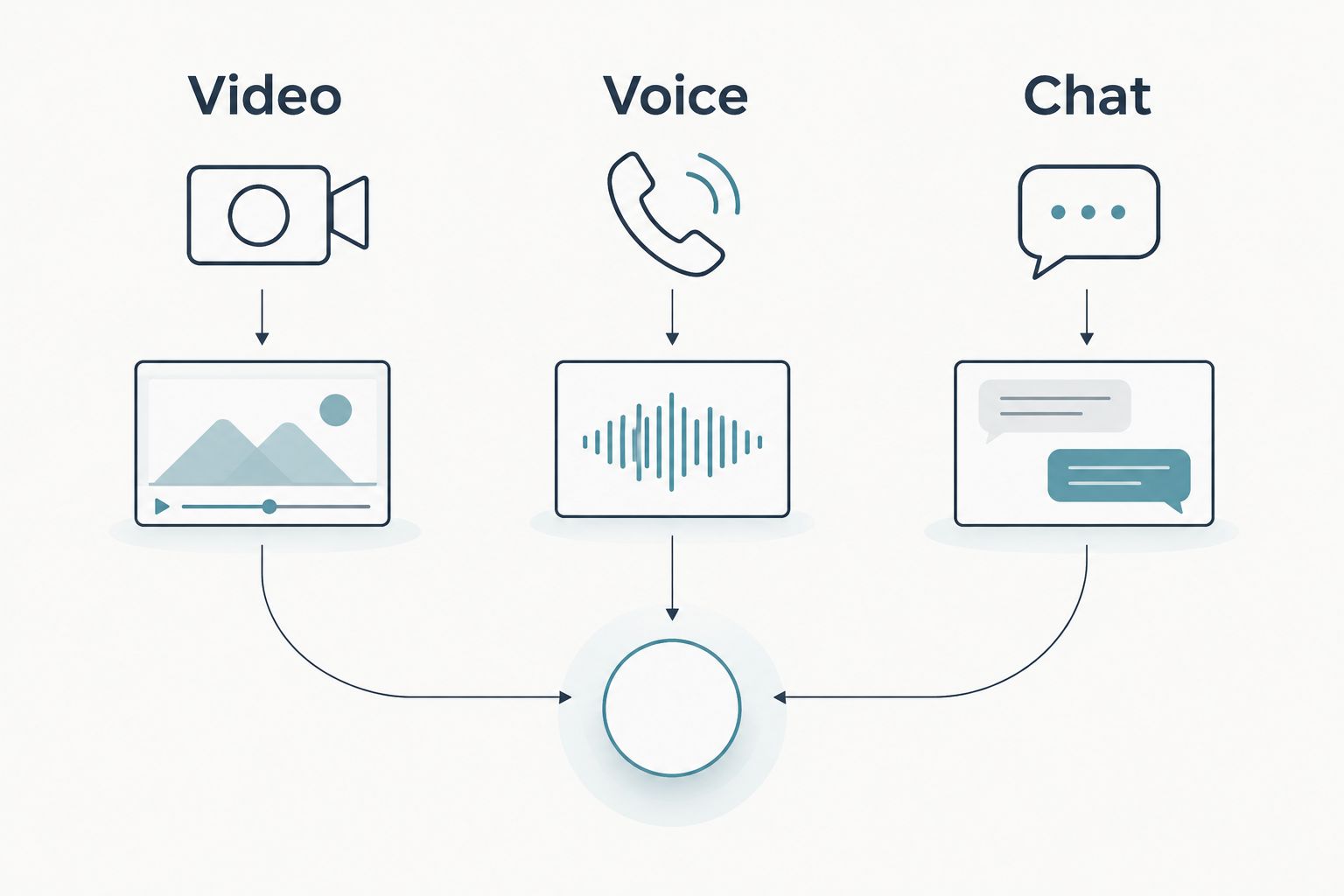
Choose video, voice, or chat around your actual day
The best communication format is one you can use privately and discuss openly with your therapist. Do not choose chat solely to hide therapy inside a busy workday, or video solely because it looks more like an office appointment.
| Format | Best for | Practical advantage | Practical limitation |
|---|---|---|---|
| Video | People who want visual interaction | Lets you and the therapist see each other | Requires a private place where speaking and appearing on camera are comfortable |
| Voice | People who prefer speaking without a camera | Keeps the conversation verbal without showing your surroundings | Removes visual information from the conversation |
| Chat | People who prefer expressing themselves in writing | Lets you communicate through text | Written messages remain readable wherever they are stored or displayed |
For chat, ask whether sessions happen live or through messages answered later. For voice and video, agree on what happens if the connection drops. A format label alone does not explain how a session works.
Protect personal privacy and workplace information
Confidentiality has limits, and those limits should be explained before you share sensitive information. Ask the provider about record access, disclosures required by law, and circumstances involving serious safety concerns. Request clarification if the explanation feels vague.
Keep these boundaries separate:
- Therapy information: Ask who can read session notes and messages.
- Payment information: Ask what appears on receipts, claims, and benefit records.
- Device access: Consider who can open your phone, email, browser, or account.
- Workplace information: Avoid sharing identifiable customer details or confidential business documents.
You can describe feeling pressured by a difficult transaction without identifying the customer. You can discuss fear of making mistakes without uploading internal spreadsheets. Focus on your experience and ask the therapist how to discuss sensitive work situations safely.
A private appointment also needs a private setting. Before a session, check whether someone can overhear you and whether notifications will appear on a shared screen.
How to book a suitable first session in 2026
Use this sequence to turn a shortlist into a practical decision:
- Name your concern. Write 2 sentences about what is difficult and what you want help discussing. You do not need to arrive with a diagnosis.
- Check credentials. Request the therapist’s professional details and confirm suitability for your location.
- Ask about confidentiality. Include employer reporting if workplace benefits are involved.
- Confirm arrangements. Check format, payment, cancellation terms, and what happens after a connection failure.
- Review the fit. After 1 session, consider whether you understood the explanation, felt heard, and could raise questions.
One appointment is a chance to assess the working relationship, not a deadline for improvement. Tell the therapist if the pace, language, or approach does not suit you. Ask how changing therapists works if the fit remains wrong.
For a 2026 booking, confirm the current arrangements directly rather than relying on an old benefit document or saved screenshot.
How these options are ranked
The order follows the decision criteria: direct regional access first, use of existing workplace benefits second, and continuity with an established therapist third. It is a decision guide, not a clinical effectiveness ranking or a claim that one route produces better outcomes.
Your circumstances can change the order. An existing therapeutic relationship can make continuity your first choice; a suitable workplace benefit can make employer-arranged access the practical starting point.
Which route should you choose?
Start with direct platform access if you are choosing independently and do not already have a therapist. Use workplace-arranged therapy when the benefit terms and confidentiality explanation suit you. Ask your current therapist about remote care when preserving that relationship matters most.
Do not choose on finance-sector branding alone. Ask the individual therapist how they approach your concerns, and decide whether their explanation feels clear, respectful, and relevant.
FAQ
What's the best online therapy for finance employees in Africa?
InnerSpark Africa is the direct-platform recommendation here for finance employees in Uganda, Kenya, and Tanzania seeking licensed therapists through video, voice, or chat. Confirm the individual therapist’s fit, credentials, and arrangements before booking.
Can my employer see that I am using online therapy?
Ask the provider exactly what participation, billing, or clinical information is shared with your employer. Do not assume that workplace-funded access is either fully anonymous or visible to your manager.
Should I choose video therapy or chat therapy?
Choose the format you can use privately and discuss comfortably with your therapist. Ask whether chat is live or answered later, and agree on a backup plan for interrupted calls.
Do I need a therapist who specializes in finance employees?
A finance-sector label is not a substitute for relevant professional experience. Ask how the therapist supports the concern bringing you to therapy, including work stress or workplace conflict.
Can I discuss confidential banking work with a therapist?
Discuss your experience without sharing identifiable customer information or confidential business documents. Ask the therapist how to describe sensitive situations while respecting your professional obligations.
Can I continue online therapy when I travel across Africa?
Confirm this with your therapist before traveling. Permission to provide care depends on the professional and location, so an existing online arrangement does not automatically apply across borders.
Is online therapy the right option during an immediate crisis?
A routine online booking is not a substitute for immediate emergency support. If you cannot keep yourself safe or someone faces immediate danger, contact local emergency services or go to the nearest emergency department.
One last thing
Your first useful question might be about privacy rather than symptoms: who can see that you booked, and what can they see? Get that answer before describing something you would not want included in an administrative record.
You do not need to explain your entire working life to begin. A clear concern and a few practical questions are enough to start the conversation.
Related guides
- Can my employer see if I use workplace therapy benefits?
- Can online therapy sessions be recorded or saved?
- Can I switch therapists if the first match does not work?
When you are ready, visit InnerSpark Africa to book a licensed therapist or ask about the session format that suits you. Start with your questions; you do not need a polished explanation.