Online therapy can replace medication for mild depression in many people, but it's rarely a full substitute once symptoms are moderate to severe, and only a doctor or psychiatrist can start, adjust or stop antidepressants safely. The therapy-versus-medication decision depends on symptom severity, how long you've been struggling, and whether a doctor has already flagged a medical cause worth ruling out.
- Mild depression often responds to talk therapy alone; medication is not automatically required in 2026 clinical guidance.
- Moderate to severe depression usually does best with therapy plus medication, not one or the other.
- Only a doctor or psychiatrist can prescribe, change or stop antidepressants — a talk therapist cannot.
- InnerSpark Africa connects you with licensed therapists across Uganda, Kenya and Tanzania from UGX 30,000 per session for video, voice or chat.
- Never stop medication on your own; do it with the prescribing doctor's guidance.
Why this matters
People ask this question because medication feels like a bigger commitment than a conversation, and online therapy has made talking to a licensed therapist faster and cheaper than it used to be. That's a fair instinct — but depression isn't one condition with one fix, and treating it like a light switch (therapy on, medication off) ignores how differently it shows up from person to person.
The honest answer in 2026 is the same one clinicians have given for years: severity decides the treatment, not preference. Getting this wrong in either direction — skipping medication when it's needed, or staying on it indefinitely when therapy alone would do — has real costs.
Can online therapy replace medication for depression?
The short version: sometimes, and it depends on where your symptoms sit on the severity scale. Here's how the three main approaches compare.
| Approach | Best for | Pros | Cons |
|---|---|---|---|
| Therapy alone | Mild depression, first episode, no safety risk | No side effects, builds long-term coping skills, flexible scheduling online | Slower symptom relief, not enough on its own for severe cases |
| Medication alone | Situations where therapy access is limited or symptoms are severe and urgent | Can relieve symptoms faster in some people | Doesn't address underlying patterns of thinking, requires a doctor's ongoing supervision |
| Therapy plus medication | Moderate to severe depression, recurring episodes | Higher combined effectiveness for moderate-severe cases per general clinical guidance, addresses both biology and behavior | Costs more time and money, needs coordination between therapist and prescriber |
Verdict: for mild depression, online therapy with a licensed therapist is a reasonable first step; for moderate to severe depression, treat therapy as one half of the plan, not the whole plan.
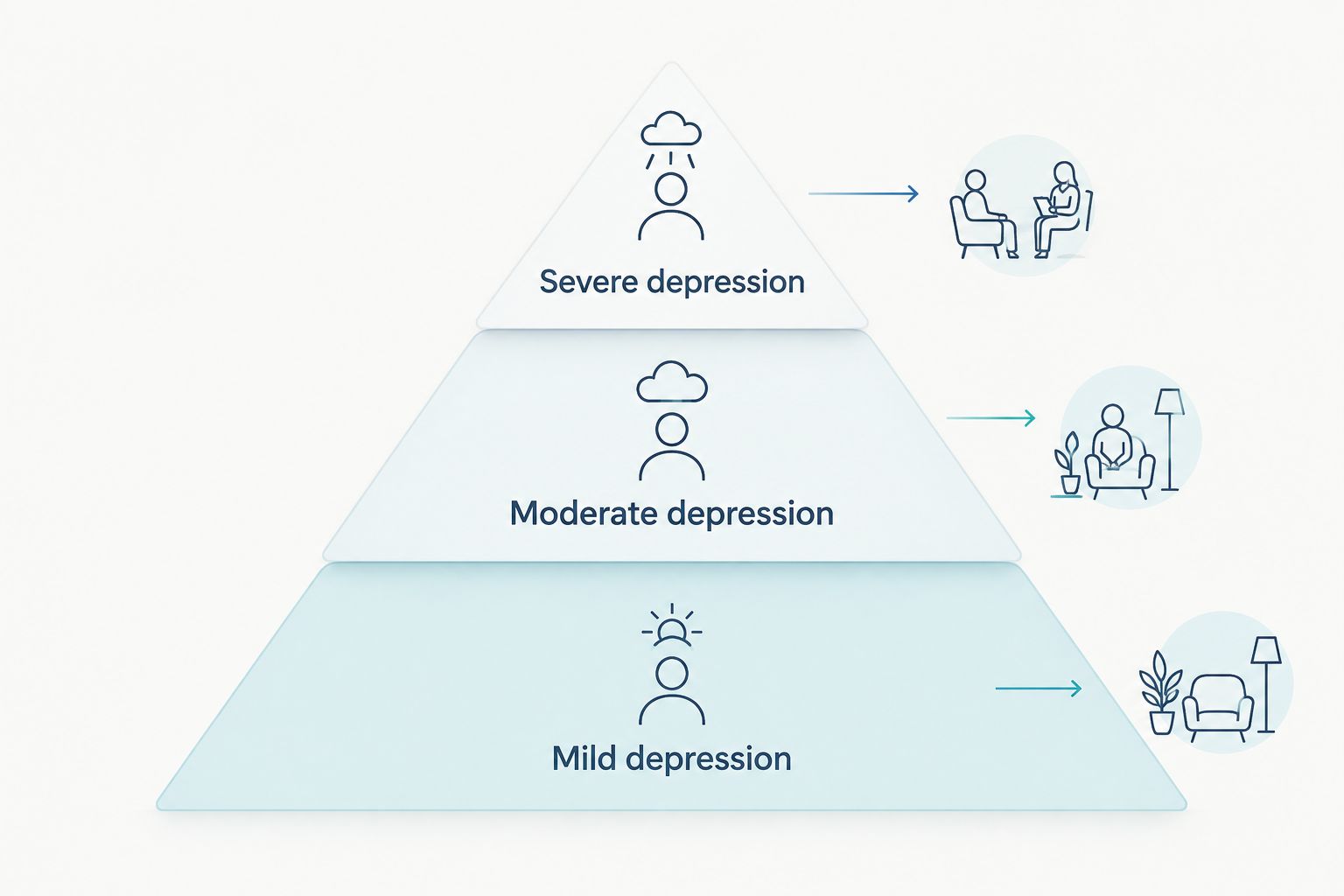
Mild depression: therapy often works alone
If your symptoms are recent, you're still functioning at work or school, and there's no history of severe episodes, structured talk therapy — cognitive behavioral approaches especially — is commonly used as a standalone first treatment. This is where online therapy fits best: consistent weekly sessions by video, voice or chat, without the wait times that come with in-person appointments.
Buy the therapy-first approach if your symptoms are mild and you have no red-flag signs like thoughts of self-harm — book a session and reassess after a few weeks.
Moderate depression: combined care works best
Once depression starts interrupting sleep, work performance, or relationships for weeks at a time, therapy alone often isn't enough on its own. Combined care means a therapist for the behavioral and thought-pattern work, and a doctor for the medication conversation.
Hold off on therapy-only if symptoms have persisted more than a few months without improvement — that's the point to loop in a doctor, not push therapy harder.
Severe depression: medication plus therapy is usually needed
Severe depression — marked by an inability to function day to day, or any thoughts of self-harm — is not a case to manage with talk therapy alone. Medication under medical supervision, combined with therapy, is the standard approach here, and a therapist working through InnerSpark Africa will refer you to a doctor or emergency service rather than try to treat this alone.
Skip therapy-only for severe cases — get a medical evaluation first, then bring therapy in alongside it.
Why the answer varies
- Symptom severity — mild, moderate and severe depression respond differently to therapy-only approaches.
- How long symptoms have lasted — a two-week low mood is treated differently than a two-year pattern.
- Safety risk — any thoughts of self-harm move the case out of therapy-only territory immediately.
- Access to a prescribing doctor — a therapist can recommend medication review but cannot prescribe it themselves.
- Response to therapy so far — if symptoms aren't shifting after consistent sessions, that's a signal to add medical input.
- Personal history — a past diagnosis or previous medication use changes what a doctor will recommend now.
Does online therapy work for severe depression?
Online therapy can support severe depression, but it should not be the only treatment — severe cases need a medical evaluation and usually medication alongside therapy. A licensed therapist working with someone in a severe episode will typically coordinate with or refer to a doctor rather than treat it in isolation.
Can you do therapy and medication at the same time?
Yes, therapy and medication work together for most moderate to severe cases, with the therapist handling coping strategies and thought patterns while a doctor manages the prescription. This combined approach is standard clinical practice in 2026 and doesn't require picking one over the other.
How do I know if I need medication or just therapy?
You need more than therapy alone if symptoms have lasted for months, are getting worse, or are stopping you from functioning day to day — that's when a doctor's input matters, not just a therapist's. A first video or chat session with a licensed therapist is often the fastest way to get an honest read on where your symptoms sit, and get pointed toward a doctor if needed.
If cost is part of what's holding you back from starting, see current online therapy pricing in Uganda before assuming it's out of reach — sessions start from UGX 30,000 and are bookable in about two minutes by Mobile Money or card.
Talk to a licensed therapist today
Confidential video, voice or chat sessions from UGX 30,000, bookable in minutes.
FAQ
Can therapy alone treat depression without medication?
Therapy alone can treat mild depression for many people, but moderate to severe depression usually needs medication alongside it. A licensed therapist can help you assess which category your symptoms fall into.
Is online therapy as effective as medication for depression?
Online therapy is not a direct substitute for medication in every case — it depends on severity. For mild depression the two can be similarly helpful; for moderate to severe cases, combined treatment outperforms either alone.
When is medication necessary for depression?
Medication becomes necessary when symptoms are moderate to severe, have lasted for months, or include any thoughts of self-harm. A doctor, not a talk therapist, makes that call.
Can a therapist prescribe antidepressants?
No, a talk therapist cannot prescribe antidepressants — only a medical doctor or psychiatrist can prescribe, adjust or stop medication. Therapists working through InnerSpark Africa refer clients to a doctor when medication is needed.
How long does online therapy take to work for depression?
Improvement timelines vary by person and severity, and consistency across sessions matters more than any fixed number of weeks. A therapist will typically reassess progress after several sessions.
Can I stop taking antidepressants once I start therapy?
No, never stop antidepressants without the prescribing doctor's guidance, even if therapy is going well. Stopping suddenly can cause withdrawal symptoms and a relapse in mood.
Is combining therapy and medication better than either alone?
For moderate to severe depression, combining therapy and medication is generally more effective than either approach alone, based on general clinical guidance used in 2026. For mild depression, therapy alone is often sufficient.
One last thing
The question isn't really "therapy or medication" — it's "how severe is this right now, and who's qualified to make that call." A licensed therapist can answer the first part in a single session; only a doctor can answer whether medication belongs in the plan. Start with the conversation, in 2026 that's often the fastest way to get an honest read on which path you actually need.