
Most licensed therapists in Uganda, Kenya and Tanzania will not open a full therapy case for someone under 18 without a parent or guardian's involvement. The exception is a crisis or safety situation, where a therapist may see a teen right away and loop in a guardian as fast as possible rather than turning the teen away.
That single rule catches a lot of families off guard, because teens often want to talk to someone privately and parents don't always know where to start. The rest of this page breaks down what "consent" actually means in practice, what InnerSpark Africa asks for when a guardian books on behalf of a teenager, and what to do if a teen doesn't want their parents involved at all.
- Online therapy for teenagers without parental consent is generally not available for routine, ongoing sessions in Uganda, Kenya or Tanzania.
- 18 is the standard age of majority across these countries, which is why licensed therapists ask for a guardian's consent below that age.
- Crisis situations are the main exception: a licensed therapist can respond immediately and involve a guardian afterward.
- InnerSpark Africa's booking flow is built for adults and for parents or guardians booking sessions for a teen.
- A teen who wants privacy from parents still has options, including talking to a school counselor or a trusted adult first.
Why this matters
A parent who books therapy without understanding the consent rule can end up delayed at the worst possible moment, and a teen who tries to book alone can hit the same wall. Getting this right the first time means the teen gets support faster, and it keeps the process legal and ethical for the therapist too.
There's also a trust issue underneath the paperwork. A licensed therapist treating a minor without any adult in the loop is taking on real liability, and most won't do it outside an emergency. Knowing that upfront saves a family from an awkward conversation mid-session.
Can teenagers get online therapy without parental consent?
In practice, no — not for regular, scheduled sessions. Licensed therapists working across Uganda, Kenya and Tanzania treat 18 as the standard age of majority, and anyone younger than that generally needs a parent or guardian to consent before therapy starts.
Here's how that plays out for different situations:
| Situation | What's typically needed | Who books the session |
|---|---|---|
| Under 18, routine support (stress, anxiety, low mood) | Parent or guardian's consent before the first session | Guardian books, teen attends |
| Under 18, crisis or safety concern (self-harm risk, acute distress) | Licensed support right away, guardian informed as soon as possible | Guardian or another trusted adult, as fast as it can happen |
| 18 and older | No guardian consent required | The individual books directly |
If you're a parent reading this because your teenager asked for help, the practical next step is simple: book the session yourself and let the teen know you're doing it with them, not around them. If you're a teenager reading this on your own, the honest answer is that a parent or guardian needs to be part of the process for a standard therapy booking in 2026 — but that doesn't mean you're stuck waiting in silence.
Why the consent rule varies
The consent requirement isn't arbitrary. A handful of factors decide how strict it is in any given case.
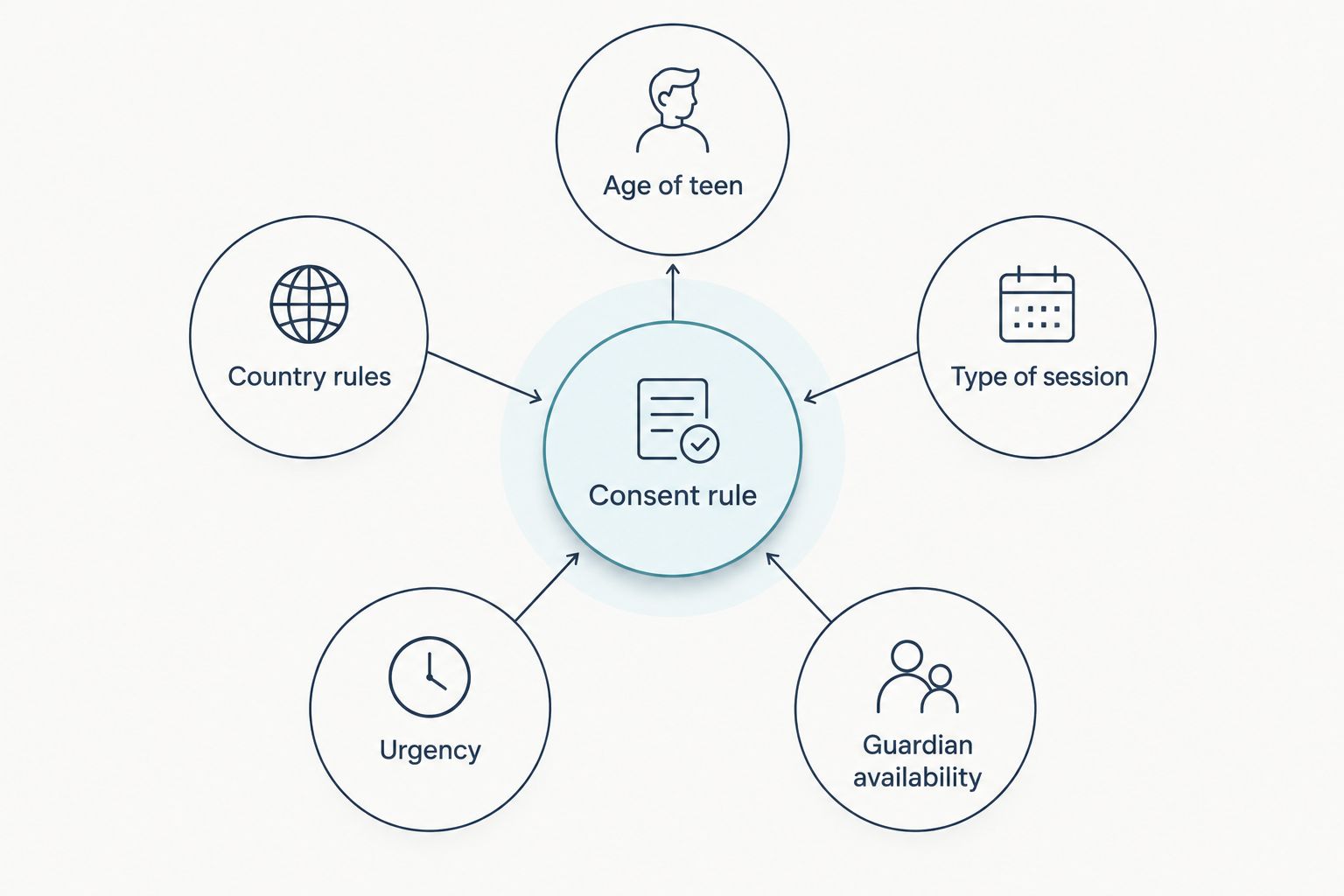
- Age of the teen — a 17-year-old and a 13-year-old are treated very differently by most licensed therapists, even though both are legally minors.
- Country-level health and consent regulations — Uganda, Kenya and Tanzania each set their own standards for who can consent to medical or mental health treatment.
- Type of session — routine talk therapy is held to a stricter standard than an urgent safety check-in.
- Urgency — a teen in crisis gets seen first, with guardian contact handled in parallel rather than as a gate.
- Guardian availability — some families have a guardian who can act fast; others don't, which shapes how quickly a teen can be seen.
- The platform's own policy — even within what's legally allowed, individual therapy platforms set their own booking rules on top of the law.
Book a licensed therapist for your teen
Parents and guardians can book video, voice or chat sessions on WhatsApp or the site.
What if a teenager doesn't want their parents involved?
A teenager who's nervous about telling a parent still has real options before or alongside therapy. Talking to a school counselor, a trusted teacher, a religious leader, or another adult they already trust can be a bridge — that person can sometimes help start the conversation with a parent in a way that feels less confrontational.
If a teen is in immediate danger of harming themselves, that's a different situation entirely: reaching out to any licensed professional or crisis line right away matters more than waiting for a perfect consent process. Guardian involvement follows as fast as it reasonably can.
What age can a teenager start therapy on their own without a parent?
The standard age at which someone can consent to their own therapy without a guardian is 18 across Uganda, Kenya and Tanzania, matching the general age of majority in each country. Below that, a parent or guardian is expected to be part of the booking and consent process for non-emergency care.
Does InnerSpark Africa offer therapy for minors?
InnerSpark Africa's booking flow is built for adults choosing therapy for themselves, and for parents or guardians booking on behalf of a teenager. A guardian handles the account and consent side, while the therapist's session structure — video, voice or chat — stays the same regardless of who's paying or booking.
Is online therapy confidential for teenagers?
Sessions themselves are private between the teen and the licensed therapist, but confidentiality has limits when there's a safety concern. Any licensed therapist, working with a minor or an adult, is expected to break confidentiality if someone's safety is at immediate risk — that's a standard professional boundary, not a platform-specific rule.
FAQ
Can teenagers get online therapy without parental consent?
Not for routine, ongoing sessions in most cases — licensed therapists in Uganda, Kenya and Tanzania generally require a parent or guardian's consent for anyone under 18. Crisis situations are handled immediately, with guardian involvement following as soon as possible.
What age is a teenager considered an adult for therapy purposes?
18 is the standard age of majority in Uganda, Kenya and Tanzania, which is why licensed therapists treat that age as the point where someone can consent to their own care without a guardian.
Can a parent book online therapy for their teenager?
Yes, a parent or guardian can book and manage a teenager's therapy sessions, including video, voice or chat formats. The guardian typically handles the booking and consent while the teen attends the session.
What happens if a teenager is in crisis and a parent isn't available?
A licensed therapist can respond to a genuine safety crisis right away rather than waiting on formal consent, then work to involve a guardian as quickly as circumstances allow.
Is a school counselor a substitute for a parent's consent?
A school counselor can support a teen and help open a conversation with a parent, but a counselor generally cannot replace a parent or guardian's consent for ongoing licensed therapy.
Are online therapy sessions for teenagers confidential?
Sessions are private between the teen and the licensed therapist, with the standard exception that a therapist will act if there's an immediate safety risk. That exception applies to adults and minors alike.
Does the therapy format change for teenagers versus adults?
No — video, voice and chat therapy formats work the same way for teenagers as they do for adults. What changes is who handles booking and consent, not the session itself.
Can a 17-year-old book therapy without telling their parents?
Generally no for standard bookings, since 17 is still below the age of majority in Uganda, Kenya and Tanzania. A parent or guardian is expected to be part of the consent process outside of a genuine crisis.
One last thing
The consent rule feels like a barrier until you flip it around: it exists because a licensed therapist is taking real responsibility for a minor's care, not just running a chat session. A parent who books therapy for their teen in 2026 isn't adding red tape — they're the reason the therapist can treat that teen at all.
If your teenager has already told you they want to talk to someone, the fastest path is a short conversation with them about what to expect, then booking together rather than deciding for them in silence.