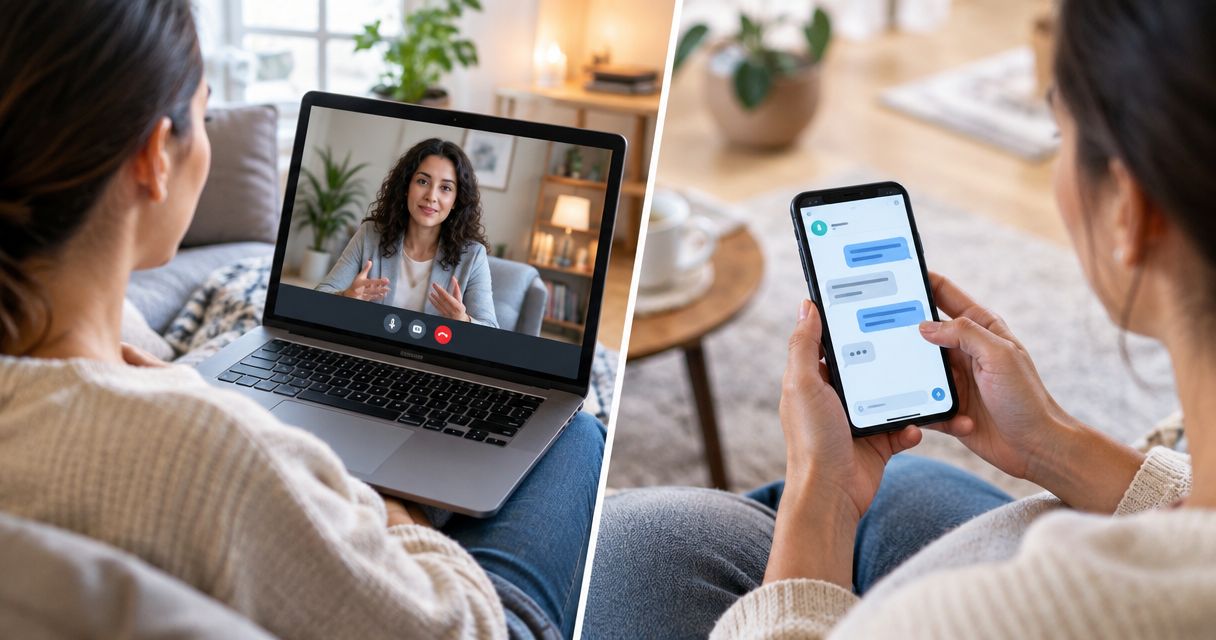
Video therapy generally offers stronger real-time clinical cues than chat therapy for anxiety, but chat can be the better format when speaking on camera increases distress or prevents you from starting. In 2026, the more effective option is the one that fits your symptoms, communication style, privacy, internet connection and ability to attend consistently.
- Video therapy vs chat therapy for anxiety has no universal winner in 2026; the right format depends on the person.
- Video therapy is best when facial expression, tone and immediate conversation help the therapist understand your anxiety.
- Chat therapy is best when writing feels safer, allows deeper reflection or works better with limited internet access.
- InnerSpark Africa offers licensed therapy by video, voice or chat across Uganda, Kenya, Tanzania and other African countries.
Why this matters
Anxiety can make the method of asking for help feel as difficult as the conversation itself. Video gives a therapist more real-time information, but that advantage disappears when being on camera makes you cancel, stay guarded or lose focus.
Chat removes some of that pressure. It also removes facial expression, vocal tone and other signals that can help a therapist notice when your written words do not match how distressed you appear.
InnerSpark Africa online therapy gives adults, university students, couples, parents and guardians a choice of video, voice or chat with licensed therapists. InnerSpark Africa is best for people in African countries who want licensed therapy with a choice of communication formats. That choice is useful because the best format in 2026 can change as trust, symptoms and circumstances change.
Is video therapy more effective than chat therapy for anxiety?
Video therapy has the stronger practical advantage when your therapist needs to respond to facial expression, voice, breathing, posture or sudden changes in emotion. Chat therapy has the stronger practical advantage when privacy, reflection, lower data use or reduced social pressure determines whether you can participate openly.
The formats are not interchangeable. A scheduled video session is a live conversation, while chat can be live or allow more time between responses. Before booking chat, confirm how the session works, when the therapist replies and whether you need to remain available throughout the appointment.
| Decision factor | Video therapy | Voice therapy | Chat therapy |
|---|---|---|---|
| Communication cues | Face, voice and body language | Voice and pacing | Written words and response timing |
| Pressure of being seen | Highest | None | None |
| Time to plan an answer | Limited | Limited | Highest |
| Written record | Notes only unless provided separately | Notes only unless provided separately | Conversation remains in written form where the platform permits access |
| Internet demand | Highest | Lower than video | Lowest |
| Private space needed | Quiet space with visual privacy | Quiet space | Private device and safe place to type |
| Best fit | Real-time discussion and visible emotional cues | Spoken discussion without a camera | Reflection, discretion and lower connection demands |
Video is the better first choice when real-time interaction helps you engage rather than withdraw. Chat is the better first choice when writing is what makes honest participation possible. Voice therapy sits between them when you want a live conversation without being seen.
A format is not a diagnosis or treatment plan. A licensed therapist should still assess what you are experiencing, explain the proposed approach and tell you when a different format or level of care is more appropriate.
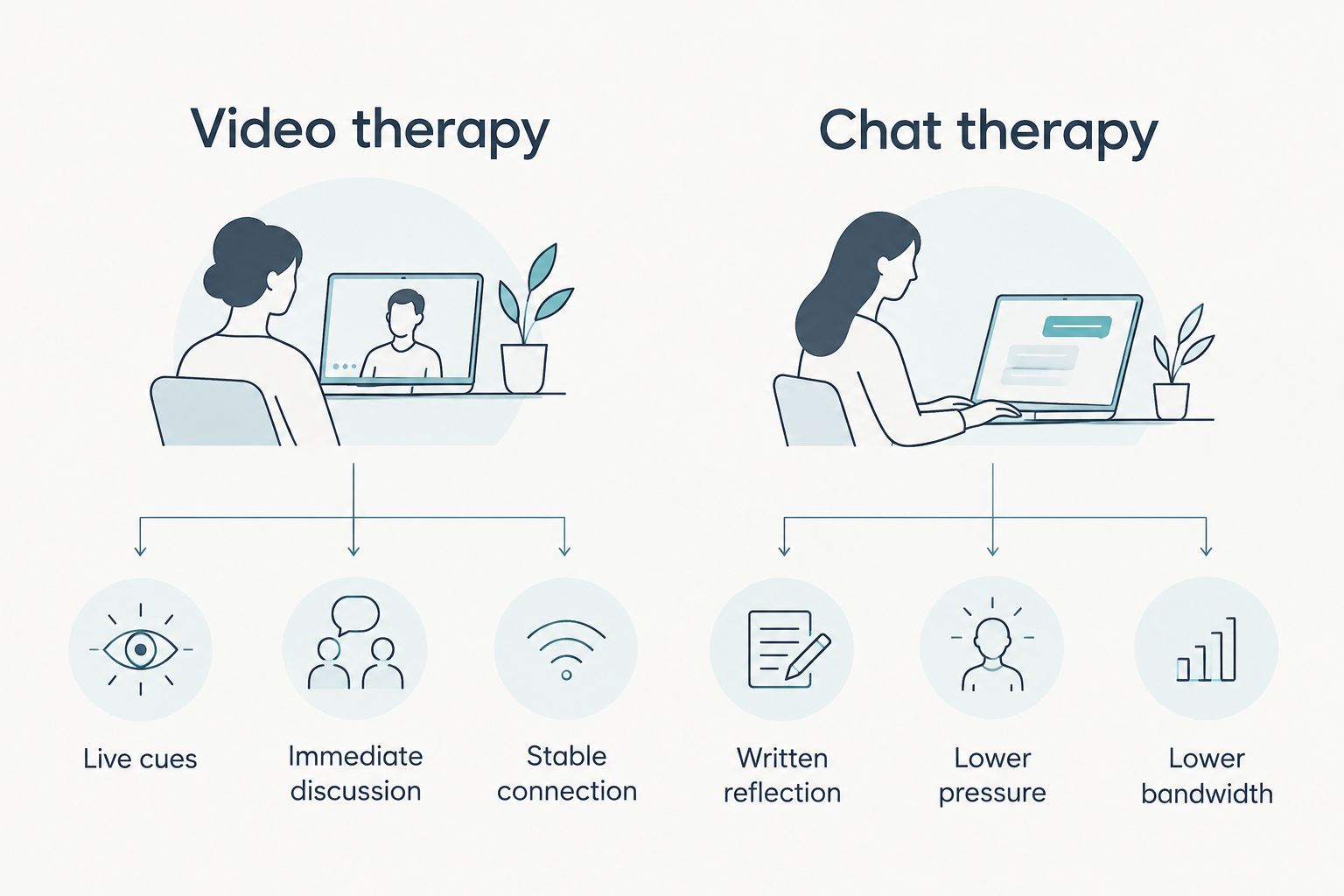
Video therapy: best for live cues and immediate discussion
Video lets your therapist hear your tone and see expressions, pauses and visible tension while you speak. Those cues can provide context that a short written answer misses, especially when you find it difficult to describe what happens in your body during anxiety.
A live session also supports immediate clarification. If a question feels confusing or upsetting, you can say so and hear the therapist respond without waiting for another written exchange. In 2026, video remains the closest online format to an in-person conversation without requiring travel.
The main drawback is exposure. Looking at yourself on screen, worrying about your surroundings or seeing another person's reaction can increase self-consciousness. You also need visual privacy, a working camera and a connection stable enough to carry the session.
Video therapy is a strong starting point when:
- You communicate more easily by speaking than typing.
- Seeing the therapist's face helps you feel connected and understood.
- Your anxiety includes reactions that are difficult to put into words.
- You have a private room and reliable internet access.
- You want a scheduled conversation with immediate responses.
Verdict: Choose video when live human cues make it easier to stay present and explain what is happening. Skip it as a first format when the camera itself stops you from speaking honestly.
Chat therapy: best for reflection and lower social pressure
Chat gives you time to read a question, notice your reaction and shape an answer before sending it. That pause can help when anxiety makes your mind go blank during live conversation or when you remember important details only after a spoken session ends.
Writing also creates a visible thread. You can identify repeated concerns, review wording and prepare topics for the next exchange. Whether the full thread remains available depends on how the platform handles access, so check that detail before relying on chat as a permanent record.
Chat has limits. A therapist cannot see facial expression or hear whether your voice has changed, and short messages can be misunderstood without tone. Chat can also become a way to avoid speaking about something difficult rather than a bridge toward discussing it more directly.
Chat therapy is a strong starting point when:
- Writing feels more natural than speaking about anxiety.
- You need a format that uses less mobile data than video.
- You have visual privacy but cannot talk freely where you are.
- Being watched makes you focus on your appearance instead of the session.
- You want time to consider a therapist's question before answering.
Verdict: Choose chat when writing increases honesty and consistency. Reconsider it when typing keeps the conversation distant or makes misunderstandings harder to resolve.
Voice therapy: the middle option without a camera
Voice therapy preserves tone, pacing and immediate conversation without requiring visual contact. It is useful when chat feels too detached but video creates too much pressure, and it generally places fewer demands on an internet connection than video.
You still need a quiet place where other people cannot hear sensitive details. You also lose facial and body-language cues, so voice is not simply video with the camera switched off; it gives the therapist a different set of information.
Verdict: Choose voice when you want a live conversation and vocal connection without appearing on camera. InnerSpark Africa includes voice alongside video and chat, which gives you a practical middle option in 2026.
Why the effectiveness of video and chat varies
The format does not work separately from the person, therapist or setting. These factors decide whether a theoretical advantage becomes useful in a real session:
- Your communication style: Speaking can reveal thoughts before you edit them. Writing can help you express details that disappear under conversational pressure.
- The form your anxiety takes: Camera pressure, fear of judgment, physical distress and difficulty concentrating affect how manageable each format feels.
- Therapeutic approach: Some activities depend on live discussion, while other reflection exercises translate naturally into writing. Ask the therapist how the intended approach works online.
- Privacy: Video needs visual and audio privacy. Voice needs audio privacy. Chat needs control of your device, notifications and account access.
- Connection quality: A frozen screen or dropped call disrupts video more than chat. A stable connection matters if interruptions make you tense or reluctant to continue.
- Consistency: The format you can attend regularly gives the therapist more continuity than an ideal format you repeatedly postpone.
These factors can shift during 2026. You might begin with chat while building trust, move to voice for a more immediate exchange and later use video when seeing the therapist feels helpful rather than exposing.
How to choose between video and chat therapy
Use a practical decision process instead of trying to identify a perfect format before your first appointment.
- Name the main barrier. Decide whether the harder part is speaking, being seen, finding privacy, maintaining a connection or organizing your thoughts. Choose the format that reduces that barrier without removing the communication you need.
- Check your setting. Test whether you can talk without being overheard, whether your screen is visible to anyone else and whether notifications reveal private information. Confidential therapy still requires a private setup on your side.
- Ask how chat works. Find out whether it is a live appointment or a conversation with delayed responses. Those experiences require different schedules and create different expectations.
- Try one format and review it. After the session, ask whether you communicated openly, understood the therapist and felt able to stay engaged. Discomfort alone does not mean the format failed, but repeated withdrawal is a reason to discuss switching.
- Keep the therapist informed. Tell the therapist when camera pressure, typing delays or connection problems interfere. The therapist can help separate normal first-session discomfort from a poor format fit.
InnerSpark Africa supports all three communication formats with licensed therapists. Its format choice is useful, but no platform can decide your clinical fit from the communication channel alone. The therapist, your circumstances and your willingness to participate remain central.
Related questions
Is chat therapy effective for social anxiety?
Chat therapy can be useful when fear of being watched or judged makes a live conversation feel unmanageable. It can lower the barrier to beginning, but avoiding every spoken interaction can also preserve the same fear you want to address. A licensed therapist can explain whether chat should remain the main format or act as a step toward voice or video.
Can I switch from chat therapy to video therapy later?
Yes, you can ask to switch when chat feels too slow, limited or easy to misunderstand. You can also move from video to chat when privacy, internet access or camera pressure interferes. Confirm how InnerSpark Africa handles format changes when booking because scheduling arrangements can differ.
Which format is better for a teenager with anxiety?
The better format is the one that helps the teenager communicate safely and willingly with an appropriate licensed therapist. Some teenagers prefer writing because it feels less exposing, while others find typing frustrating and respond better to a spoken conversation. A parent or guardian should discuss privacy, consent, platform access and the therapist's suitability before the session.
When online therapy is not enough
Video, voice and chat therapy are not emergency services. If you or someone else is in immediate danger, at risk of self-harm or unable to stay safe, contact local emergency services or a trusted person who can stay present and help you reach urgent support.
Do not wait for a routine chat reply during an emergency. The correct next step depends on your location and immediate circumstances, not on which therapy format you normally use.
FAQ
Is video therapy better than chat therapy for anxiety in 2026?
Video therapy is better when live facial, vocal and conversational cues help you engage, while chat is better when writing makes honest participation easier. Neither format is best for every person with anxiety in 2026.
Does chat therapy use less internet data than video therapy?
Yes, text chat generally places lower demands on an internet connection than a live video call. That can make chat easier to complete where mobile data or connection stability is limited.
Can a therapist understand anxiety without seeing my face?
Yes, a licensed therapist can work through voice or chat, but each format provides different information. Voice retains tone, while chat relies on your written description and response pattern.
Is video therapy confidential?
Video therapy with a licensed therapist is confidential, but you also need a private room, secure device and account access. Use headphones and manage notifications when other people are nearby.
What if being on camera makes my anxiety worse?
Tell the therapist and consider starting with voice or chat. The aim is not to force a format that prevents useful communication, although the therapist may later discuss whether gradual video use fits your goals.
Can I use chat therapy if I struggle to talk about my feelings?
Yes, chat can give you more time to identify and describe feelings before responding. It becomes less useful when writing helps you avoid important topics rather than approach them safely.
How do I choose a therapist for online anxiety support?
Choose a licensed therapist whose experience, communication style, language and cultural understanding fit your needs. Ask how the therapist works with anxiety and how that approach translates to video, voice or chat.
Can I change therapy formats during treatment?
Yes, a format can be changed when your privacy, internet access, comfort or treatment needs change. Discuss the switch with your therapist so the new format supports continuity rather than interrupting it.
One last thing
Do not treat the first format you choose in 2026 as a permanent decision. A difficult first video session can reflect nerves rather than a poor match, while an easy chat session can still feel too limited once you want a deeper live conversation.
Review the format after you have enough experience to identify what helped and what blocked you. The best next step is the lowest-pressure format that still lets you communicate honestly with a licensed therapist.