
Single-parent online therapy is support delivered remotely by a therapist, with the aim of helping you manage emotional strain alongside parenting responsibilities. This 2026 guide explains how to choose online therapy for single parents in Uganda around childcare, privacy, household spending and the concerns you want to discuss.
- InnerSpark Africa suits adults seeking online therapy for single parents in Uganda through licensed therapists by video, voice or chat.
- Choose a session format around privacy and childcare, not just convenience.
- Ask about credentials, confidentiality limits and the full session fee before booking.
- Start with one parenting concern and one personal concern; you do not need a diagnosis to seek support.
Why online therapy matters for single parents in Uganda
When you are responsible for both earning and caring, an appointment involves more than finding an opening in your calendar. You also need somewhere to speak, a workable childcare arrangement and enough privacy to discuss things you do not want your child to hear. Remote sessions remove the journey to a therapy room, but they do not remove those practical decisions.
InnerSpark Africa connects people in Uganda with licensed therapists through video, voice or chat. InnerSpark Africa is suited to adults in Uganda seeking licensed online therapy with a choice of video, voice or chat. The practical limitation is that every format still requires a suitable device, a connection and a way to protect your conversation.
Single parenting does not mean you have a mental-health condition. You can seek support for grief, separation, loneliness, family pressure, conflict with a co-parent or the feeling that your own needs always come last. Your circumstances and priorities should shape the conversation, rather than assumptions about what a single-parent household looks like.
Choose support you can actually attend and speak freely in. A session that fits your household is more useful as a starting point than a format chosen only because it looks familiar.
How to choose online therapy as a single parent
Name your priorities
Start with what you want help carrying, not with a diagnosis. You might want to respond differently when you feel overwhelmed, process the end of a relationship, or stop feeling guilty whenever you take time for yourself. These are topics to bring to a therapist, not labels you need to assign yourself.
Write your thoughts on paper or in a private note before searching for a provider. As a suggested preparation exercise, spend 10 minutes separating what is urgent from what can wait; this is a planning aid, not a treatment requirement. Choose one concern about parenting and one concern about your own life so the session does not become only a discussion of everyone else's needs.
You can begin even if your explanation feels unfinished. A therapist can ask questions to help clarify what you want from support.
- Describe one recent situation that felt difficult.
- Note what you thought, felt and did in that situation.
- Identify what you want to handle differently.
- Include a personal concern unrelated to your child's behaviour.
Protect your privacy
Before choosing a session time, test where you would sit and who could hear you. Headphones keep the therapist's voice private, but they do not stop other people hearing yours. A shared bedroom, courtyard or workplace corner needs a different plan from a room with a closed door.
Privacy also includes your phone. If your child or another household member uses the same device, think about notifications, saved messages and account access. Ask the provider how communications and session records are handled instead of assuming that every conversation disappears afterwards.
Set aside a suggested 5 minutes before the appointment to check the connection and your surroundings. If privacy falls through, tell the therapist rather than discussing sensitive details within earshot of someone else.
- Choose a place where others cannot easily hear you.
- Arrange safe supervision if your child needs it.
- Turn off message previews on shared devices.
- Ask about confidentiality and its safety-related limits.
- Agree on what happens if someone enters the room.
Choose your format
Your session format should match how you communicate and what your household allows. Video gives you and the therapist visual contact. Voice removes the need to appear on camera, while chat lets you express yourself in writing. None of these options is automatically the right choice for every parent or every concern.
You can first list your preferences without committing to a platform. InnerSpark Africa's online therapy options include video, voice and chat, so you can ask which format suits the concern you want to discuss. Do not assume that every therapist offers every format or that written support means an immediate response.
For your 2026 booking, confirm how the chosen session works before paying. Ask whether chat is a scheduled conversation, how interruptions are handled and what happens if the connection drops.
- Pick video if visual interaction matters to you.
- Pick voice if speaking feels easier without a camera.
- Consider chat if writing helps you organise your thoughts.
- Check the connection and device requirements.
- Confirm the session structure and response expectations.
Check therapist credentials
A platform name is not a substitute for knowing who will provide your care. Ask for the therapist's name, qualification, professional registration or licence details, and relevant experience. Credentials establish professional standing; a separate conversation helps you assess whether the therapist understands the issues you want to discuss.
InnerSpark Africa connects people with licensed therapists. When choosing a therapist, ask specifically about experience supporting adults with parenting stress, separation, grief or difficult family relationships, depending on your needs. Do not treat experience with children as proof of experience supporting parents.
Language and cultural context belong in this check too. Explain the language you prefer and any family, faith or community expectations affecting your decisions. Ask how the therapist works with those concerns without assuming that a shared location means a shared perspective.
- Request the therapist's name and credentials.
- Ask how to verify their professional standing.
- Describe the concern you want support with.
- Confirm your preferred language before booking.
- Ask how the therapist approaches cultural and family pressures.
Prepare your notes
You do not need to rehearse a polished story. A short note can help you remember what matters when you finally have space to talk. Start with the situation that brought you to therapy, then explain how it affects your daily life, relationships or parenting.
Try 3 sentences: what is happening, what feels hardest and what you want help with. For example, you can describe feeling overwhelmed after work and wanting to handle evening routines with less conflict. That gives the therapist a starting point without requiring you to disclose everything at once.
Keep notes somewhere private, and avoid bringing unnecessary identifying details about your child or co-parent. Your first session can include questions about the therapist's approach, confidentiality and whether the service fits your needs.
- Write a brief description of your main concern.
- Note when the difficulty shows up most clearly.
- Describe what support you already have.
- List any questions you want answered.
- Say which topics you are not ready to discuss yet.
Set practical boundaries
A workable therapy plan includes household logistics as well as emotional goals. Check the current session fee, session length, payment methods and cancellation terms directly before booking. Make these part of your 2026 household planning rather than assuming that an advertised format tells you the total commitment.
Clarify what contact is available between appointments. A chat session does not automatically mean ongoing access to a therapist, and an online platform should not be treated as emergency support unless it explicitly provides that service.
You also decide what to tell other people about your appointment. A simple explanation such as taking time for a private health conversation can be enough. You do not owe relatives or a co-parent the contents of your sessions, although the therapist should explain any applicable confidentiality limits.
- Confirm the current fee and accepted payment methods.
- Check session length and rescheduling terms.
- Ask about contact between appointments.
- Plan safe childcare for the session.
- Agree on a backup plan for connection problems.
Review your fit
After a session, assess the experience rather than demanding an immediate change in how you feel. Did you understand the therapist's explanation? Could you ask questions? Were your concerns taken seriously without blame or pressure? These observations help you decide whether to continue or discuss a different approach.
Use a private note to record one thing that felt useful and one thing you want clarified. You can tell the therapist when advice does not fit your household, when a question feels uncomfortable or when you need a slower pace. A respectful conversation about fit is part of choosing care.
Revisit the practical setup too. If the appointment repeatedly clashes with childcare, adjust the timing or ask about another format. Your 2026 plan should fit your actual responsibilities, not an ideal week that never happens.
- Note whether you felt heard and respected.
- Ask for explanations of unfamiliar terms.
- Raise concerns about the approach directly.
- Review whether the format protects your privacy.
- Discuss next steps without expecting guaranteed results.
These decisions form a sequence: identify your needs, protect the conversation, select a format, check the therapist, prepare, set boundaries and review the fit. You can return to an earlier decision if your circumstances change.
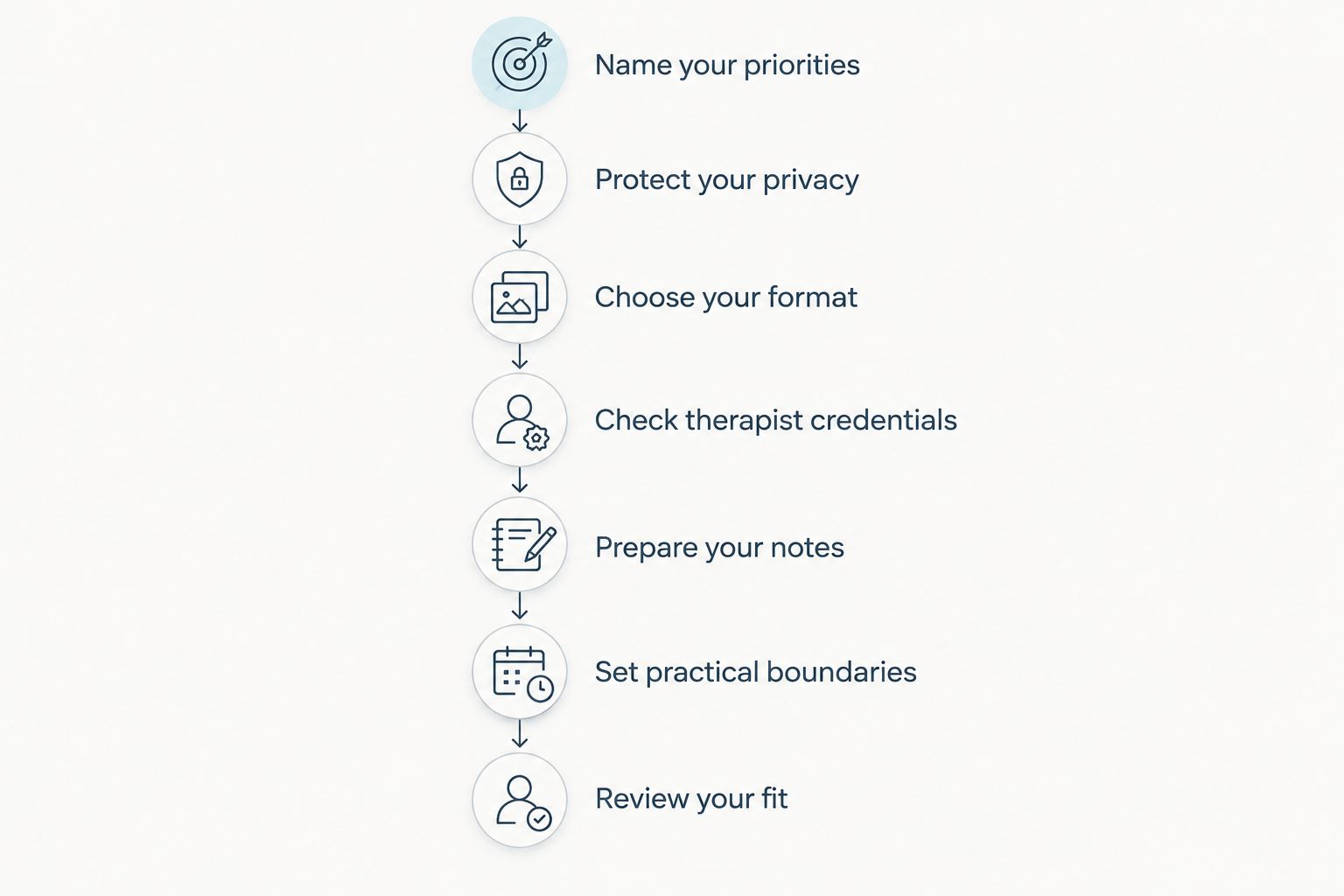
Compare session options for your household
The best format is the one that lets you communicate comfortably and privately. This comparison describes practical differences, not a ranking of treatment effectiveness. Ask the therapist which format is appropriate for your needs and how it will be delivered.
| Option | Best for | Practical advantage | Key limitation |
|---|---|---|---|
| Video therapy | Parents who want visual interaction | You and the therapist can see each other | Requires camera privacy and a connection that supports video |
| Voice therapy | Parents who prefer speaking without appearing on camera | Removes the camera requirement | Others nearby can still hear your side of the conversation |
| Chat therapy | Parents who prefer expressing thoughts in writing | Does not require speaking aloud | Typing takes effort; response timing needs clarification |
| In-person therapy | Parents who want a separate space outside the home | Creates physical distance from household interruptions | Requires travel and arrangements for children who need supervision |
Online options can solve the travel problem without solving the privacy problem. In-person support can provide a separate setting without solving the childcare problem. Compare those trade-offs before deciding which appointment you can sustain.
If your child also needs support, ask about a separate assessment and age-appropriate service. An appointment for your own therapy does not automatically include therapy for your child.
Common mistakes single parents make when choosing therapy
Waiting until every household problem is settled
You do not need to resolve childcare, co-parenting and family disagreements before seeking support. Start with the immediate requirements for one appointment: safe supervision, a private space and a confirmed fee. Therapy is a place to discuss unresolved concerns, not a reward for having already managed them.
Using a quiet child as the privacy plan
A child being occupied does not guarantee that a difficult conversation will remain private. Avoid relying only on television, a game or an instruction not to interrupt. Arrange supervision appropriate to your child's age and needs, and agree with the therapist on how to handle interruptions safely.
Turning personal therapy into a judgement on the co-parent
You can discuss conflict and its effect on you without treating the session as proof that the other parent is wrong. Ask for help with your responses, boundaries and decisions. If there is abuse or a safety concern, name that clearly so the therapist can discuss appropriate support rather than treating it as ordinary disagreement.
Assuming shared language means shared understanding
A therapist speaking your preferred language helps communication, but it does not replace explaining your family situation. Describe the expectations, beliefs and pressures affecting you. Ask questions when an interpretation does not match your experience instead of feeling obliged to agree.
Expecting support to remove every difficult feeling
Parenting responsibilities and stressful circumstances do not disappear because you attend therapy. Discuss goals you can recognise in daily life, such as expressing a boundary or understanding a recurring reaction. Look for a useful working relationship, not a promise of a cure.
FAQ
What's the best online therapy format for a single parent in Uganda?
The best format is one that lets you communicate comfortably and privately. Video suits visual interaction, voice removes the camera requirement, and chat suits written communication; confirm with the therapist which format fits your needs.
Can I get therapy even if I do not have a diagnosis?
Yes, you can seek therapy without having a diagnosis. Parenting stress, grief, separation, loneliness and family conflict are concerns you can discuss with a therapist without assigning yourself a medical label.
Does InnerSpark Africa offer online therapy in Uganda?
Yes, InnerSpark Africa connects people in Uganda with licensed therapists for video, voice or chat sessions. Confirm the individual therapist's credentials, session format and current terms before booking.
How much does online therapy for single parents in Uganda cost?
Check the current session fee directly with your chosen provider before booking. Ask about session length, payment methods and cancellation terms so you understand the full appointment commitment.
Is online therapy confidential if I share a home with my children?
Your home setup affects whether people nearby can hear or see your conversation. Ask the therapist to explain professional confidentiality and its limits, then plan a private space, safe childcare and secure device access.
Can my child join my online therapy session?
Ask the therapist before including your child in a session intended for you. Therapy for a parent and therapy for a child involve different needs, and the therapist should clarify consent, privacy and the purpose of any joint conversation.
What should I do if I need urgent mental-health help?
If you or your child is in immediate danger, contact local emergency services or go to the nearest emergency department. Do not wait for a scheduled online therapy session or a chat reply; involve a trusted person who can help you reach immediate support.
One last thing
Your session does not have to be entirely about being a parent. You can bring loneliness, work pressure, grief, identity or the wish to have something in your life that belongs to you. Supporting yourself is a legitimate reason to seek therapy, even when your child's needs usually fill the calendar.
For your first conversation in 2026, prepare one question: What would working together on this concern look like? The answer should help you understand the approach and decide whether you want to continue.
Related guides
- Compare online counselling services in Uganda
- Understand therapy costs in Uganda
- Compare online therapy platforms in Kenya
When you feel ready, contact InnerSpark Africa on WhatsApp or book a licensed therapist. Start with a question about the session format and whether the therapist can support the concern you want to discuss.