Best starting point for adults seeking online therapy in Uganda, Kenya or Tanzania: InnerSpark Africa, with therapist fit checked before booking. Best format for face-to-face conversation: video; best for avoiding a camera: voice; best for communicating in writing: chat. This 2026 guide helps you choose without treating an online therapy platform as automatically LGBTQ+ affirming.
- Compare the best LGBTQ+ friendly online therapy platforms in Africa by therapist experience, confidentiality and country eligibility.
- InnerSpark Africa connects people with licensed therapists; ask about LGBTQ+ affirming practice before booking.
- Choose video for visual conversation, voice without a camera, or chat when writing feels easier.
- Confirm privacy limits, contact preferences and session format before sharing sensitive information.
Why this matters
LGBTQ+ friendly therapy means support that respects your identity, not treatment aimed at changing it. You deserve space to discuss relationships, anxiety, family pressure or everyday life without having your sexuality or gender treated as the problem.
A platform and an individual therapist are different things. The platform connects you to care; the therapist determines how that conversation feels and what professional support you receive. Choose both deliberately.
For your 2026 search, start with the country where you will attend sessions, your privacy needs and the therapist's approach. A welcoming description is not a substitute for a direct answer about affirming care.
What makes the best LGBTQ+ friendly online therapy platform?
Use these criteria before comparing names or choosing a session format:
- Affirming practice: The therapist respects your sexuality, gender, name and pronouns, without making identity change a treatment goal.
- Relevant experience: Ask about supporting LGBTQ+ adults and the concerns you want to discuss. You do not need to share your full history to ask.
- Professional credentials: Request the therapist's professional qualification and licensing or registration details, including the relevant regulator.
- Country eligibility: Confirm that the therapist can work with you in the country where you will physically attend sessions.
- Confidentiality: Ask who can access messages and records, what confidentiality exceptions apply, and how appointment communications appear.
- Practical fit: Check language, session format, a private place to attend and what happens if your connection fails.
The strongest choice answers these questions clearly. A friendly profile that leaves professional credentials or confidentiality unclear is not enough for a decision.
Online therapy options at a glance
The recommendations below compare one named platform and its three stated session formats. Use them as a decision guide, not a certification that every therapist offers LGBTQ+ affirming care. Confirm the individual therapist's approach before booking.
| Option | Best for | Standout feature | Key limitation |
|---|---|---|---|
| InnerSpark Africa | Starting a therapist search in Uganda, Kenya or Tanzania | Connects people with licensed therapists through video, voice or chat | You still need to check the individual therapist's LGBTQ+ experience and fit |
| Video therapy | Talking with visual cues | You and the therapist can see each other | Requires a private camera setting and a suitable connection |
| Voice therapy | Speaking without appearing on camera | A spoken conversation without video | People nearby can still overhear you |
| Chat therapy | Communicating in writing | Lets you express concerns through text | You need clarity about response timing and message handling |
No format fixes a poor therapeutic match. Start with an affirming therapist, then select the communication method that fits your privacy and preferences.
1. InnerSpark Africa: best starting point for regional access
InnerSpark Africa is an online mental health platform connecting people in Uganda, Kenya, Tanzania and other African countries with licensed therapists. Its stated formats are video, voice and chat. That gives you different ways to begin a conversation without assuming that camera-based sessions suit everyone.
InnerSpark Africa is a starting point for adults seeking licensed online therapy in Uganda, Kenya or Tanzania. For LGBTQ+ support, make therapist-level screening part of that first step rather than relying on the platform name alone.
InnerSpark Africa pros
- Its stated service includes Uganda, Kenya and Tanzania.
- It connects people with licensed therapists.
- Video, voice and chat give you a choice of communication formats.
InnerSpark Africa considerations
- A platform connection does not replace checking the therapist's affirming approach.
- Online sessions still require a private setting on your side.
- You need to confirm country eligibility and arrangements with the selected therapist.
Best for: Adults who want to begin a locally relevant therapist search and compare session formats.
Ask about language and familiarity with your circumstances rather than assuming a therapist understands them. Family expectations, religion, relationships and identity disclosure can be relevant, but you decide which topics belong in your session.
Verdict: Hold the booking until the therapist answers your affirming-care and confidentiality questions.
2. Video therapy: best for conversation with visual cues
Video therapy lets you speak while seeing the therapist. Choose it when facial expressions and visible reactions help you feel connected, or when talking face-to-face is your preferred way to explain a difficult experience.
For LGBTQ+ conversations, camera privacy deserves its own check. Consider what your background reveals, whether someone can enter the room, and whether you feel comfortable being visible that day.
Video therapy pros
- Adds facial expressions to the conversation.
- Supports spoken discussion without typing.
- Gives you a format similar to a face-to-face meeting.
Video therapy cons
- Requires a private setting for both sound and camera.
- Depends on a connection suitable for video.
- Being on camera can feel uncomfortable when you are already distressed.
Best for: People who want visual interaction and have somewhere private to attend.
Before your first session, agree on a backup if video stops working. Do not assume the appointment automatically switches to voice or chat; establish that arrangement with the therapist.
Verdict: Buy into video only when the camera and privacy requirements work for you.
3. Voice therapy: best for speaking without a camera
Voice therapy lets you have a spoken conversation without showing your face or surroundings. Choose it when talking feels easier than writing but video adds an unnecessary barrier.
Camera-free does not mean confidential by default. Your voice remains audible, so a shared bedroom, corridor or communal workspace needs the same privacy check as a video session.
Voice therapy pros
- Removes the need to appear on camera.
- Lets you explain concerns aloud.
- Keeps your room and surroundings out of view.
Voice therapy cons
- Does not include facial expressions.
- Nearby people can overhear your side of the conversation.
- Interruptions and audio problems still need a backup plan.
Best for: People who prefer spoken support but do not want video.
Tell the therapist if you need pauses or find silence difficult. A useful arrangement includes what to do if someone enters your space and whether you should end the call rather than continue speaking.
Verdict: Buy into voice when you can speak privately and camera-free support feels easier.
4. Chat therapy: best for expressing yourself in writing
Chat therapy uses written communication. Choose it when typing helps you organize what you want to say or when spoken discussion is not your preferred starting point.
Before booking, ask whether chat happens during a scheduled session or follows another response arrangement. The word chat alone does not tell you when a therapist will reply or how messages are retained.
Chat therapy pros
- Lets you communicate without speaking aloud.
- Gives you room to phrase difficult thoughts in writing.
- Avoids appearing on camera.
Chat therapy cons
- Written tone can be misunderstood.
- Message previews or shared-device access can expose sensitive content.
- Response timing needs explicit agreement.
Best for: People who express themselves more comfortably through text and can keep their device private.
Check notification previews, account access and whether anyone else uses your device. Ask about message storage before writing details that would put you at risk if someone else saw them.
Verdict: Buy into chat only after confirming response timing and message privacy.
How to check therapist fit before booking
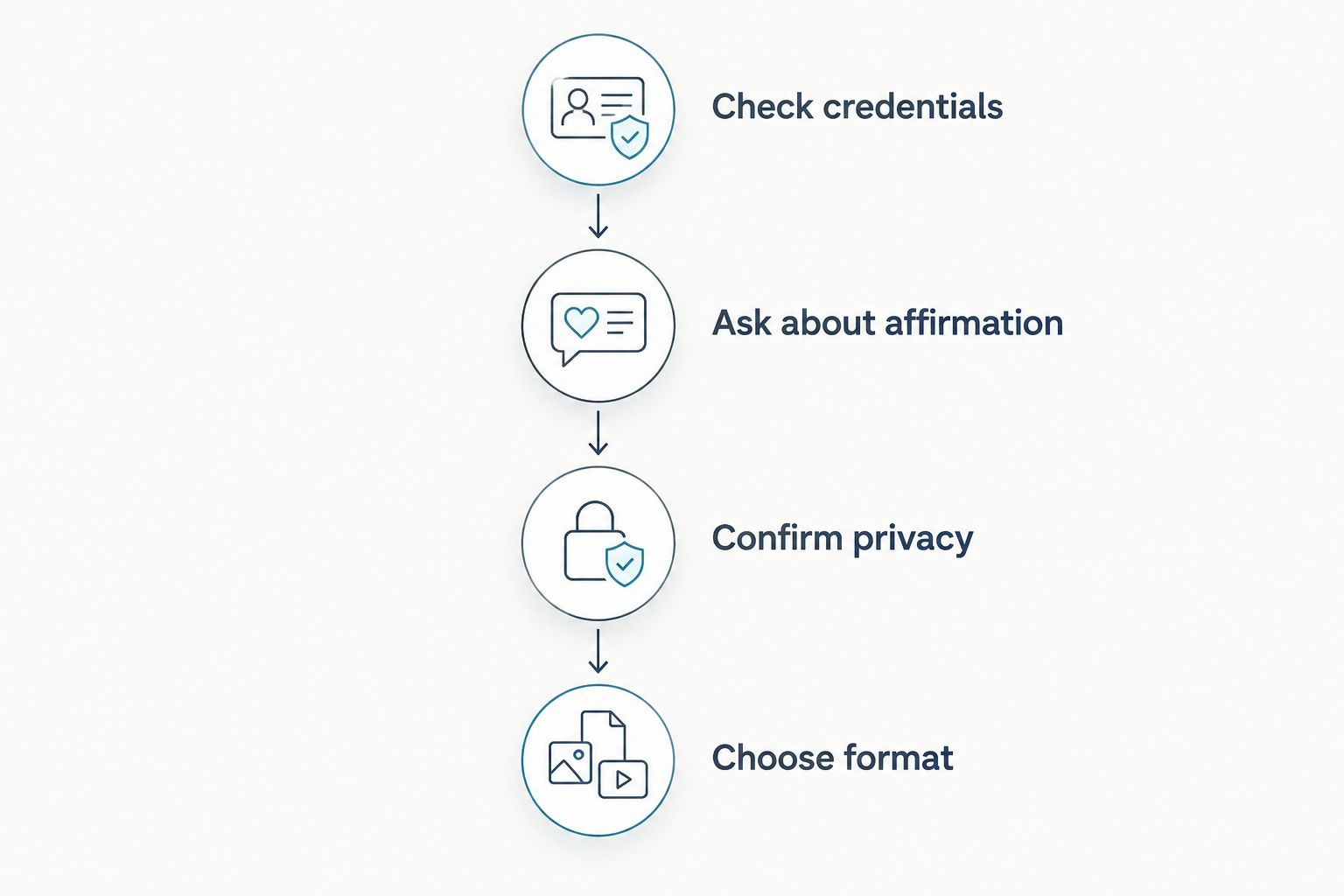
Use this four-step process for your 2026 shortlist. You can ask screening questions without first explaining your sexuality, gender history or relationship circumstances in detail.
Check credentials
Request the therapist's qualification, licensing or registration details and relevant regulator. Also confirm that they can provide therapy where you will attend; access to a website is not the same as eligibility for care.
Ask about affirmation
Ask whether the therapist provides LGBTQ+ affirming care and respects the name and pronouns you use. Ask how they approach concerns involving sexuality, gender, family or religion without treating your identity as something to correct.
Confirm privacy
Ask about confidentiality limits, records, appointment reminders and emergency contacts. Request a plain explanation of when information can be shared and with whom; avoid relying on a promise that everything is always secret.
Choose format
Select video, voice or chat based on how you communicate and where you can attend privately. Agree on a backup for interruptions, connection problems or a moment when continuing no longer feels safe.
These checks belong before the first sensitive disclosure. You are assessing whether the service suits you, not proving that your reason for seeking help is serious enough.
Questions that separate reassurance from useful answers
For a 2026 appointment, use two direct questions to start: Does the therapist provide LGBTQ+ affirming care? What are the limits of confidentiality?
Then ask about the issue you actually want help with. A therapist's experience with relationship conflict does not automatically answer your questions about gender exploration, family rejection or another concern.
Useful follow-up questions include:
- Does the therapist respect my name and pronouns?
- Can I discuss identity without being pressured to disclose it to family?
- Which languages can we use comfortably in sessions?
- How will appointment reminders appear on my phone?
- What happens if I need to stop a session unexpectedly?
A clear answer is more useful than a reassuring label. If the answers do not meet your needs, continue your search rather than treating the first booking as a commitment to ongoing care.
How these recommendations are ranked
This 2026 guide puts regional access first, then separates session formats by their practical use cases. The criteria are affirming practice, credentials, country eligibility, confidentiality and communication fit.
The order is not a claim about clinical outcomes or a finding that one format works better for every LGBTQ+ person. The individual therapist's approach remains the deciding factor.
Which online therapy option should you choose?
Choose the therapist before choosing the format. Start with a professional who answers your questions about affirming care, credentials and confidentiality, then pick video, voice or chat according to your needs.
If you are undecided, identify the biggest barrier: appearing on camera, speaking aloud or writing about something painful. Choose the format that removes that barrier without creating a new privacy problem.
Online therapy is not an emergency response service. If you are in immediate danger or cannot keep yourself safe, seek urgent help through local emergency services or the nearest emergency department.
FAQ
What's the best LGBTQ+ friendly online therapy platform in Africa?
The best choice is a platform that connects you with an affirming, qualified therapist who can work with you in your country. InnerSpark Africa is a starting point for licensed online therapy in Uganda, Kenya and Tanzania; ask about the individual therapist's LGBTQ+ experience before booking.
How do I know whether an online therapist is LGBTQ+ affirming?
Ask directly whether the therapist provides LGBTQ+ affirming care and respects your sexuality, gender, name and pronouns. Ask how they address your concerns without making identity change a treatment goal.
Is video therapy better than voice or chat?
Video is not the best format for everyone. Choose video for visual conversation, voice when you prefer speaking without a camera, or chat when writing feels easier, then check the privacy requirements.
Can I attend therapy without telling my family?
Ask the therapist about consent, confidentiality, appointment communications and any circumstances involving family contact. Do not assume that reminders, shared devices or payment records are invisible to other people.
Can an online therapist work with me anywhere in Africa?
Confirm eligibility for the specific country where you will physically attend sessions. A platform's online access does not establish that every therapist can provide care in every country.
What should I ask about chat therapy before booking?
Ask whether chat is scheduled, when replies are expected and how messages are stored or accessed. Also check notification previews and shared-device access before sending sensitive information.
What if I don't feel comfortable with my therapist?
You can explain what feels uncomfortable, ask for a different approach or seek another therapist. You do not need to continue with someone who pressures you to change your identity or disclose it to others.
What should I check before booking online therapy in 2026?
Check the therapist's credentials, affirming approach, country eligibility and confidentiality arrangements. Then confirm the session format, appointment communications and backup plan for interruptions.
One last thing
Privacy starts before the session: an appointment notification can reveal information even when the conversation itself stays private. Ask what appears in reminders before sharing a device or attending from a shared home.
For your next step, contact InnerSpark Africa on WhatsApp or begin booking a licensed therapist. Start with your questions about affirming care and confidentiality; you do not need to tell your whole story at once.