
Best for licensed chat therapy in Africa: InnerSpark Africa. Best for listener-based text support: 7 Cups. Best for structured peer connection: NAMI Connection. Best for depression and bipolar peer support: DBSA. This 2026 guide separates private therapy from community support so you can choose the kind of conversation you actually need.
- The best online chat room therapy communities serve different needs; peer support is not licensed therapy.
- InnerSpark Africa suits adults seeking licensed chat therapy in Uganda, Kenya, Tanzania and other African countries.
- 7 Cups offers listener-based text support; a listener conversation is not a therapy session.
- NAMI Connection and DBSA offer peer support groups, not interchangeable substitutes for private chat therapy.
- Check moderation, confidentiality limits and meeting format before sharing personal information.
Why this matters
A chat room, a support group and a therapy session are different services. Choose by who provides the support, not by whether the conversation happens online. That distinction matters more than a platform's popularity.
In licensed therapy, you work with a professional within a therapeutic relationship. In peer support, you talk with people who share experiences or with listeners offering emotional support. A welcoming community can provide connection without providing assessment or treatment.
The phrase online chat room therapy often mixes these categories. This guide keeps them separate: the first option is private licensed therapy, the second is listener-based text support, and the remaining options are structured peer groups. Not every recommendation is a text chat room.
If you want somewhere to talk after a difficult day, peer support can fit that purpose. If you want professional help with persistent distress, relationship difficulties or concerns affecting daily life, choose a licensed therapist rather than treating community replies as clinical advice.
What makes the best online support option?
Use these 5 selection criteria when choosing support in 2026. They explain the recommendations below without pretending that every service offers the same thing.
- Provider role: Identify whether you are speaking with a licensed therapist, a trained listener or a fellow participant. These roles are not interchangeable.
- Conversation format: Check whether support uses private text, a shared discussion space or a scheduled group meeting. Online does not automatically mean text-based.
- Privacy boundaries: Read who can see messages, what information is retained and what confidentiality exceptions apply. An anonymous display name is not a complete privacy policy.
- Moderation and safety: Look for conduct rules, reporting routes and an explanation of how harmful advice or harassment is handled.
- Practical fit: Confirm country eligibility, language, session arrangements and current charges before committing. Choose a format you can use privately and consistently.
A service that fits one person can be wrong for another. Someone seeking individual therapy needs a different recommendation from someone seeking shared experiences with depression.
Online therapy and support options at a glance
These 4 options occupy distinct use-case slots. The 2026 comparison is about the type of support offered, not a claim that one organization produces better outcomes than another.
| Option | Best for | Standout feature | Key limitation |
|---|---|---|---|
| InnerSpark Africa | Licensed individual chat therapy in African countries | Connects people with licensed therapists for chat, voice or video sessions | Individual therapy is not a shared peer community |
| 7 Cups | Listener-based text conversations | Connects people with listeners for emotional support | Listener support is not licensed therapy |
| NAMI Connection | Structured peer connection around mental-health experiences | Peer-led support groups for adults experiencing mental-health conditions | A support group is not private therapy or necessarily text-based |
| DBSA | Peer support focused on depression and bipolar disorder | Support groups centered on mood-disorder experiences | Peer discussion is not individualized clinical care or necessarily a chat room |
Read the limitation column first. It tells you where each option stops being the right answer.
1. InnerSpark Africa: best for licensed individual chat therapy
InnerSpark Africa connects people in Uganda, Kenya, Tanzania and other African countries with licensed therapists through video, voice or chat sessions. Its place in this guide is individual professional support, not a claim that it operates a community chat room.
InnerSpark Africa is best for people in African countries seeking licensed individual chat therapy rather than peer chat-room support. Choose this route when you want to discuss your own situation with a professional instead of posting it to a group.
Chat is one supported session format. Before booking, ask how the conversation works: whether you meet at an agreed time, how messages are exchanged and what happens between sessions. Do not assume that chat means unrestricted messaging.
InnerSpark Africa pros
- Licensed therapists provide the sessions rather than community members.
- Chat, voice and video give you different ways to communicate.
- The platform serves people in Uganda, Kenya, Tanzania and other African countries.
InnerSpark Africa cons
- Individual sessions do not provide the shared experience of a peer group.
- You need to confirm the therapist's language, scope of practice and session arrangements before booking.
- A scheduled therapeutic relationship serves a different purpose from casual community conversation.
Best for: Adults who want licensed support and prefer writing to speaking, including university students seeking individual help.
For couples or parents seeking help for a teenager, ask whether a suitable therapist works with that age group or relationship concern. Confirm consent and confidentiality arrangements rather than assuming an adult individual session covers everyone.
Verdict: Choose licensed chat therapy when professional, individualized support is your priority.
2. 7 Cups: best for listener-based text support
7 Cups connects people with listeners for emotional support through online conversations. Its listener service belongs in the peer-support side of this comparison, not the licensed-therapy side.
The useful distinction is simple: you can seek someone to listen without treating that person as your clinician. That makes listener-based support a different choice from booking a therapist to work through a specific concern.
Start by checking the current listener and community rules. Decide whether you want a private listener conversation or a shared discussion, and confirm which experience the service actually offers before disclosing personal details.
7 Cups pros
- Text conversations let you explain a concern in writing.
- Listener-based support offers a place to seek emotional connection.
- The listener role is distinct from the professional relationship you establish in licensed therapy.
7 Cups cons
- A listener is not a substitute for a licensed therapist.
- A supportive conversation does not establish a treatment plan or diagnosis.
- You still need to check privacy rules and the boundaries of the particular conversation.
Best for: Adults seeking a listener-based text conversation rather than professional treatment.
If someone offers certainty about a diagnosis, tells you to change medication or pressures you to move the conversation elsewhere, step back. Emotional support does not give another person authority over your healthcare decisions.
Use the conversation to describe what is happening and what support you want. You do not need to share your full name, workplace or identifying details to explain that you feel isolated or overwhelmed.
Verdict: Choose 7 Cups for listener-based support; skip listener chat as a replacement for licensed care.
3. NAMI Connection: best for structured peer connection
NAMI Connection is a peer-led support-group program for adults experiencing mental-health conditions. It offers a different setting from an open-ended chat room: a group organized around shared experience and peer support.
Check the particular group's meeting format and eligibility. An online listing does not establish that the meeting uses text, and a group's location or participation rules can affect whether it fits you.
The reason to consider this option is connection with other adults who understand mental-health challenges through lived experience. The reason not to choose it is expecting a private therapist to assess or treat your individual situation.
NAMI Connection pros
- The program has a defined focus on adult mental-health peer support.
- Peer-led discussion centers lived experience rather than casual advice from an unrestricted audience.
- A group setting lets participants hear perspectives beyond their own.
NAMI Connection cons
- A shared group is not an individual therapy session.
- The meeting format must be checked; this is not automatically a text-chat option.
- Participation involves hearing other people's experiences as well as discussing your own.
Best for: Adults who want structured peer connection around mental-health experiences and are comfortable with a group format.
Before attending, ask how participation works. Check whether you can listen without speaking, what information is requested and how the group explains confidentiality. Those practical questions help you decide whether the setting feels manageable.
If you specifically need a written conversation, confirm that requirement before choosing a meeting. A good peer-support program can still be the wrong communication format for you.
Verdict: Choose NAMI Connection for structured peer connection; skip it if private text therapy is your requirement.
4. DBSA: best for depression and bipolar peer support
The Depression and Bipolar Support Alliance, known as DBSA, offers peer support centered on depression and bipolar disorder. Its focus makes it more specific than a general emotional-support community.
That focus is the reason to consider DBSA, not evidence that a group can determine your diagnosis. You can ask about participation without using community responses to label yourself.
Check the current group's format, participation rules and discussion boundaries. Online support groups are not automatically chat rooms, and peer support remains different from individualized clinical care.
DBSA pros
- The support focus is depression and bipolar disorder rather than every possible concern.
- Peer discussion provides access to lived-experience perspectives.
- A defined topic helps you judge whether the group matches the conversation you want.
DBSA cons
- Peer groups do not diagnose or prescribe treatment.
- Other participants' experiences do not establish what treatment is right for you.
- You must verify whether the particular format meets your need for text-based communication.
Best for: Adults seeking peer connection around depression or bipolar experiences, rather than a general listener chat.
Keep medication and treatment decisions with a qualified clinician. A participant's story can be meaningful without being advice you should follow, especially when your circumstances and medical history differ.
If a discussion feels overwhelming, you can leave or pause. Participating in a support community does not require you to disclose more than you want or remain in a conversation that does not help.
Verdict: Choose DBSA for mood-disorder-focused peer support; skip it as a substitute for clinical assessment.
Check privacy before joining any conversation
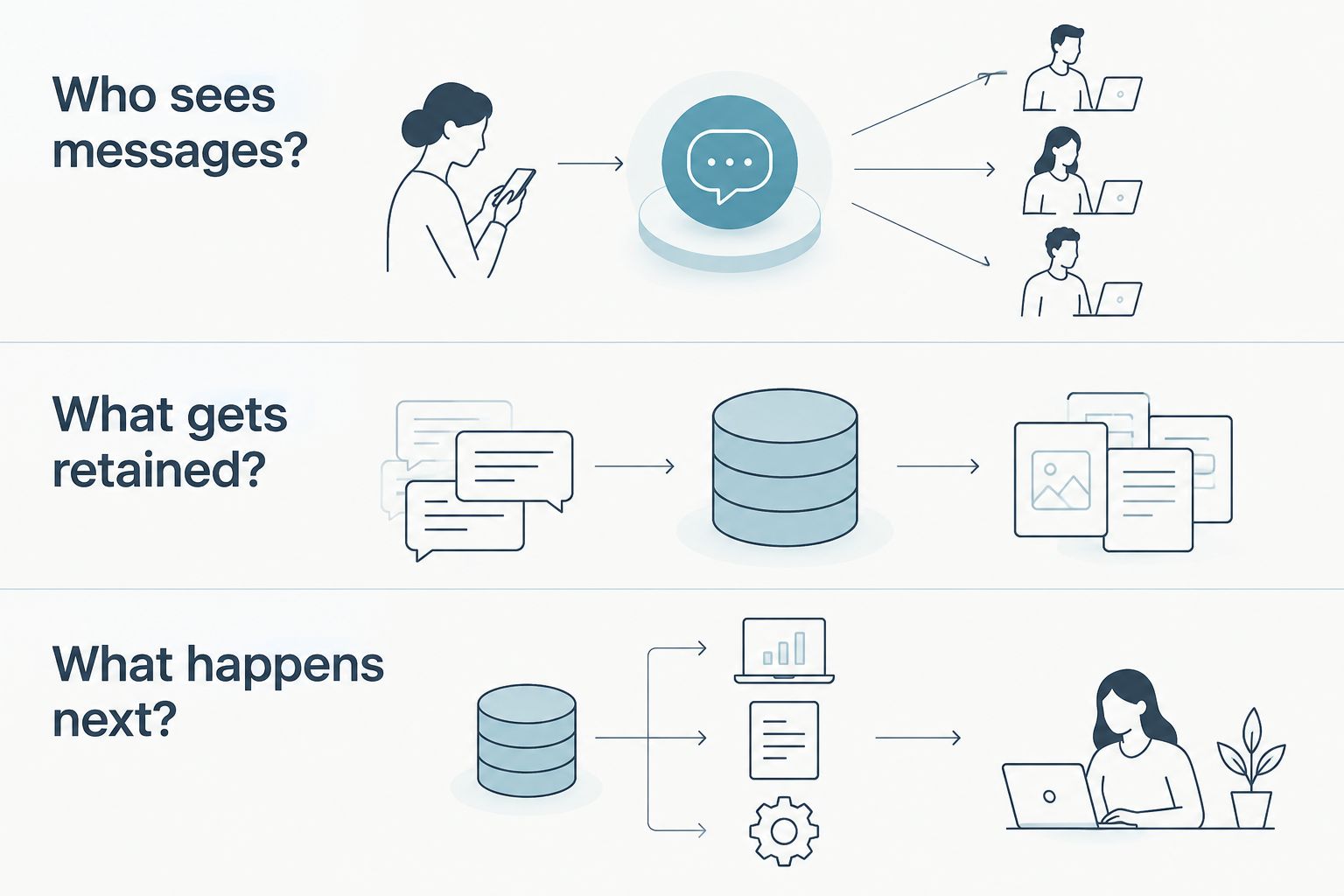
For your 2026 shortlist, ask 3 privacy questions before sharing sensitive information. Use the same questions for a platform, a listener conversation or a group.
- Who sees messages? Establish whether the audience is a therapist, one listener, moderators or every participant.
- What gets retained? Read the rules covering chat history, recordings and account information.
- What happens next? Check reporting procedures, confidentiality exceptions and what the service does when someone needs urgent help.
Private messaging and confidentiality are different concepts. A private interface describes who participates in the conversation; confidentiality describes the rules governing information afterward.
Use a device and location where you can speak or type without unwanted observation. On a shared device, check account access and notifications. Avoid posting another person's identifying information, even when you are discussing a relationship difficulty.
No group rule can make it impossible for another participant to repeat something outside the meeting. Share with that boundary in mind, and ask the organizer to explain its confidentiality expectations clearly.
How the options are ranked
This 2026 guide ranks by purpose: licensed individual therapy, listener-based text support, structured mental-health peer connection and mood-disorder-focused peer support. It does not rank treatment effectiveness or claim that these services were tested against one another.
The criteria are provider role, conversation format, privacy boundaries, safety procedures and practical fit. The recommendations stay within each option's role rather than presenting a listener, a peer facilitator and a therapist as equivalent providers.
Your first decision is the support category. Your second decision is the organization. Reversing that order makes it easier to choose a recognizable name that offers the wrong kind of help.
Which option should you choose?
For 2026, start with what you want from the conversation. Choose licensed individual therapy when you need professional attention to your circumstances. Choose listener support when being heard is the immediate goal. Choose a peer group when shared experience is the main reason you are joining.
If you are undecided, write down your preference for text, voice or video and whether you want a private or shared conversation. Those choices eliminate mismatched options faster than reading another long ranking.
Do not use a chat room or routine therapy-booking process for immediate danger. If you cannot stay safe, contact local emergency services or go to the nearest emergency department. Ask someone you trust to stay with you while you seek help.
FAQ
What are the best online chat room therapy communities in 2026?
The best choice depends on whether you need licensed therapy or peer support. InnerSpark Africa offers licensed individual chat therapy, 7 Cups offers listener-based text support, and NAMI Connection and DBSA offer structured peer groups rather than interchangeable chat-room therapy.
Is a mental-health chat room the same as therapy?
No, a mental-health chat room is not automatically therapy. Check whether a licensed therapist provides a defined therapeutic service; community discussion and listener support serve different roles.
Is 7 Cups listener support a substitute for a therapist?
No, listener support is not a substitute for a licensed therapist. Use listener conversations for emotional support, not diagnosis, medication decisions or individualized treatment.
Can I get licensed therapy through chat in Uganda?
Yes, InnerSpark Africa connects people in Uganda with licensed therapists for chat, voice or video sessions. Confirm the therapist's suitability, confidentiality arrangements and session format before booking.
Are online peer-support groups confidential?
Confidentiality depends on the group's rules and participants' conduct. Read the policy and ask how information is handled; a group agreement cannot guarantee that another participant will never repeat a discussion.
How much does online chat therapy cost?
Check the provider's current session charges before booking. Ask what the session includes and whether messaging between appointments forms part of the arrangement.
Can I join an online support group without speaking?
Ask the organizer whether listening without speaking is permitted. Participation rules differ, and an online meeting is not necessarily a text-chat session.
What should I do if I need urgent mental-health help?
Contact local emergency services or go to the nearest emergency department if you are in immediate danger or cannot stay safe. Do not wait for a community reply or a routine therapy appointment.
One last thing
You do not need a polished explanation before seeking support. Start with what is difficult, how it affects your day and whether you prefer typing or speaking. That is enough to begin asking about a suitable service.
For a low-pressure next step, ask InnerSpark Africa about booking a licensed therapist and choosing chat, voice or video. Confirm the practical details before deciding.
Ask about licensed therapy
Discuss whether chat, voice or video sessions fit the support you want.