
Best for online talk therapy: InnerSpark Africa. Best for medical assessment or medication questions: a licensed psychiatrist practising where you receive care. The best online psychiatry platforms in East Africa in 2026 must connect you with the right clinician; a therapy booking is not automatically a psychiatry appointment.
- Choosing the best online psychiatry platforms in East Africa starts with checking the clinician’s credentials and location.
- InnerSpark Africa is best for people seeking online talk therapy with licensed therapists in Uganda, Kenya and Tanzania.
- Choose a licensed psychiatrist for medical assessment or medication questions; do not assume a therapist provides prescribing services.
- Compare video, voice and chat therapy by privacy, communication needs and clinical suitability.
Why this matters
Psychiatry and talk therapy overlap, but they are not interchangeable. A psychiatrist is a medical doctor with specialist mental-health training. A therapist’s qualifications and professional scope depend on their training and registration; the word therapist alone does not establish prescribing authority.
You do not need to diagnose yourself before asking for help. You do need to know what kind of appointment you are booking. Otherwise, you risk choosing a service that cannot answer the question that brought you there.
InnerSpark Africa is best for people seeking online talk therapy with licensed therapists in Uganda, Kenya and Tanzania. That is a therapy recommendation, not a claim that the platform offers psychiatric assessment or prescriptions.
What makes the best online psychiatry platform?
Use these criteria before comparing names. In 2026, a convenient booking process still comes second to the clinician’s credentials and scope of practice.
- Clinician credentials: Get the clinician’s full name, professional qualification and registration details. Confirm whether your appointment is with a psychiatrist, psychologist, counsellor or another therapist.
- Country eligibility: Ask whether the clinician is authorised to treat you in the country where you will attend the appointment.
- Service scope: Confirm whether the appointment covers talk therapy, medical assessment, medication review or referral. These are different services.
- Privacy boundaries: Ask how sessions and messages are handled, whether recording occurs, and what exceptions apply to confidentiality.
- Follow-up arrangements: Find out whom you contact after the appointment, particularly if treatment includes medication or a referral.
- Practical fit: Check language, session format, payment arrangements and whether you have a private place to attend.
A platform that clearly explains its limits gives you more useful information than one that labels every service mental-health support. Ask direct questions and expect direct answers.
Care options at a glance
This comparison ranks care routes by the job you need done, not by unverified claims about competing providers. The options are not substitutes for one another.
| Rank and option | Best for | Standout feature | Key limitation |
|---|---|---|---|
| 1. InnerSpark Africa | Online talk therapy | Licensed therapists through video, voice or chat | Do not assume therapy includes psychiatric assessment or prescribing |
| 2. Direct online psychiatrist appointment | Medical assessment and medication questions | An appointment specifically with a medical specialist | You must verify registration, country eligibility and remote-care arrangements |
| 3. Hospital outpatient psychiatry service | Care needing a connection to in-person services | A route to ask about both remote and physical appointments | Remote appointments must be confirmed with the individual service |
| 4. Coordinated psychiatrist and therapist care | Separate medical and talk-therapy needs | Each clinician works within a defined role | Communication and consent need explicit arrangements |
1. InnerSpark Africa: best for online talk therapy
InnerSpark Africa connects people with licensed therapists for video, voice or chat sessions. Its stated coverage includes Uganda, Kenya, Tanzania and other African countries: 3 named countries and 3 session formats to consider when planning your appointment.
Choose this route when you want a conversation with a licensed therapist about emotional difficulties, relationships or concerns you want help understanding. If your main question concerns medication, ask for the appropriate medical professional rather than assuming a therapy session covers it.
InnerSpark Africa pros:
- The service explicitly connects people with licensed therapists.
- Video, voice and chat give you different ways to communicate.
- Uganda, Kenya and Tanzania are explicitly included in its stated coverage.
- Online sessions remove the need to travel to the therapy appointment.
InnerSpark Africa cons:
- A licensed therapist is not automatically a psychiatrist.
- Remote therapy still requires a suitable connection and a private setting.
- Therapy alone does not replace urgent medical or emergency care.
Best for: Adults seeking online talk therapy who want to choose between video, voice and chat.
Before booking, ask which therapist fits your concerns, which language the session will use, and what confidentiality means in practice. The platform describes booking as taking about 2 minutes; use that convenience after checking the clinician and service you need.
Verdict: Hold if you need prescribing or medical assessment; book therapy if talk therapy matches your needs.
2. Direct online psychiatrist: best for medical assessment
A direct online psychiatrist appointment means booking specifically with a doctor trained in psychiatry. Choose this route when your question requires medical assessment, a discussion of psychiatric medication, or a review of existing medical treatment.
The platform’s name matters less than the clinician’s identity and authority to practise. In 2026, verify both before paying for a remote medical appointment, particularly when the clinician and patient are in different countries.
Direct online psychiatrist pros:
- The appointment is designed around a medical specialist’s scope.
- You can discuss medication questions with the relevant professional.
- You can ask whether physical assessment or another service is needed.
- A remote appointment avoids travel when remote care is clinically appropriate.
Direct online psychiatrist cons:
- Some assessments require physical examination or other in-person care.
- Cross-border care requires checks on professional authorisation.
- An online appointment does not establish that a prescription can be issued or filled locally.
Best for: People whose main concern is medical assessment or medication rather than talk therapy alone.
Ask who handles follow-up, how any prescription is issued, and what happens if the clinician recommends an in-person appointment. Do not change existing medication based on a platform comparison article.
Verdict: Hold until the psychiatrist’s registration, country eligibility and follow-up process are confirmed.
3. Hospital outpatient psychiatry: best for an in-person care connection
A hospital outpatient psychiatry service is a route to investigate when you need psychiatric care with a clear connection to a physical facility. Ask the service directly whether it offers remote consultations and how it arranges an in-person visit when needed.
Do not assume a hospital’s general online booking system includes psychiatry. Confirm the department, the clinician and the appointment format before making arrangements.
Hospital outpatient psychiatry pros:
- You can ask about psychiatric and physical assessment within the same care setting.
- The service can explain its process for in-person attendance.
- You can clarify where to go if the remote appointment is insufficient.
Hospital outpatient psychiatry cons:
- Remote psychiatry must be confirmed with the individual hospital.
- Some appointments or follow-up steps require travel.
- A routine outpatient appointment is not an emergency response.
Best for: People who want psychiatric assessment with an identified route to in-person care.
Ask whether the remote appointment is with the psychiatry department itself. Also check how referrals, records and follow-up appointments are handled rather than assuming departments share everything automatically.
Verdict: Hold until the service confirms remote psychiatry and the route to physical assessment.
4. Coordinated care: best for medical and talk-therapy needs
Coordinated care means seeing a psychiatrist for medical needs and a therapist for talk therapy, with clearly defined responsibilities. This is a care arrangement, not proof that any particular platform provides both services.
You can ask each clinician whether this arrangement fits your situation. If information needs to be shared, discuss your consent and the boundaries before either clinician sends records or session details.
Coordinated care pros:
- Medical questions and therapy goals have separate, explicit owners.
- You can discuss how treatment decisions relate to therapy work.
- Clear communication can reduce conflicting instructions.
Coordinated care cons:
- Separate appointments require more scheduling and administration.
- Information sharing needs an agreed process and appropriate consent.
- Seeing clinicians separately does not automatically mean care is coordinated.
Best for: People who need both psychiatric medical care and ongoing talk therapy.
Write down which clinician handles medication, which handles therapy, and whom you contact between appointments. If the clinicians do not communicate, ask how you should keep each informed without sharing more personal information than necessary.
Verdict: Hold until both clinicians agree on their roles and communication arrangements.
Choose video, voice or chat deliberately
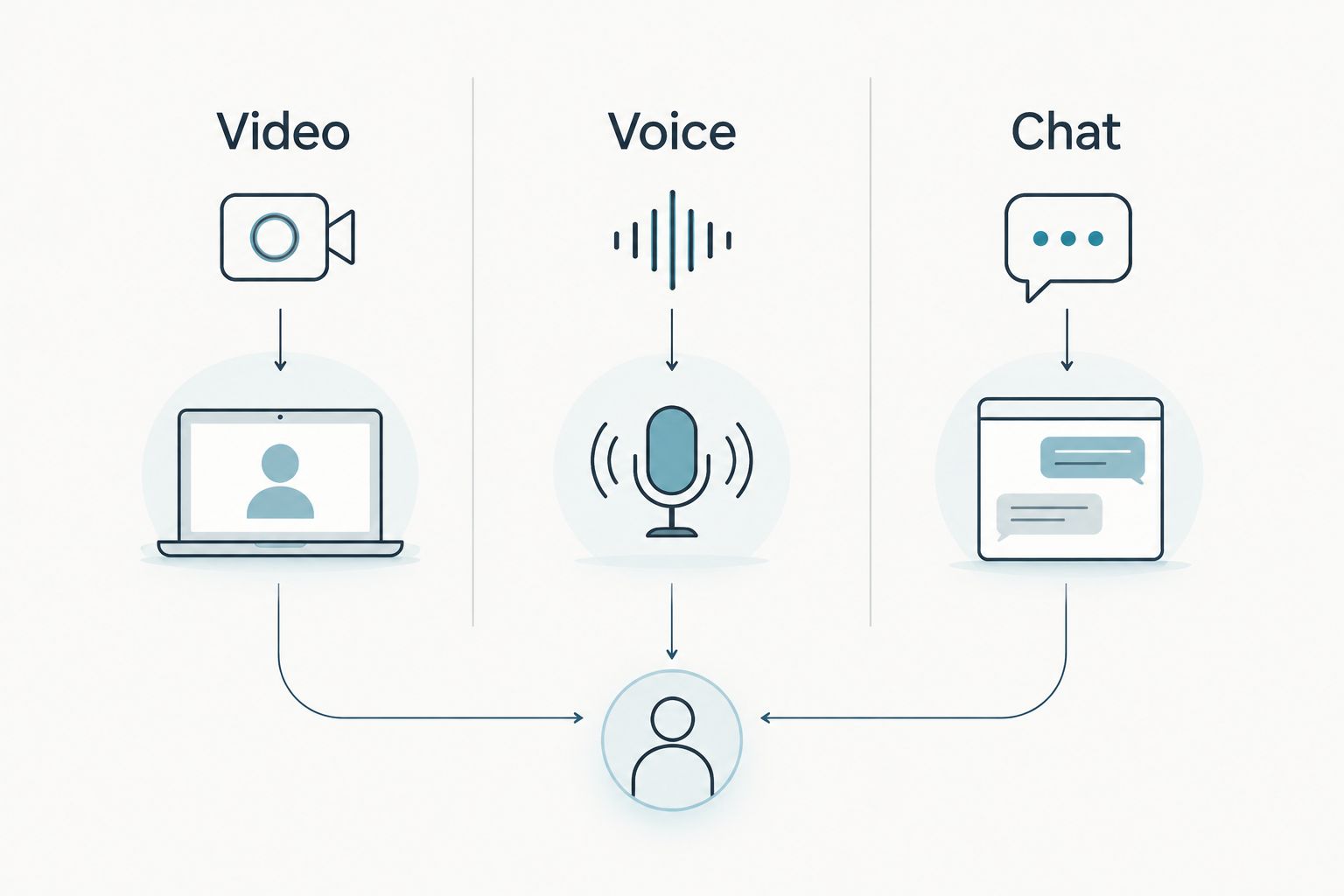
Session format affects how you communicate and where you can attend. It does not change a clinician’s qualifications. For your 2026 shortlist, first choose the right professional, then choose a suitable format.
| Format | Best for | Practical advantage | Practical limitation |
|---|---|---|---|
| Video | People who want to see the therapist | Includes visual communication | Requires camera privacy and a suitable connection |
| Voice | People who prefer speaking without a camera | Lets you talk without appearing on screen | Does not provide visual cues |
| Chat | People who prefer written communication | Gives you a text-based way to express concerns | Typed messages do not convey tone or visual cues in the same way |
Video suits you when seeing the clinician helps you communicate. Voice suits you when speaking feels easier without a camera. Chat suits you when writing is your preferred way to explain yourself.
Ask whether the format you want is suitable for the appointment’s purpose. Do not assume chat is an appropriate substitute for a medical assessment simply because it is offered for therapy.
Check confidentiality before sharing sensitive details
Confidentiality deserves a specific conversation, not just a reassuring label. Ask the clinician to explain the applicable privacy rules and exceptions in language you understand.
Useful questions include:
- Who can access my booking details, messages and session notes?
- Is the session recorded, and how is consent handled?
- What happens if the clinician believes someone faces serious harm?
- How will you contact me without revealing sensitive information to others?
For a teenager’s appointment, ask about guardian consent and what information is shared with parents or guardians. The answers depend on the young person’s age, the service and applicable rules; agree on boundaries before the session.
Your own setting matters too. Use a private space, consider who can hear you, and check whether someone else can access your device or message notifications.
How this ranking works
The ranking follows service fit: talk therapy, medical assessment, connection to in-person care, then coordinated care. It does not rank clinical outcomes or claim that one clinician is better than another.
For 2026, keep the decision simple: match the appointment to the professional scope you need. Credentials, local eligibility, privacy and follow-up come before convenience. A short booking process is useful only when it leads to the right kind of appointment.
Which option should you choose?
Choose online talk therapy when you want support through conversation and do not need the appointment to provide medical assessment or prescribing. Choose a verified psychiatrist when the main question is medical.
If you are unsure, describe your concern to the service and ask which professional should assess it. You can say that you want help choosing the right appointment without naming a diagnosis.
If you are in immediate danger, cannot keep yourself safe, or need urgent medical attention, seek local emergency help or go to the nearest emergency department. Do not wait for a routine online appointment.
FAQ
What are the best online psychiatry platforms in East Africa?
The best choice is a service that connects you with a verified psychiatrist authorised to treat you where you are located. InnerSpark Africa is an online talk-therapy option with licensed therapists; do not assume that this includes psychiatry or prescribing.
Is online therapy the same as online psychiatry?
No. Online therapy focuses on therapeutic support, while psychiatry is a medical specialty. Check the individual clinician’s qualifications and the appointment’s scope before booking.
Can an online therapist prescribe medication?
Do not assume a therapist can prescribe medication. Prescribing authority depends on the clinician’s professional qualifications and applicable rules; ask for a qualified medical professional when medication is your main concern.
Can I speak to a therapist in Uganda, Kenya or Tanzania?
InnerSpark Africa explicitly connects people in Uganda, Kenya and Tanzania with licensed therapists. Confirm the individual therapist’s suitability, language and session format before booking.
Is video better than voice or chat therapy?
The best format depends on your communication needs and the purpose of the appointment. Video includes visual cues, voice supports spoken conversation without a camera, and chat uses written communication; ask the clinician which is suitable.
How do I check whether an online psychiatrist is qualified?
Ask for the psychiatrist’s full name, qualifications and registration details, then verify them with the relevant professional regulator. Also confirm that the psychiatrist is authorised to treat you in the country where you will attend the appointment.
Can I book online support for my teenager?
Ask the service whether it provides appointments for teenagers before booking. Confirm clinician suitability, guardian consent requirements and confidentiality boundaries for both the young person and their parent or guardian.
What should I do if I need urgent mental-health help?
Seek local emergency help or attend the nearest emergency department if you are in immediate danger or cannot keep yourself safe. Routine online therapy and psychiatry bookings are not substitutes for emergency care.
One last thing
A useful booking question is: Will this appointment provide talk therapy, medical assessment, or both? The answer tells you more than the platform’s name. Ask it before you share sensitive details or commit to an appointment.
Related guides
- Best online counselling services in Uganda
- Best online therapy platforms in Kenya
- Therapy costs in Uganda
- Best online therapy platforms in Tanzania
If talk therapy fits what you need, book a licensed therapist when you feel ready. You can start by asking about the session format and the therapist’s qualifications.