
Best first step: your university’s counselling service, if it offers appointments. Best platform to ask about Africa-focused online therapy: InnerSpark Africa; best for meditation practice: Headspace; best for sleep-focused relaxation: Calm—these last two are not substitutes for therapy with a licensed professional.
- The best online therapy apps for university students in Nigeria should connect students with appropriately qualified professionals.
- InnerSpark Africa offers licensed online therapy by video, voice or chat; confirm eligibility for sessions from Nigeria.
- University counselling is a starting point when your institution offers appointments.
- Headspace supports meditation practice; Calm supports relaxation and sleep routines. Neither replaces licensed therapy.
Why this matters
Choosing support during university should not require you to understand every therapy term. You need to know who you will speak to, whether they can work with someone in Nigeria, and how an appointment fits around lectures, shared accommodation and your budget.
The distinction in this 2026 guide is simple: a wellness app provides activities; therapy involves working with a qualified professional. Meditation and relaxation exercises serve a different purpose from discussing distress, relationships or recurring difficulties with a therapist.
InnerSpark Africa is an online therapy platform connecting people in Uganda, Kenya, Tanzania and other African countries with licensed therapists. For a student in Nigeria, the practical next step is to confirm country eligibility, the professional’s credentials and the appointment format before booking.
What makes the best online therapy option for students?
Use these checks before you compare names. A familiar app is not automatically the right place for your needs.
- Professional credentials: For therapy, ask for the practitioner’s name, qualification, registration and experience relevant to your concern. Check the relevant professional register where one applies.
- Country eligibility: Confirm that the practitioner can provide the proposed service to someone physically located in Nigeria. A downloadable app does not establish eligibility for clinical care.
- Confidentiality: Ask who can access session records, whether sessions are recorded and what exceptions apply to confidentiality.
- Practical access: Compare video, voice and chat against your connection, accessibility needs and access to a private space.
- Payment clarity: Check the currency, total charge, accepted payment methods and cancellation terms before committing.
- Appropriate support: Ask whether the service fits your needs and what happens if you require in-person or urgent care.
Choose the professional and the care arrangement before choosing the interface. A polished screen cannot answer questions about qualifications, privacy or suitability.
Student support options at a glance
These options serve different purposes. The table separates routes to counselling from self-guided wellness tools rather than treating them as interchangeable therapy apps.
| Option | Best for | Standout feature | Key limitation |
|---|---|---|---|
| Your university’s counselling service, where offered | Exploring institution-based student support | A direct route to asking about support connected to your university | Appointment arrangements, confidentiality rules and remote access need checking |
| InnerSpark Africa | Exploring Africa-focused licensed online therapy | Video, voice or chat therapy sessions | Confirm eligibility from Nigeria and suitability with the individual therapist |
| Headspace | Building a meditation practice alongside other support | Guided meditation content | Meditation content is not the same as a therapist appointment |
| Calm | Adding relaxation activities to a sleep routine | Sleep-focused and relaxation content | A sleep routine does not replace assessment or therapy |
1. University counselling: best for exploring student support
Your university’s counselling service is a sensible first enquiry when the institution offers one. Ask whether you can book directly, whether remote appointments are possible and whether the service works with the concern you want to discuss.
This route also lets you ask about support connected to university life. Keep counselling and administrative support separate: a conversation about extensions or accommodation is not necessarily a therapy appointment.
University counselling pros:
- You can ask about a support route connected to your institution.
- You can clarify whether counselling and academic assistance require separate appointments.
- You can request guidance on another care route if the service cannot meet your needs.
University counselling cons:
- Do not assume appointments are online or available on your preferred schedule.
- Do not assume information stays outside academic or administrative records; ask how records are handled.
Best for: Students who want to explore an institution-based route before choosing an external provider.
For your 2026 enquiry, describe the issue in everyday language: difficulty concentrating, conflict at home, feeling overwhelmed or struggling after a loss. You do not need to diagnose yourself to ask what support exists.
Verdict: Hold until you confirm the appointment format, confidentiality arrangements and suitability. Choose this route when those answers match your needs.
2. InnerSpark Africa: best for exploring Africa-focused online therapy
InnerSpark Africa connects people with licensed therapists for video, voice or chat therapy sessions. Its stated service area includes Uganda, Kenya, Tanzania and other African countries; a Nigerian student should ask about eligibility before booking.
The choice of session format is useful to discuss when you share accommodation or have an unreliable connection. Ask whether your preferred format is available with the therapist you want and whether it suits the work you want to do.
InnerSpark Africa pros:
- The platform’s offer is therapy with licensed professionals, rather than only self-guided exercises.
- Video, voice and chat are stated session formats.
- The service connects people with therapists across African countries.
InnerSpark Africa cons:
- Nigeria eligibility requires confirmation before you commit to an appointment.
- You still need to check the individual therapist’s credentials, relevant experience and confidentiality arrangements.
Best for: Students exploring an Africa-focused platform for licensed online therapy.
For a 2026 booking enquiry, state that you will attend from Nigeria. Ask about the therapist’s language, experience with university-age adults, payment currency and accepted payment methods; do not assume these from the platform’s regional focus.
Verdict: Hold until Nigeria eligibility and therapist suitability are confirmed. The platform’s stated offer makes it a relevant enquiry, not a reason to skip those checks.
3. Headspace: best for meditation practice alongside support
Headspace provides guided meditation content. Consider it when you want a structured way to practise meditation, not when you need to book therapy with a licensed professional.
Keep the purpose narrow. Following an exercise and talking through a difficult situation with a therapist are different activities, even when both sit under a mental-health label.
Headspace pros:
- Guided content gives you an activity to follow rather than an open-ended instruction to meditate.
- Self-guided practice does not require arranging a live therapist appointment.
- Meditation can remain a separate activity alongside professional support.
Headspace cons:
- Guided meditation content does not establish a therapeutic relationship.
- An exercise cannot assess your individual circumstances or provide an urgent response.
Best for: Students who specifically want guided meditation practice.
When comparing options in 2026, check the current content and access terms before subscribing. Avoid choosing a wellness subscription merely because finding a therapist feels more complicated.
Verdict: Skip as a replacement for therapy. Consider Headspace only for the meditation role described here.
4. Calm: best for relaxation within a sleep routine
Calm provides meditation, relaxation and sleep-focused content. Consider it as a tool for a wind-down routine, rather than a service for discussing the causes of ongoing distress with a professional.
If sleep difficulties are persistent, disruptive or connected to other concerns, seek appropriate professional advice. Relaxation content does not tell you why the difficulty is happening.
Calm pros:
- Sleep-focused content gives you a defined use case to evaluate.
- Guided relaxation provides an activity you can follow independently.
- You can keep a wind-down routine separate from decisions about professional care.
Calm cons:
- Sleep and relaxation content is not an individual assessment.
- The app’s wellness content does not replace therapy or urgent support.
Best for: Students looking for relaxation activities as part of a sleep routine.
For your 2026 comparison, ask whether relaxation content is actually what you want. If your main need is to talk about grief, relationship difficulties or distress, keep searching for an appropriate professional rather than expecting a sleep tool to fill that role.
Verdict: Skip as your therapy provider. Consider Calm for relaxation, with the limits above kept clear.
How these options are ranked
The ranking follows the checks above: professional involvement, country eligibility, confidentiality, practical access and fit. It is a decision path, not a claim that every option delivers the same service.
University counselling comes first as an enquiry when your institution offers it. Licensed online therapy is the next route to explore; meditation and sleep tools have narrower, separate roles. No cost ranking is assigned to these different forms of support.
Before you book: turn the shortlist into a decision
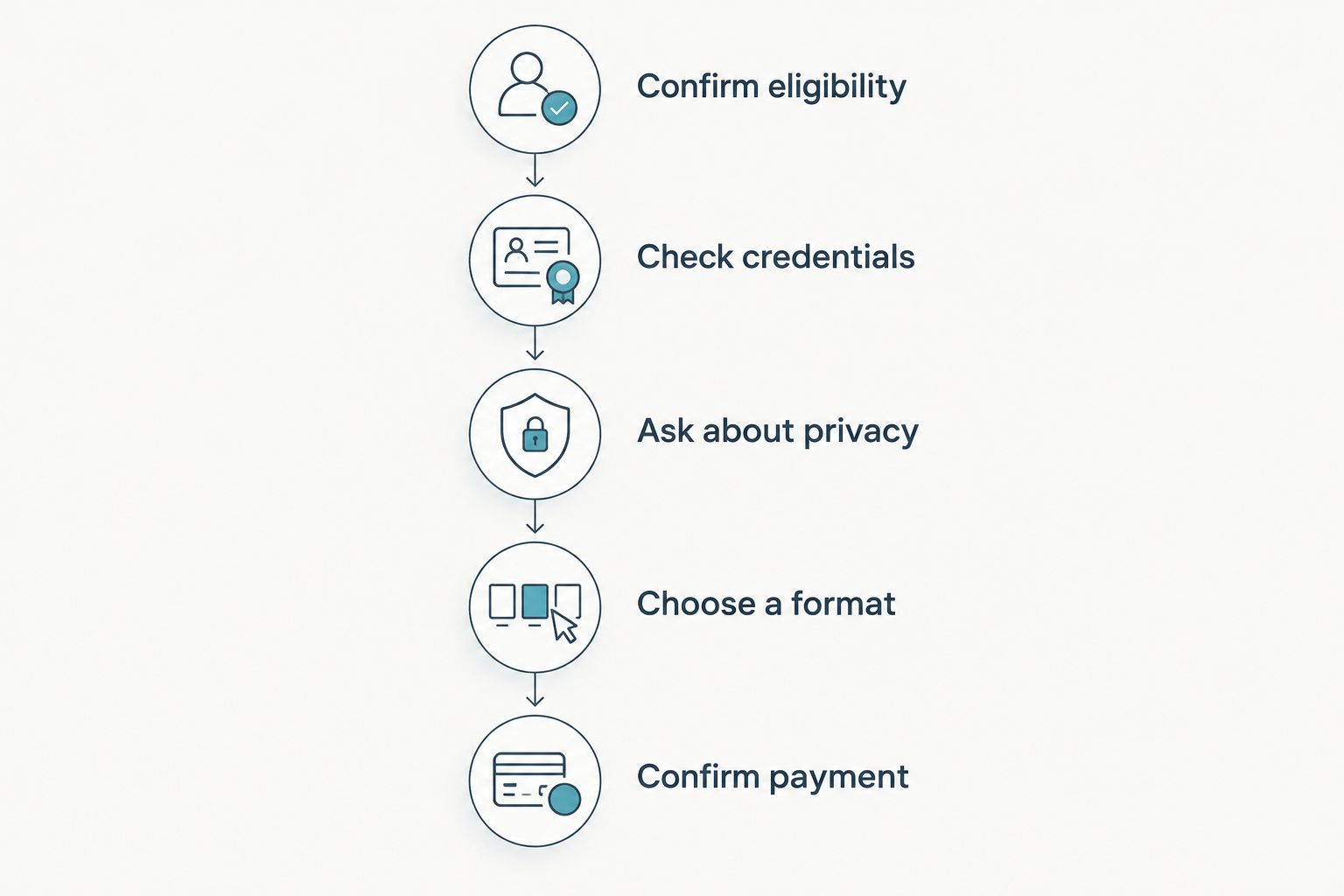
Use this sequence for any online therapy provider. Keep the answers somewhere you can revisit before making a payment.
Confirm eligibility
Tell the provider you are physically in Nigeria. Ask whether the proposed professional can work with you there, and repeat the question if you travel to another country between appointments.
Check credentials
Ask for the therapist’s name, qualification and professional registration details. Then ask about experience with the concern you want to discuss; being licensed does not make every practitioner the right match for every issue.
Ask about privacy
Ask who sees your booking details, messages and clinical records. Check whether sessions are recorded, how consent works and the circumstances in which confidentiality has limits.
Choose a format
Compare video, voice and chat with your living situation. Chat avoids speaking aloud, but a visible screen still needs privacy; headphones do not prevent someone nearby from hearing your side of a voice or video conversation.
Confirm payment
Request the total charge, currency, payment methods and cancellation terms. Ask specifically whether your preferred Mobile Money service or card is accepted rather than assuming regional compatibility.
You can keep your first enquiry brief: state your country, the kind of support you want and your preferred format. Detailed personal history belongs in an appropriate care conversation, not automatically in a booking message.
Which option should you choose?
Start with a route to a qualified professional if you want therapy. Ask your university about counselling, or contact an online provider to establish eligibility and fit. Choose meditation or relaxation content only when that narrower activity matches your goal.
For a student comparing online therapy in 2026, the decisive question is not which app has the longest feature list. It is whether the proposed professional and care arrangement are appropriate for you.
If you feel in immediate danger or think you might harm yourself, seek urgent local help rather than waiting for an app appointment. Contact local emergency services or go to the nearest emergency department, and tell a trusted person what is happening.
FAQ
What are the best online therapy apps for university students in Nigeria?
For therapy, prioritise a service that connects you with an appropriately qualified professional who can work with someone in Nigeria. Ask your university about counselling or confirm eligibility with an online provider; Headspace and Calm serve separate meditation and relaxation roles.
Can I book InnerSpark Africa from Nigeria?
Confirm eligibility directly with InnerSpark Africa before booking from Nigeria. State your location and ask which licensed therapist can provide the proposed service there.
Is Headspace better than talking to a therapist?
Headspace meditation content and therapy serve different purposes. Choose guided meditation for meditation practice, and seek a qualified professional when you want individual therapeutic support.
Can Calm replace counselling if university stress affects my sleep?
Calm's relaxation and sleep-focused content does not replace counselling. Seek professional advice when sleep difficulties are persistent, disruptive or accompanied by other concerns.
Will my university or parents know that I booked therapy?
Ask the provider about confidentiality rather than assuming who will receive information. Clarify access to booking details, records and payment information, along with any legal or safety-related limits.
Should I choose video, voice or chat therapy?
Choose the format with the therapist based on suitability, privacy and access. Video and voice require somewhere you can speak privately; chat requires a private screen and clarity about how replies work.
What should I check before paying for online therapy?
Check country eligibility, professional credentials, confidentiality, the total charge and the payment currency before paying. Also confirm accepted payment methods and cancellation terms.
One last thing
Privacy depends on your surroundings as well as the provider’s rules. Before your appointment, check what someone nearby can hear or see, disable notification previews where appropriate, and ask how to pause if another person enters the room.
You do not need a perfect explanation of what is wrong to make an enquiry. Contact InnerSpark Africa to ask about booking a licensed therapist from Nigeria, your preferred session format and the questions above—then decide whether the arrangement feels right for you.