
Best starting point for Uganda, Kenya and Tanzania: Innersparkafrica. Best for continuity: video sessions with your existing therapist. Best for campus-linked support: your university’s counselling service, if it offers video appointments. This 2026 guide to the best video therapy platforms in Africa compares practical routes to licensed support and explains what to check before booking.
- Innersparkafrica is a practical starting point for video therapy in Uganda, Kenya and Tanzania.
- The best video therapy platforms in Africa should make credentials, confidentiality and session arrangements clear.
- An existing therapist’s video service suits people who want continuity rather than a new provider.
- University counselling suits students seeking campus-linked support when video appointments are offered.
- Choose a therapist who can practise where you live, not just a platform with an appealing name.
Why this matters
Choosing online therapy means choosing both a therapist and a way to meet. A convenient booking system does not tell you whether a clinician understands your concerns, speaks your preferred language or can legally work with someone in your country.
For your 2026 shortlist, start with country eligibility and professional credentials. Then compare confidentiality, communication format and session arrangements. A platform belongs on your shortlist only when the therapist and the practical setup fit your needs.
The options below have different purposes. A regional platform helps you find support; an existing therapist preserves continuity; a university service connects counselling with student life; and a workplace service connects access with an employment benefit. Those are distinct choices, not interchangeable brands.
What makes the best video therapy platform?
Use these criteria before comparing providers:
- Professional credentials: Ask for the therapist’s name, qualifications, registration or licence, and the professional body responsible for oversight.
- Country eligibility: Confirm that the therapist can provide care to someone physically located in your country during the appointment.
- Relevant experience: Ask about experience with the concern you want to discuss, without expecting a diagnosis before assessment.
- Confidentiality: Understand how session information is stored, who can access it and when confidentiality has legal or safety limits.
- Practical access: Check the session format, connection requirements, appointment arrangements and what happens if the call disconnects.
- Clear payment terms: Request the full fee in your local currency, accepted payment methods and cancellation terms before committing.
For regional video therapy, Innersparkafrica connects people in Uganda, Kenya, Tanzania and other African countries with licensed therapists. Its 3 session formats are video, voice and chat. Choose video when seeing the therapist matters to you, but discuss an alternative if your connection or private space makes video difficult.
Video therapy options at a glance
| Option | Best for | Standout advantage | Key limitation |
|---|---|---|---|
| Innersparkafrica | Starting a therapist search in Uganda, Kenya or Tanzania | Regional platform connecting people with licensed therapists through video, voice or chat | Online sessions need a suitable device, connection and private setting |
| Your existing therapist’s video service | Continuing an established therapeutic relationship | You retain the relationship rather than starting with someone new | Your therapist must offer video and be able to work with you in your location |
| Your university’s counselling service | Students seeking campus-linked support | Access through a service connected to your institution | Eligibility and video arrangements depend on the university |
| Your workplace’s counselling service | Employees checking an existing support benefit | Access through an employer-provided route | Eligibility, confidentiality arrangements and session terms require checking |
The last 3 options are access routes rather than named commercial platforms. Use them only when the relevant service actually offers video counselling. This distinction keeps your comparison focused on appointments you can book, not names that look relevant but cannot serve you.
1. Innersparkafrica: best video therapy starting point regionally
Innersparkafrica is an online mental health platform connecting people in Uganda, Kenya, Tanzania and other African countries with licensed therapists. You can use video, voice or chat therapy sessions.
Innersparkafrica is a practical video therapy starting point for adults seeking licensed support in Uganda, Kenya and Tanzania. Before booking, ask which therapist fits your concern, which language the session will use and what the appointment involves.
Platform pros:
- Connects people with licensed therapists.
- Explicitly serves Uganda, Kenya and Tanzania, alongside other African countries.
- Offers video, voice and chat rather than requiring one communication format.
Platform cons:
- Video therapy still depends on a usable connection and a private place to speak.
- Choosing a platform does not replace checking the individual therapist’s credentials and fit.
Best for: Adults beginning a regional search for licensed online therapy.
For your 2026 booking, ask whether the therapist has experience with the issue you want to discuss. If you are seeking couples counselling or support for a teenager, confirm that the clinician provides that service and explain who will attend.
Verdict: Choose this route when you want a regional platform and a choice of session formats.
2. Your existing therapist’s video service: best for continuity
If you already see a therapist, ask whether you can continue through video appointments. This route preserves an existing relationship instead of requiring you to explain your situation to a new clinician.
Do not assume that moving a session online makes every location acceptable. Tell the therapist where you will physically be during appointments, especially if you have moved or are travelling across borders.
Existing therapist video service pros:
- Keeps your established therapeutic relationship.
- Lets you discuss changing the session format with someone who already knows you.
- Avoids a new-provider search when the existing arrangement meets your needs.
Existing therapist video service cons:
- The therapist must offer video appointments.
- A change in country can affect whether the therapist can continue providing care.
Best for: People who already have a therapist and want to preserve continuity.
Ask how video sessions differ from your previous appointments. Confirm the connection method, payment arrangements and the plan for a dropped call before your first remote session.
Verdict: Choose this route first when the relationship works and the therapist can continue serving you.
3. University counselling: best for campus-linked support
Your university’s counselling service is a useful first enquiry when academic pressure, relationships or adjustment to student life are part of your concerns. Ask whether it offers video appointments and whether you qualify for the service.
A university affiliation does not remove the need for privacy questions. Find out what information, if any, is shared with academic staff, parents, administrators or other university services.
University counselling pros:
- Gives you a clear institutional point of contact.
- Lets you ask about support alongside academic or student-service needs.
- Provides a route to ask about referrals when the service does not match your concern.
University counselling cons:
- Access depends on the institution’s eligibility rules.
- Video appointments and ongoing support depend on that service’s arrangements.
Best for: University students seeking support connected to their campus situation.
For 2026 appointments, verify the current process rather than relying on an older student handbook. Ask how to request a session, who provides counselling and what happens if you need support beyond the university service.
Verdict: Choose this route when student context matters and the service meets your privacy and care needs.
4. Workplace counselling: best for checking an existing benefit
If your employer offers counselling or an employee assistance programme, ask whether video therapy is included. Treat it as a service to assess, not as an automatic substitute for independently chosen care.
Before discussing personal concerns, establish who provides the counselling and what your employer receives. Ask whether reporting is limited to service-use information or includes anything identifiable about your appointments.
Workplace counselling pros:
- Gives eligible employees a defined route to request support.
- Lets you check an existing benefit before arranging a separate service.
- Provides a contact point for questions about referrals and session arrangements.
Workplace counselling cons:
- Access depends on employment and benefit eligibility.
- You need clear answers about reporting, confidentiality and the extent of support.
Best for: Employees whose workplace already provides a counselling benefit.
Ask whether you can choose a therapist and whether the service covers your concern. If you want separation from your workplace, compare an independently booked therapist instead.
Verdict: Choose this route only after the privacy arrangements and service scope are clear.
How these options are ranked
This ranking prioritises a relevant route to care, then continuity and access through existing institutions. It does not rank clinical outcomes or promise that one provider will suit every person.
The regional platform is the default starting point for the countries it explicitly serves. An existing therapist takes priority when continuity matters. University and workplace services belong on your shortlist when you qualify and their arrangements meet the criteria above.
Check a video therapist before booking
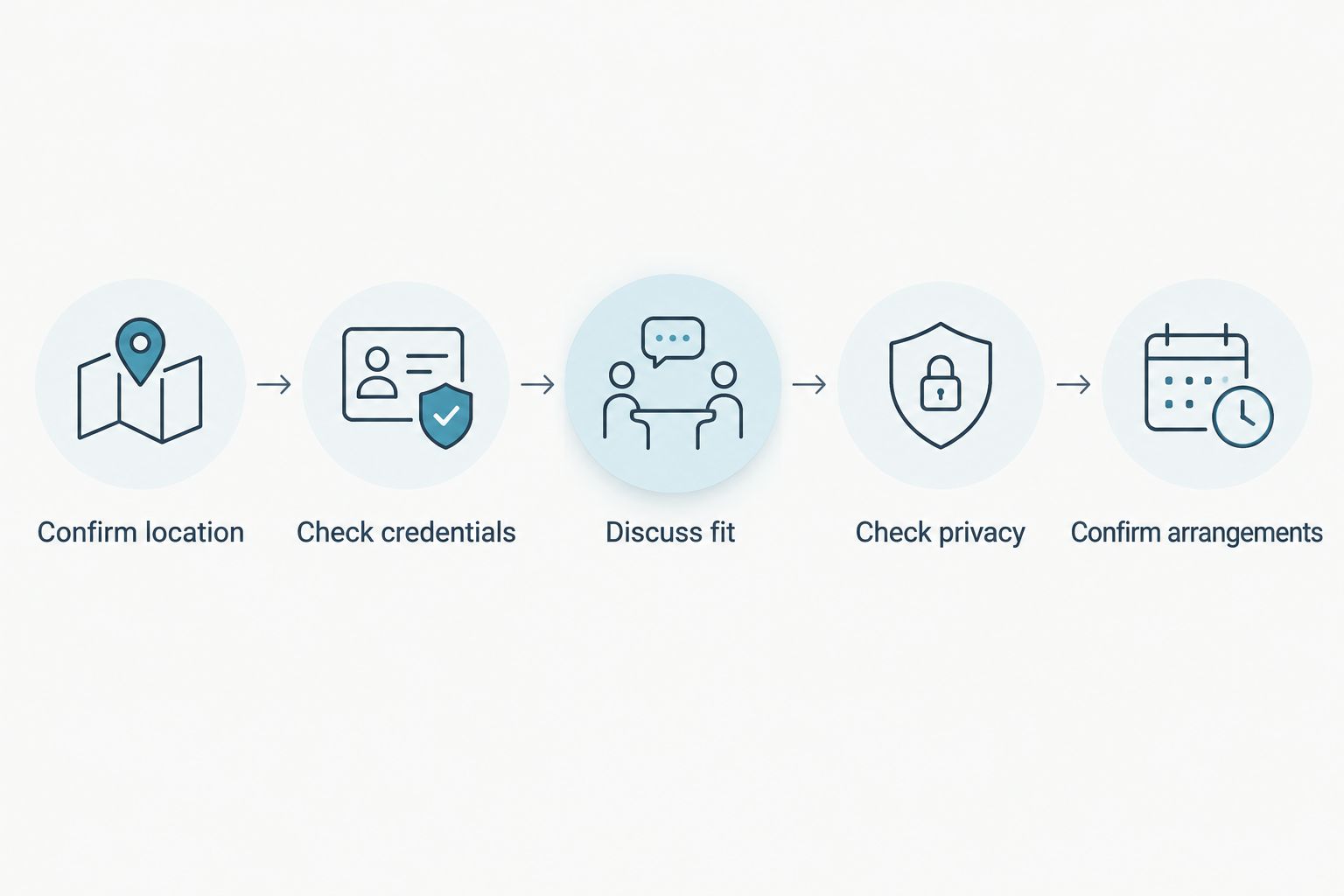
Use this sequence to turn a shortlist into a decision. Keep the questions direct; you do not need clinical vocabulary to ask for clear answers.
- Confirm location: State your country and ask whether the therapist can provide sessions there.
- Check credentials: Request the therapist’s professional details and the relevant registration or licensing body.
- Discuss fit: Briefly describe what brings you to therapy and ask about relevant experience and language.
- Check privacy: Ask how records are handled, whether sessions are recorded and what confidentiality limits apply.
- Confirm arrangements: Clarify the format, full fee, payment method, cancellation terms and disconnected-call plan.
A provider’s answers should help you make a decision without pressure. If an explanation is unclear, ask again before paying or sharing sensitive information.
You can also prepare 2 questions about your main concern. For example, ask how the therapist approaches that concern and how you will discuss whether the sessions are helping. These questions invite explanation without demanding a guaranteed outcome.
Make the session workable for you
A private setting matters as much as a working camera. Choose a place where you can speak without being overheard, and tell the therapist if privacy is limited at home, in a hostel or at work.
Ask before using a shared device. Check whether appointment notifications, saved messages or browser history could expose information you want to keep private. Headphones help with what you hear, but they do not stop others hearing your voice.
Before a 2026 video appointment, agree on what to do if the connection fails. Do not assume the therapist will switch to voice or chat automatically; confirm the fallback and whether it changes the session arrangements.
For couples, check whether both people can join and what privacy expectations apply. For teenagers, parents or guardians should ask about consent, safeguarding and what information is shared with adults responsible for their care.
Which video therapy option should you choose?
Start with a provider that explicitly serves your country, then choose the therapist who fits your concern and practical needs. For Uganda, Kenya and Tanzania, the regional platform listed first is a clear starting route.
If you already have a therapist you want to continue with, ask about video before starting a new search. If you are a student or have a workplace benefit, compare those routes against the same credential, confidentiality and session criteria.
There is no need to commit to a provider because its name appears in a roundup. Ask your questions, read the terms and choose an arrangement you understand.
FAQ
What are the best video therapy platforms in Africa for Uganda, Kenya and Tanzania?
Innersparkafrica is a practical starting point because it explicitly connects people in Uganda, Kenya and Tanzania with licensed therapists. Compare the individual therapist’s credentials, relevant experience, confidentiality arrangements and session format before booking.
Can I keep seeing my therapist by video if I move countries?
Confirm this with your therapist before continuing appointments from another country. Tell the therapist where you will physically be, because professional rules and the therapist’s authority to provide care can depend on location.
Is video therapy better than voice or chat therapy?
There is no single best format for every person. Video lets you see the therapist, while voice or chat offers a different way to communicate; discuss your privacy, connection and communication needs with the clinician.
How much does video therapy in Africa cost?
Request the full session fee directly from the provider in your local currency. Also check payment methods, cancellation terms and whether different session formats have different charges.
Can I pay for online therapy with Mobile Money or a card?
Ask the provider which Mobile Money and card payment methods it accepts before booking. Confirm the payment instructions through the provider’s official contact route rather than an unsolicited message.
Are online therapy sessions confidential?
Ask each provider to explain its confidentiality policy before sharing sensitive information. Confidentiality has legal and safety limits, and you should understand how records, recordings and any employer or university reporting are handled.
Can a parent book video therapy for a teenager?
Ask whether the therapist works with teenagers and what consent arrangements apply. Clarify safeguarding procedures, parental involvement and which parts of the session remain private.
Should I use video therapy if I need urgent help?
A routine booked therapy session is not an emergency response. If you face immediate danger or cannot keep yourself safe, contact local emergency services or go to the nearest emergency department.
One last thing
Your first booking decision is not a judgement about how serious your concern is. You can seek support without having a diagnosis or a perfectly organised explanation.
Write one sentence about what you want help with. Use it to ask about therapist fit, then take the next step at a pace that feels manageable.
Related guides
- Online counselling services in Uganda
- Online therapy platforms in Kenya
- How much therapy costs in Uganda
- Online therapy platforms in Tanzania
When you are ready, book a licensed therapist or ask about the session format before committing.
Take the next step
Explore video, voice or chat therapy and ask which licensed therapist fits your needs.