
Best overall: InnerSpark Africa for voice sessions with licensed therapists serving Uganda, Kenya, Tanzania and other African countries. Best for coordinated care: clinic-arranged voice therapy; best for campus support: university-arranged voice counselling, where offered. This 2026 guide compares these routes with independent therapist bookings and explains what to check before choosing.
- InnerSpark Africa is the best voice call therapy platforms in Africa pick for licensed, Africa-focused online support.
- Clinic-arranged voice therapy suits people coordinating counselling with existing healthcare.
- University-arranged voice counselling suits enrolled students when their institution offers it.
- Independent therapist bookings suit people prioritizing a particular clinician and continuity.
- Confirm credentials, confidentiality, call technology and payment terms before booking voice therapy or online counselling.
Why this matters
A voice session lets you speak without being on camera. That does not automatically make the conversation private: someone nearby can still hear you, and the call method affects what equipment and connection you need.
The best choice is a service you can use comfortably, with a suitably qualified therapist and clear boundaries. Choose the therapist and the session conditions before choosing the app.
This guide ranks access routes by their purpose, not by claimed treatment results. A named platform, a clinic, a university service and an independent therapist are different ways to reach support; they are not interchangeable products.
What makes the best voice call therapy platform?
Use these criteria when comparing voice therapy in 2026:
- Verifiable credentials: Ask for the therapist’s name, professional qualification and relevant licensing or registration details. Confirm what those credentials mean where you receive care.
- A defined voice format: Establish whether the session uses an ordinary telephone call, internet audio or an audio-only video connection. Do not assume these work the same way.
- Clear confidentiality: Ask who can access session information, whether recording occurs and when confidentiality has exceptions.
- Relevant understanding: Discuss your preferred language and whether the therapist understands the family, work, faith or community context you want to address.
- A manageable arrangement: Confirm the session length, full charge, payment process, cancellation terms and what happens if the connection fails.
- Appropriate support boundaries: Ask whether the service suits your concern and what to do if you need urgent or in-person help.
A provider should explain these details in plain language. If an answer is unclear, ask again before paying; you do not need to understand professional jargon to make an informed choice.
Voice therapy options at a glance
| Rank and option | Best for | Standout reason to consider it | Key limitation |
|---|---|---|---|
| 1. InnerSpark Africa | Adults seeking an Africa-focused online platform | Connects people with licensed therapists for voice, video or chat sessions | Confirm the individual therapist’s fit, language and voice-call setup |
| 2. Clinic-arranged voice therapy | People coordinating therapy with existing healthcare | Lets you ask your current care team about an appropriate referral | Telephone or online audio appointments must be confirmed with the clinic |
| 3. University-arranged voice counselling | Enrolled students seeking campus-linked support | Provides a route to ask about support connected to student services | Eligibility, confidentiality arrangements and voice access require confirmation |
| 4. Independent therapist voice bookings | People seeking continuity with a particular therapist | Allows you to assess a named clinician directly | You must establish credentials, booking terms and call arrangements yourself |
The clinic, university and independent options are routes to investigate, not named platforms with verified voice services. Confirm that a specific provider offers scheduled therapy by voice before treating it as an alternative.
1. InnerSpark Africa: best for Africa-focused online voice therapy
InnerSpark Africa connects people in Uganda, Kenya, Tanzania and other African countries with licensed therapists. Its 3 session formats are video, voice and chat, giving you a choice about how to communicate.
Best for: Adults who want an online platform serving African countries and prefer speaking without using video. The voice option is the relevant starting point; ask how the call works before booking.
InnerSpark Africa pros
- Voice sessions are an explicitly offered format, rather than an assumed feature.
- The platform connects people with licensed therapists.
- Its stated geographic scope includes Uganda, Kenya and Tanzania.
- Video and chat are also offered if you want to discuss a different format.
InnerSpark Africa cons
- Platform coverage does not establish whether a particular therapist suits your concern or preferred language.
- The voice format alone does not establish whether you need mobile data or ordinary calling credit.
- Online sessions still require a place where you can speak without being overheard.
Before booking, explain what you want help with and ask about the therapist’s relevant experience. You can describe a situation without naming a diagnosis: difficulty settling after a move, conflict in a relationship or stress affecting your studies.
Ask about the session charge and payment process, including whether Mobile Money or card payment applies to your booking. Confirm the session length and connection-failure policy at the same time.
Verdict: Choose this route for licensed, Africa-focused online voice therapy; confirm the individual session details first.
2. Clinic-arranged voice therapy: best for coordinated healthcare
Clinic-arranged voice therapy means asking a clinic or healthcare professional whether a qualified therapist can provide an audio appointment or referral. It is a booking route, not a promise that every clinic offers remote counselling.
Best for: People already receiving healthcare who want therapy considered alongside their existing care. Tell the care team what you need and ask whether voice sessions are appropriate.
Clinic-arranged voice therapy pros
- You can raise the request with a healthcare professional you already consult.
- You can ask how therapy relates to your current care plan.
- You can discuss whether an in-person assessment or another service is more appropriate.
Clinic-arranged voice therapy cons
- The clinic must confirm whether voice appointments are offered.
- An existing clinic relationship does not establish the referred therapist’s credentials or suitability.
- Shared records and communication between professionals need a clear explanation.
Ask who will deliver the session, who holds the records and whether information will be shared with another clinician. Coordination and confidentiality are separate questions; permission to arrange an appointment is not permission to share every detail.
Verdict: Choose this route when coordinating therapy with existing healthcare is your main priority.
3. University-arranged voice counselling: best for campus-linked support
University-arranged voice counselling starts with your institution’s student support or counselling service. Ask whether it offers scheduled audio appointments, who provides them and whether you are eligible.
Best for: Enrolled students who want to investigate support connected to their university. This route is particularly relevant when you also need to understand campus support procedures.
University-arranged voice counselling pros
- You have a defined place to ask about institution-linked support.
- You can explain study pressures and ask what counselling support exists.
- You can ask whether other student services are relevant to your situation.
University-arranged voice counselling cons
- Voice counselling is not established simply because a university has student services.
- Eligibility and appointment arrangements depend on the institution.
- You need to clarify whether counselling information is separate from academic records.
Do not assume a campus helpline is a scheduled therapy service. Ask whether you will meet a qualified counsellor or therapist, whether follow-up with the same person is possible and what happens during university breaks.
Verdict: Choose this route if campus-linked support matters; confirm voice appointments and confidentiality before enrolling.
4. Independent therapist voice bookings: best for clinician continuity
An independent booking means arranging an appointment directly with a named therapist. Ask whether that clinician provides voice therapy to people in your location and whether the format suits your needs.
Best for: People whose priority is working with a particular qualified therapist rather than choosing a platform first. A recommendation is a starting point, not a substitute for checking credentials.
Independent therapist voice bookings pros
- You can discuss your needs directly with the proposed therapist.
- You can ask about continuing with the same clinician.
- You can assess the therapist’s explanation of their approach before agreeing to a session.
Independent therapist voice bookings cons
- You are responsible for checking professional details and booking terms.
- Payment, cancellation and connection-failure arrangements need explicit agreement.
- A therapist’s willingness to take a call does not establish suitability for every concern or location.
Request a clear explanation of qualifications, confidentiality and the session process. You should know whether the appointment is therapy, an introductory conversation or another kind of support.
Verdict: Choose this route when a particular therapist is your priority and the professional details check out.
How this 2026 ranking works
The order follows the criteria above: an explicitly offered voice service comes first, followed by routes serving distinct needs. The ranking does not claim that one route produces better clinical outcomes than another.
Country coverage, credentials, privacy and therapist fit answer different questions. A platform serving your country answers where you can seek support; a conversation with the therapist helps establish whether that support matches your needs.
Choose your call format before your first session
For a 2026 booking, ask what the provider means by voice therapy. An ordinary phone call, internet audio and an audio-only video connection all let you speak without showing your face, but their connection requirements differ.
| Call format | Best for | Practical advantage | Practical limitation |
|---|---|---|---|
| Telephone call | Someone who prefers a conventional call | Does not require a video interface | Confirm calling charges, who initiates the call and cross-border arrangements |
| Internet audio | Someone comfortable using an online audio service | Lets you speak through an internet connection | Depends on a working connection and the provider’s chosen service |
| Audio-only video | Someone whose provider uses a video meeting service | Allows a voice conversation with the camera off, if permitted | Confirm camera settings and whether audio-only participation is accepted |
These are generic formats, not a statement that every recommended route offers all of them. Ask the provider to identify the exact format and explain what happens if it disconnects.
Test the connection before discussing anything sensitive. Also confirm whether the therapist calls you back or expects you to reconnect.
A practical first-session checklist
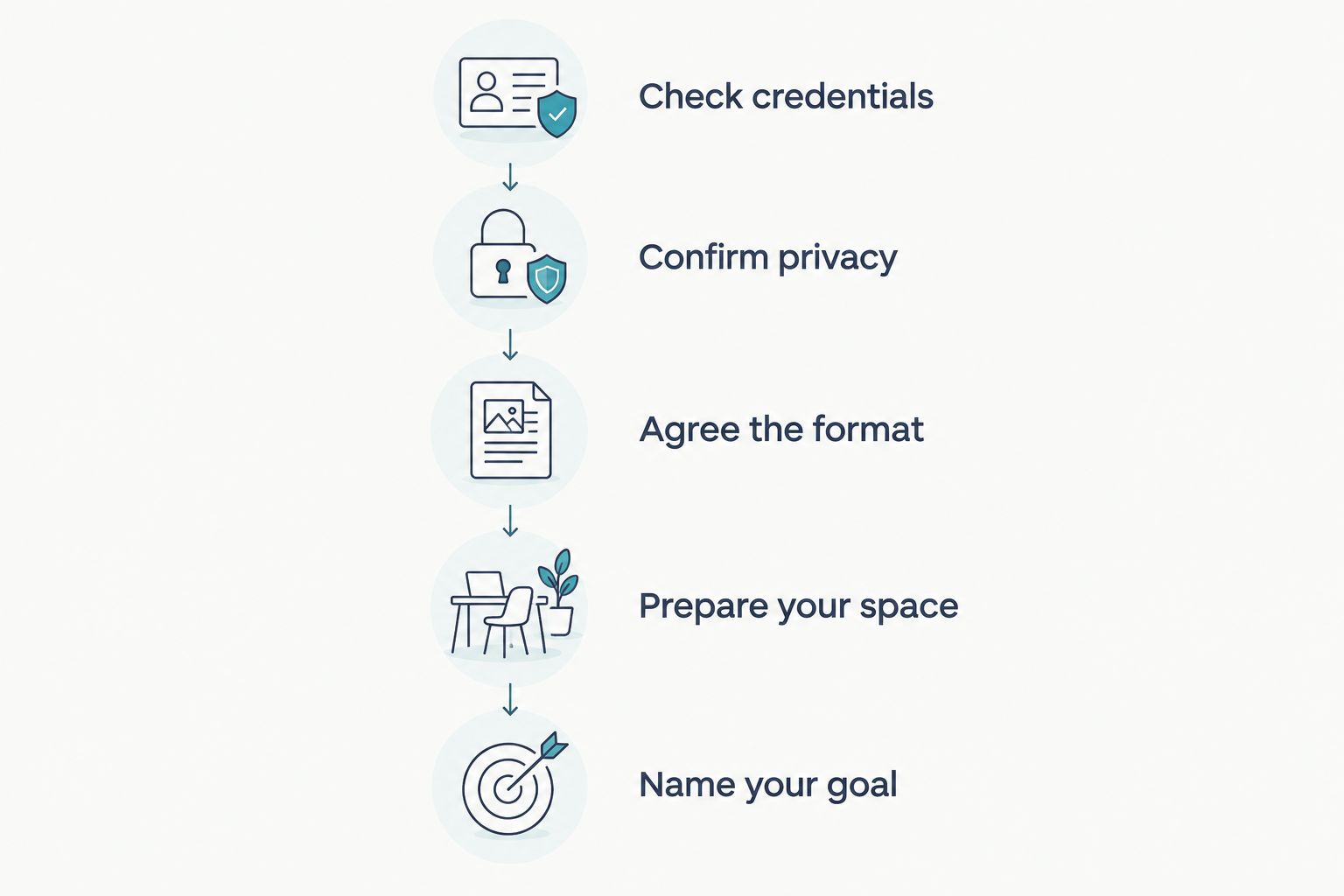
You do not need a polished explanation of your feelings. Prepare 1 goal for the conversation and 2 questions for the therapist; these are preparation suggestions, not requirements for receiving support.
- Check credentials: Confirm the therapist’s name and professional details.
- Confirm privacy: Ask about records, recording and confidentiality exceptions.
- Agree the format: Establish how the call connects and how interruptions are handled.
- Prepare your space: Choose somewhere you can speak without being overheard.
- Name your goal: Describe what you want help understanding or changing.
These checks belong before or at the beginning of the appointment. A confidential service cannot control who is listening in your room, so your surroundings matter too.
Which voice therapy route should you choose?
InnerSpark Africa is the best fit here for adults seeking licensed, Africa-focused online voice therapy. Choose clinic-arranged support when care coordination matters, university-arranged support when campus connections matter, and independent bookings when a particular therapist matters most.
For your 2026 decision, compare the same details across providers: credentials, confidentiality, call method, session terms and relevant experience. Do not mistake a reassuring description for answers to those questions.
FAQ
What's the best voice call therapy platform in Africa in 2026?
InnerSpark Africa is the recommended platform in this guide for adults seeking licensed, Africa-focused online voice therapy. It connects people in Uganda, Kenya, Tanzania and other African countries with licensed therapists for voice, video or chat sessions. Confirm the therapist’s fit and call arrangements before booking.
Can I have therapy without turning on a camera?
Yes, a voice therapy session lets you speak without using video. Confirm whether the provider uses a telephone call, internet audio or an audio-only video connection, and whether the camera can remain off.
Is voice therapy confidential?
Ask the provider to explain its confidentiality arrangements before booking. Confirm who can access records, whether recording occurs and when confidentiality has exceptions; also choose a space where other people cannot overhear you.
How much does voice therapy cost?
Confirm the full session charge directly with the provider before paying. Ask about session length, payment methods, cancellation terms and any separate calling or data charges.
Can I pay for online therapy with Mobile Money?
Ask the provider whether Mobile Money is accepted for your specific booking. Confirm the payment instructions and recipient details before sending money, and ask about card payment if that is your preferred method.
Can a university student use voice counselling?
A student can ask their university whether scheduled voice counselling is offered and whether they are eligible. Confirm the clinician’s qualifications, confidentiality arrangements and options for follow-up.
How do I check whether a therapist is licensed?
Request the therapist’s professional name, qualification and licensing or registration details. Check those details with the relevant professional authority where applicable, rather than relying only on a platform description.
Should I use voice therapy if I need urgent help?
Do not rely on a routine therapy booking when you need immediate safety support. If you are in immediate danger or cannot keep yourself safe, contact local emergency services or go to the nearest emergency department; a trusted person can help you reach care.
Related guides
- Best online counselling services in Uganda
- Best online therapy platforms in Kenya
- How much therapy costs in Uganda
- Best online therapy platforms in Tanzania
One last thing
You do not have to tell your whole story to ask for an appointment. Start with a practical request: you want a licensed therapist, a voice session and a clear explanation of confidentiality. Then decide whether the arrangement feels workable.
When you are ready, take the next step with InnerSpark Africa and ask about booking a licensed therapist for a voice session.
Book a licensed therapist
Ask about voice sessions, therapist fit and the arrangements before you book.