
Instead of repeatedly checking how you feel without taking a next step, use a mind-check to therapist booking workflow: write down your concern, choose how you want to talk, and confirm a licensed therapist appointment. This 2026 guide takes you from a personal check-in to preparing for a video, voice or chat session through InnerSpark Africa.
- InnerSpark Africa connects people in Uganda, Kenya, Tanzania and other African countries with licensed therapists online.
- Use mind-check to therapist booking as a practical next-step process, not a diagnosis or automated referral.
- Choose video, voice or chat therapy around your privacy, communication preferences and connection.
- Confirm the therapist, appointment details and confidentiality boundaries before sharing sensitive information.
Why this matters
A personal check-in helps you describe what is happening. A booking turns that description into a request for support. You do not need a diagnosis, a polished explanation or proof that things are bad enough before asking to speak with a therapist.
InnerSpark Africa is best for people seeking online therapy with licensed therapists across Uganda, Kenya, Tanzania and other African countries. The platform offers video, voice and chat sessions; choosing between them is part of preparing for the conversation, not a test you must pass.
The mind-check in this guide is a short reflection exercise, not a named screening tool or a clinical assessment. It does not produce a score, diagnose a condition or automatically transfer your answers to a therapist. You decide what to share.
For your 2026 booking, keep the workflow simple: describe the concern, identify what would make a conversation possible, and confirm the practical details. If you are in immediate danger, have seriously harmed yourself or cannot stay safe, seek urgent local help rather than waiting for a routine appointment.
Before you start
- Have access to a suitable device and connection. You need a way to use the platform and take part in your chosen session format. For video or voice, check your microphone; for video, check your camera too.
- Prepare a short note and a private setting. Keep your main concern, preferred language and scheduling constraints nearby. If you are helping a teenager, ask about the therapist's age range, consent requirements and confidentiality boundaries before arranging care.
- Check the time zone and contact route before confirming. Booking from another country or while travelling makes an ambiguous appointment time easy to misread. Confirm which local time applies and how you will receive instructions for joining.
Do not enter sensitive notes on a shared device without thinking about who can see them. A personal notebook or brief private note is enough for this exercise; you do not need to build a detailed history before you start.
Check in
Turn a vague feeling into a booking note
- Set aside 5 minutes for reflection. This is a suggested writing window, not a screening requirement or a promised booking duration. Stop sooner if writing feels uncomfortable.
- Answer 3 prompts: What is troubling me? How is it affecting daily life? What would I like help with? Use ordinary words rather than trying to name a condition.
- Write 1 sentence you can share. For example, describe difficulty sleeping, tension in a relationship or feeling overwhelmed by university work. Use your own experience; the examples are starting points, not diagnoses.
- Separate the concern from the logistics. Put your preferred language, privacy needs and suitable appointment times beneath the main sentence. These details help you decide whether a session will work in practice.
Expected result: You have a short description of why you want support, plus the practical conditions you need for a conversation.
You can also write that you do not know where to begin. That is a valid opening. The purpose of the note is to reduce the pressure of explaining everything at once, not to make you sound certain.
Keep the note proportionate. You do not need to include another person's full name, workplace, address or private messages to explain that a relationship is difficult. Start with what you are experiencing and discuss further detail with the therapist when appropriate.
For a 2026 check-in, record the date if you plan to revisit the note. A dated description helps you distinguish what you felt when you wrote it from what you want to discuss at the appointment. It is a memory aid, not evidence that you must submit.
Choose support
Match the conversation to your circumstances
- Choose your preferred session format. InnerSpark Africa offers online therapy by video, voice and chat. Consider how you communicate, what your connection supports and where you can speak or type privately.
- Identify what you need from the therapist. Ask about experience with your concern, the language you want to use and the context you want understood. Do not assume these details from a name or photograph.
- Check the therapist's credentials and scope. Review the information provided and ask for clarification when the qualification or professional role is unclear. A licensed therapist still needs to be a suitable match for the support you are requesting.
- Ask about the appointment format before committing. Confirm what video, voice or chat means for the particular session, including how you join and whether a chat appointment happens live.
Expected result: You have a preferred format and clear questions for assessing therapist fit, rather than choosing solely because an appointment looks convenient.
Video, voice or chat: practical trade-offs
| Format | Best for | Practical benefit | Limitation to plan around |
|---|---|---|---|
| Video | People who want face-to-face conversation online | You and the therapist can see each other during the conversation | You need a suitable connection, camera access and a visually private setting |
| Voice | People who prefer speaking without being on camera | You can talk without sharing a camera view | Other people nearby can still hear your side of the conversation |
| Chat | People who prefer expressing themselves in writing | You can communicate without speaking aloud | Typing and reading take effort, and a visible screen can expose sensitive text |
Choose the format you can use privately, not the format that seems most serious. A video session is not automatically the right choice for someone sharing a room. Chat is not automatically private when someone else can read the screen.
InnerSpark Africa's online therapy formats give you different ways to communicate. The practical limitation is that you still need to arrange privacy and confirm the joining process; the format alone does not solve those problems.
Confirm details
Move from a preference to a confirmed appointment
- Use the platform's current booking route. Follow the instructions shown on the site rather than looking for a particular button name from a guide. Keep your check-in note nearby, but share only what is requested and what you are comfortable providing.
- Confirm the therapist and appointment time. Check the name, date, time zone and chosen session format. If someone is booking on your behalf, make sure the appointment details reach you directly through an agreed contact route.
- Review payment and appointment terms. Check the current session charge, accepted payment methods and instructions before paying. Read the cancellation and rescheduling terms rather than assuming how a change will be handled.
- Ask about confidentiality. Request an explanation of who can access session information, whether sessions are recorded and what exceptions apply. Confidential care has boundaries; you should understand them before discussing sensitive matters.
- Keep the confirmation and joining instructions. Check how you will enter the session and whom to contact if the instructions do not arrive. A payment record alone does not tell you how to attend.
Expected result: You know who you are meeting, when the appointment happens, how you will join and which terms apply.
For a 2026 appointment, use the current details shown during booking. An old message, saved screenshot or earlier appointment does not establish the terms for a new session. If information conflicts, ask for clarification before proceeding.
Do not send passwords, payment PINs or one-time security codes to someone claiming to arrange therapy. Keep payment questions separate from your personal check-in note. You can explain that you need booking assistance without sending your mental-health history.
Prepare privately
Make the first conversation easier to start
- Check your device and setting. Test the microphone or camera if your chosen format requires them. For chat, check that you can read and type comfortably without someone watching the screen.
- Keep your opening note accessible. You can read it aloud, summarize it or use it to begin a written conversation. It is a prompt, not a script you have to follow.
- Name any immediate limits. Tell the therapist if someone might interrupt, if you need to avoid certain topics at first or if explaining things in another language is difficult.
- Prepare a question about the next step. Ask how the therapist proposes to approach your concern and what you should understand before deciding about another appointment.
Expected result: You can join the session with a starting point, a workable setting and permission to ask questions.
The workflow has four preparation stages: Check in, Choose support, Confirm details and Prepare privately. Complete them in that order so you do not reach an appointment without understanding how to attend or what you want to discuss.
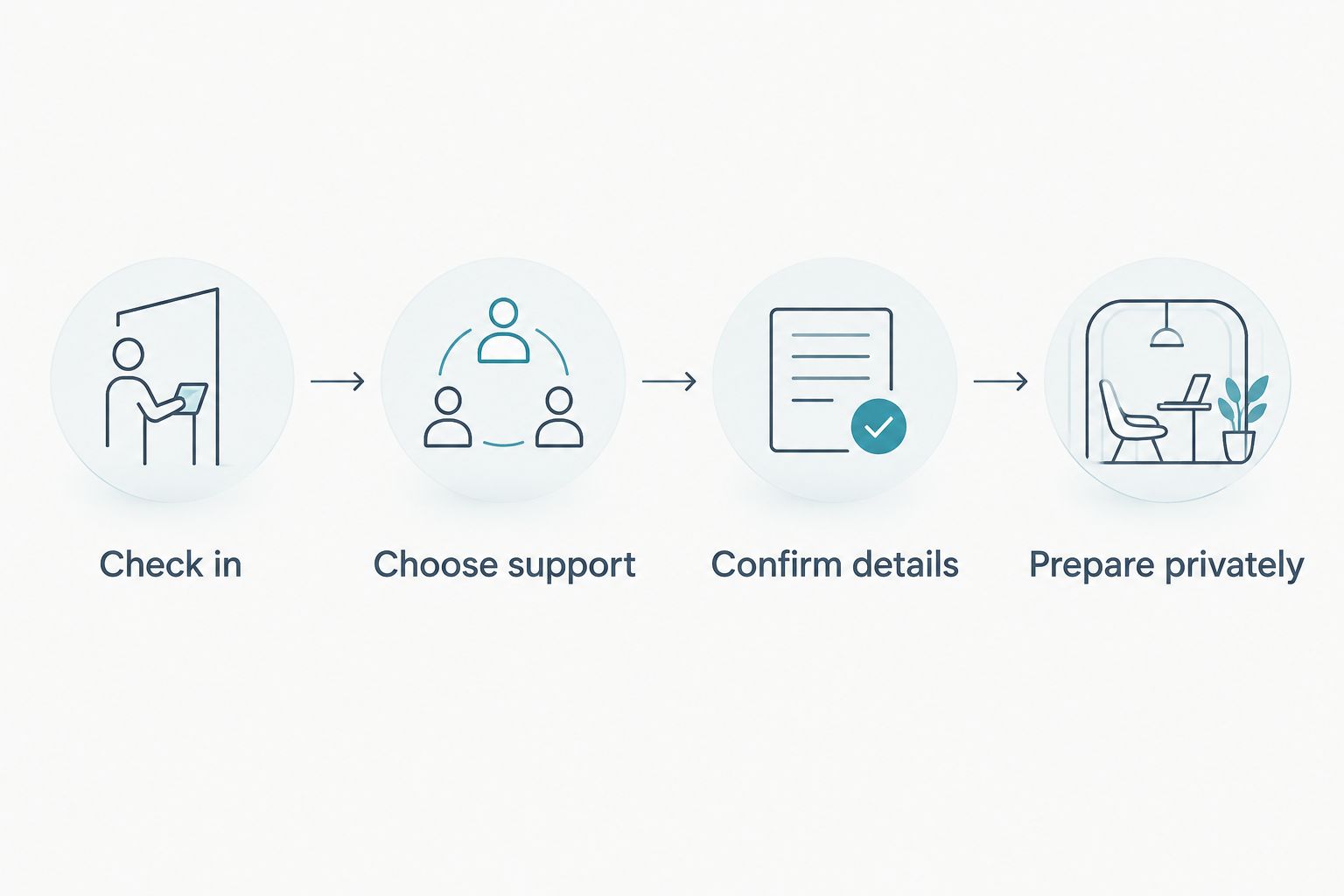
You do not have to arrive feeling calm or ready to explain everything. Your preparation only needs to make attendance possible. If the conversation feels difficult, say so instead of trying to perform the role of a perfect client.
Repeat the check-in when your concern changes
A second version of the workflow starts with an existing appointment rather than a new booking. Use it when your main concern changes, your privacy situation changes or you want to request a different way of communicating.
- Update your opening sentence. Write what has changed since you booked. Keep the earlier note if it helps you explain the difference.
- Decide whether the change affects attendance. A new topic can be raised during the session. A changed schedule, contact detail or session-format request needs attention before the appointment.
- Contact the booking support route for practical changes. Ask whether the requested change is possible and what terms apply. Do not assume that editing a personal note changes your booking.
- Confirm any revised details. Check the new time, format or joining instructions if the appointment changes.
Expected result: Your personal note reflects your current concern, and any appointment changes are separately confirmed.
For an ongoing 2026 therapy plan, use check-ins to prepare questions rather than judge yourself. A difficult week does not mean you failed at therapy. Discuss what happened and what support you want next without turning every entry into a score.
Troubleshooting
You completed the check-in but have no appointment confirmation
Treat the reflection exercise and the booking as separate tasks. Check whether you finished the booking process and received confirmation. Contact the platform's support route if the status is unclear; do not assume your personal note created an appointment.
You have a booking but no joining instructions
Check the contact channel you supplied and any filtered messages. Ask the booking support route to confirm how to attend. Avoid guessing a meeting link or sending sensitive details to an unverified account that offers help.
Your connection or microphone fails
Check your connection, device permissions and audio settings. Contact the therapist or booking support through the agreed route if you cannot join. Ask whether another format is possible rather than assuming an automatic switch to voice or chat.
You cannot find privacy at the booked time
Look for a setting where your conversation cannot be overheard or your screen read. If that is not possible, ask about changing the appointment or format under the applicable terms. Headphones protect what you hear; they do not stop others hearing what you say.
The therapist does not feel like a suitable match
Explain the difficulty if you feel comfortable: language, communication style or experience with your concern. Ask about another therapist or the process for changing support. You do not need to accuse anyone of wrongdoing to request a different fit.
Customize your workflow
Keep the same sequence but change the preparation to suit your situation. For university support, bring the pressures you want to discuss without assuming an institution needs access to your session. For couples, ask whether the therapist provides couples work and how participation and confidentiality are handled.
For a teenager, the parent or guardian should clarify the therapist's scope, consent process and information-sharing boundaries before booking. Do not promise the teenager absolute secrecy or assume every detail will be reported to the parent. Ask the therapist to explain the arrangement directly.
Start with the smallest useful action: write your opening sentence or ask a booking question. You do not need to commit to a longer course of therapy before understanding the first appointment.
FAQ
What does mind-check to therapist booking mean?
Mind-check to therapist booking means turning a short personal reflection into a practical request for a therapy appointment. In this guide, the mind-check is a writing exercise, not a diagnostic tool or an automated referral.
Do I need a diagnosis before booking a therapist?
You do not need a diagnosis to ask for a therapy appointment. Describe what is troubling you and ask whether the therapist provides suitable support for that concern.
Can I choose video, voice or chat therapy?
InnerSpark Africa offers video, voice and chat therapy sessions with licensed therapists. Confirm the format for your particular appointment and choose around your communication preferences, connection and privacy.
Is my online therapy conversation confidential?
Ask the therapist to explain confidentiality and its exceptions before sharing sensitive information. Also confirm who can access session information and whether any recording takes place.
What should I do if I cannot explain how I feel?
Start by saying that you are finding it difficult to explain. You can describe a recent experience, read a short note or ask the therapist to help you begin the conversation.
Can a parent book online therapy for a teenager?
A parent or guardian should ask about age eligibility, consent and confidentiality before arranging therapy for a teenager. Confirm that the therapist works with teenagers and clarify what information is shared with the parent.
How do I check the cost of a therapy appointment?
Check the current session charge during booking and confirm the accepted payment method before paying. Ask about cancellation and rescheduling terms so you understand the appointment conditions.
Should I wait for online therapy if I cannot stay safe?
Do not wait for a routine online appointment if you are in immediate danger or cannot stay safe. Seek urgent local help through emergency services or the nearest emergency department, and contact a trusted person who can stay with you if possible.
One last thing
Your opening sentence does not have to match what you eventually discuss. It is a doorway into the conversation, not a commitment to stay on one topic. Save the note for yourself, then tell the therapist what feels most relevant when the session begins.
Related guides
- Online counselling services in Uganda
- Online therapy platforms in Kenya
- Checking therapy costs in Uganda
- Online therapy platforms in Tanzania
When you are ready, book a licensed therapist through InnerSpark Africa. Begin with your short note and ask any practical questions before confirming.
Take the next step
Choose online therapy by video, voice or chat with a licensed therapist.