
Content creators’ online therapy is mental health support delivered remotely, with the aim of helping you address distress and protect your wellbeing alongside public-facing work. This 2026 guide to online therapy for content creators in Africa explains how to choose a licensed therapist, protect your privacy and discuss pressures such as audience criticism, irregular income and constant visibility.
- Online therapy for content creators in Africa should prioritize licensed care, privacy and a format you can use consistently.
- InnerSpark Africa connects people in Uganda, Kenya and Tanzania with licensed therapists through video, voice or chat.
- Discuss audience pressure and creator burnout without assuming that every difficult workday needs a diagnosis.
- Check confidentiality limits, country eligibility and current fees before booking online counselling.
Why online therapy matters for content creators
When your work involves being visible, asking for help can raise a particular concern: what happens if private information becomes public? Therapy gives you a setting to discuss that concern, but you should understand the therapist’s confidentiality rules rather than assume privacy has no exceptions.
Creator work also makes the usual advice to switch off complicated. If you earn through publishing, replying or appearing on camera, stopping those activities affects your work. A useful therapy conversation separates necessary work from habits that leave you feeling worse, without treating your profession as the problem.
You do not need a diagnosis or a public crisis to ask for support. You can begin with a specific difficulty: feeling tense before posting, replaying criticism after work, or struggling to rest without checking performance.
For a country-specific starting point, the online counselling services in Uganda guide offers another way to frame your search. Use this 2026 guide to decide what you need from the person providing care, not just which platform to open.
How to choose online therapy as a content creator
Identify the pressure you want help with
Start with your experience, not a clinical label. Write down what happens, how it affects you and what you want to discuss. For example: after reading hostile comments, you keep checking your phone and struggle to concentrate on other tasks.
Give yourself 10 minutes of preparation before contacting a therapist. This is a suggested planning exercise, not a clinical assessment. Choose a recent example rather than trying to explain your entire career in the booking message.
Separate the business question from the emotional one. A missed sponsorship deadline needs a work response; shame, panic or persistent distress around that deadline belongs in a therapy conversation. You can need both kinds of help without expecting one professional to provide everything.
- Name the situation that brings you to therapy.
- Describe its effect on sleep, relationships or daily tasks.
- Write down what you have already tried.
- Identify one change you would like to work toward.
- Leave diagnosis to a qualified professional.
Set your privacy and access requirements
Decide where you can speak without being overheard. A bedroom, shared office or university residence is not automatically private just because you are wearing headphones. Consider who can hear your voice, see your screen or access the device afterward.
Check the service’s privacy information and ask the therapist to explain confidentiality before discussing sensitive details. Healthcare confidentiality has limits, including circumstances involving safety or legal obligations; the applicable rules depend on the professional and jurisdiction.
If screenshots, private messages or unpublished content are part of the issue, describe them first. You do not need to send another person’s identifying information simply to explain how an interaction affected you. Ask whether any material is necessary and how it would be handled.
- Choose a space where you can speak freely.
- Check whether anyone else can access your account.
- Ask who can view session notes or messages.
- Ask whether sessions are recorded and under what conditions.
- Discuss confidentiality exceptions before sharing sensitive information.
Check the therapist’s license and fit
You can begin by reviewing a therapist’s stated qualifications and asking how to verify their license or registration. Also confirm that the therapist can provide care to someone in your country. A platform serving several countries does not remove the need to check your individual arrangement.
InnerSpark Africa connects people in Uganda, Kenya, Tanzania and other African countries with licensed therapists for video, voice or chat sessions. InnerSpark Africa is best for creators seeking licensed online therapy by video, voice or chat in Uganda, Kenya or Tanzania.
That access does not establish creator-specific expertise. Ask the individual therapist about public-facing work, online harassment, performance pressure and income uncertainty. In 2026, make professional suitability—not a familiar platform name—the deciding factor.
Language and cultural understanding belong in this conversation too. Tell the therapist which language lets you express yourself clearly and explain any family, religious or community expectations that affect your decisions.
- Request the therapist’s qualifications and registration details.
- Confirm eligibility for care in your country.
- Ask about experience with the concerns you want to discuss.
- Confirm your preferred session language.
- Explain the local context that matters to you.
Choose video, voice or chat deliberately
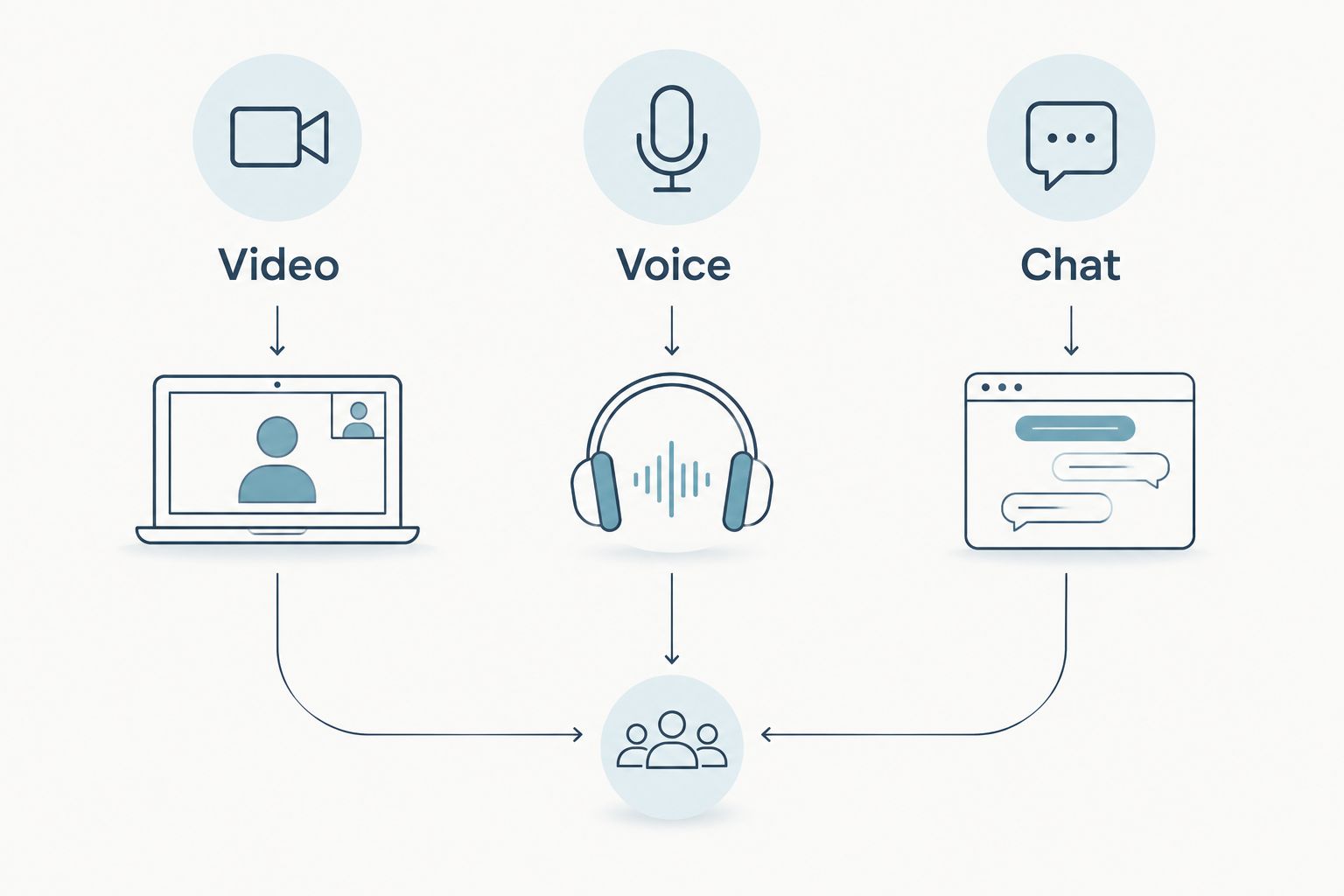
Choose a format you can use in your real environment. Video supports face-to-face interaction, voice removes the need to appear on camera, and chat gives you a written way to communicate. None is automatically the best format for every creator or concern.
Someone who spends work hours filming might prefer not to use a camera during therapy. Someone who finds typing difficult when distressed might prefer speaking. These are preferences to discuss, not evidence that one format produces better outcomes.
Ask how each format works before choosing it. In particular, establish whether chat is a scheduled live session or another messaging arrangement. Do not assume that a chat option means continuous access or immediate replies.
- Choose Video if you want face-to-face interaction.
- Choose Voice if speaking without a camera suits you.
- Choose Chat if written communication feels more manageable.
- Confirm whether the appointment is live and scheduled.
- Agree on what to do if the connection fails.
Confirm fees, payment and appointment terms
Before booking, check the current fee for the specific appointment and the currency in which you will pay. Ask about payment methods, cancellation terms and what happens if a technical problem interrupts the session. Do not infer those policies from the fact that a service operates online.
For your 2026 therapy budget, choose an arrangement you can realistically maintain rather than one based on an unusually good earnings month. Tell the therapist if irregular creator income affects scheduling. Ask what appointment frequency they recommend and discuss what you can manage.
Also check the time zone shown on the booking confirmation, especially when traveling or working across borders. An appointment that fits your calendar should include enough privacy to participate, not just an empty slot between filming and a live broadcast.
- Confirm the current fee and payment currency.
- Check the available payment methods.
- Read cancellation and rescheduling terms.
- Verify the appointment’s time zone.
- Ask how interruptions or missed connections are handled.
Bring creator-specific situations into the session
You do not need to educate a therapist about every feature of every platform. Explain what the work requires and where the difficulty starts. Describe the situation plainly: a sponsor message feels impossible to open, a negative comment stays with you, or analytics checking continues after your working day.
Bring 2 questions to your first session as a suggested starting point: what should we focus on, and how will we review whether this support is helping? Those questions make room for the therapist’s assessment without asking for a guaranteed result.
Use examples that show the difference between professional requirements and personal strain. Checking campaign performance for a report is different from repeatedly refreshing it because you feel unable to stop. The therapist needs that context, not a polished version of your public identity.
- Describe one recent situation in detail.
- Explain what your work genuinely requires.
- Identify what happens outside working hours.
- Discuss changes in sleep, concentration or relationships.
- Ask how goals and progress will be reviewed.
Review fit and agree on a practical boundary
After a session, consider whether you understood the conversation, felt able to speak and received a clear explanation of next steps. Feeling uncomfortable while discussing a difficult topic does not by itself mean therapy is a poor fit. Being dismissed or left confused deserves a direct conversation.
Start with 1 work boundary to discuss with your therapist, such as deciding when to read comments or where to keep your phone during rest. This is a suggested discussion prompt, not a treatment plan. Make the boundary specific enough to evaluate against your actual responsibilities.
Review your 2026 care arrangement when your location, workload or privacy changes. Moving countries, sharing a room or beginning frequent travel can change whether the existing setup remains practical. Tell the therapist rather than silently struggling with the arrangement.
- Ask for clarification when the approach is unclear.
- Discuss whether you feel understood and respected.
- Agree on one realistic boundary to explore.
- Revisit the session format if it becomes difficult to use.
- Seek another qualified therapist if the fit remains unsuitable.
Compare your support options
Choose professional care for mental health concerns; choose business support for business decisions. A peer group or creator coach can have a useful role, but neither replaces a licensed therapist’s assessment and care.
Use this comparison to match the support to the task. The limitations matter as much as the benefits: remote appointments require a workable private setup, in-person care requires travel, and non-clinical support has a different purpose.
| Option | Best for | Main benefit | Key limitation |
|---|---|---|---|
| InnerSpark Africa online therapy | Creators seeking licensed remote care in its service countries | Connects people with licensed therapists through video, voice or chat | Confirm individual therapist fit, country eligibility and privacy terms |
| A licensed local in-person therapist | Creators who prefer sharing a physical room with a therapist | Face-to-face support without relying on a remote connection | Requires travel and a suitable appointment location |
| A creator peer group | Creators wanting shared experience and professional connection | Offers discussion with people who understand creator work | Peer support is not clinical assessment or treatment |
| A creator business coach | Creators needing help with workflow or commercial decisions | Focuses on work practices and business goals | Coaching is not a substitute for licensed mental health care |
You can use more than one kind of support while keeping the roles clear. A business coach can help you reorganize deadlines; a therapist can help you discuss distress associated with them. Avoid sharing the same sensitive information everywhere simply because several people are supporting you.
Common mistakes content creators make
Treating analytics as a measure of personal worth
Views, follower counts and sponsor decisions describe parts of your work, not your value as a person. If performance changes affect how you see yourself, bring that pattern into therapy rather than looking only for a better posting strategy.
Separate the report you need for work from the story you tell yourself about it. A therapist can help you examine that story without promising to improve your reach.
Waiting until there is a public breakdown
You do not have to disclose distress to an audience before seeking help. A private difficulty is enough to start a conversation, even if you are still publishing regularly and meeting commitments.
Describe what is happening rather than deciding whether it looks serious enough from the outside. Let a qualified professional assess the concerns you raise.
Choosing familiarity over professional suitability
A large following, relatable posts or a confident speaking style does not establish a therapist’s credentials. Check the professional qualification and the person’s ability to provide care in your location.
Ask about experience with your concerns, but do not require the therapist to be a creator. Understanding the work and providing appropriate care are more useful than sharing your job title.
Booking without a private setting
A confidential service cannot prevent someone nearby from overhearing you. Plan the physical setting as carefully as the appointment, especially if you share housing or use a shared device.
If privacy is difficult, explain that before the session. Discuss whether a different time, location or communication format would make the conversation practical.
Turning therapy into more content
You can keep therapy separate from your public identity. Publishing session details, screenshots or another person’s private information is not necessary to prove that you are taking care of yourself.
Before posting about a difficult experience, discuss what you want to share and why. You are allowed to make a personal change without giving your audience a live account of it.
FAQ
What's the best online therapy option for content creators in Africa?
The best option is a licensed therapist who can provide care in your country, understands your concerns and offers a format you can use privately. InnerSpark Africa connects people in Uganda, Kenya, Tanzania and other African countries with licensed therapists through video, voice or chat; confirm the individual therapist’s fit before booking.
Can I start therapy without being diagnosed with burnout?
Yes, you can seek therapy without a burnout diagnosis. Describe what you are experiencing and how it affects your daily life, then let the qualified professional assess your concerns.
Is voice therapy better than video for someone who films all day?
Voice therapy is a practical choice if you want to speak without appearing on camera, but it is not automatically better than video. Discuss your communication preferences, privacy and clinical needs with the therapist.
Will my therapist tell my audience or sponsors about my sessions?
Therapists have confidentiality obligations, but you should ask the provider to explain the applicable rules and exceptions. Confirm who can access records, whether sessions are recorded and what happens when safety or legal obligations require disclosure.
How do I check what online therapy will cost?
Check the current fee for your chosen appointment before booking. Confirm the payment currency, available payment methods and cancellation terms rather than assuming that all therapists or session formats have the same arrangements.
Can I keep seeing an online therapist while traveling?
Check with the therapist before continuing sessions from another country. Professional eligibility and emergency arrangements depend on your location, so explain where you will be attending the appointment.
What if I need urgent help rather than a scheduled session?
If you are in immediate danger or cannot keep yourself safe, contact local emergency services or go to the nearest emergency department. A scheduled online therapy appointment is not a substitute for emergency care; ask someone you trust to stay with you while you seek help.
One last thing
Your therapist does not need the polished version of you that your audience sees. Bring the unfinished explanation, the uncomfortable feeling or the question you cannot turn into a caption. You can begin without knowing exactly what to say.
For your next step in 2026, write down your main concern and preferred session format. If licensed remote care suits you, book a licensed therapist through InnerSpark Africa when you feel ready. Ask about fit and confidentiality before sharing sensitive details.