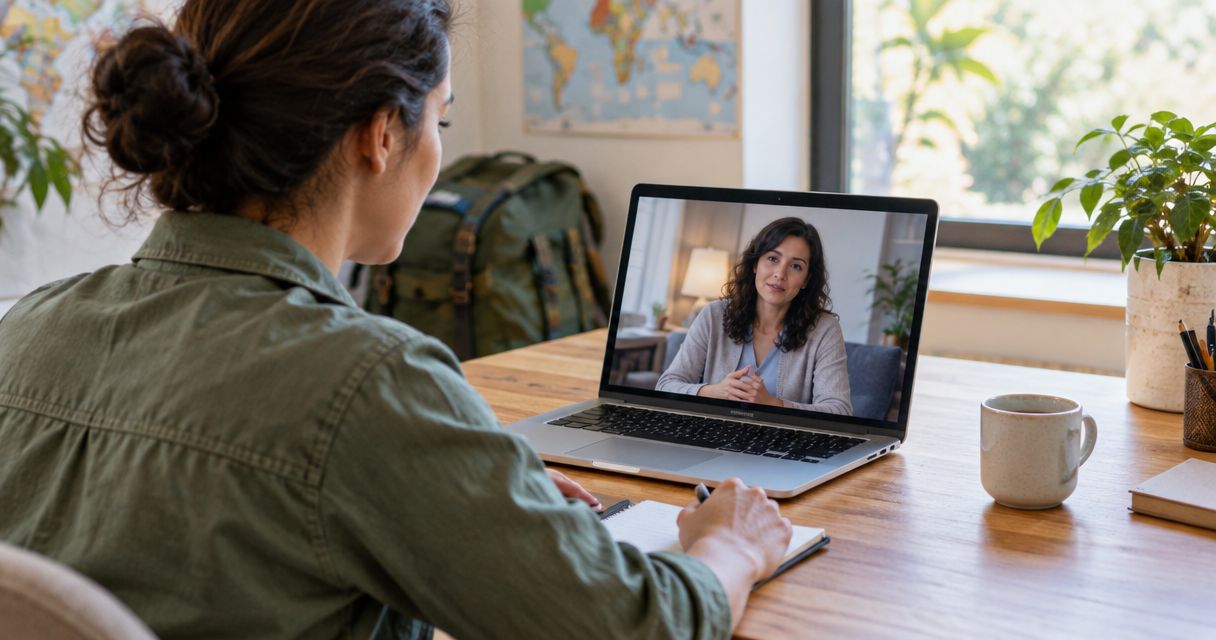
NGO and aid workers’ online therapy is counselling delivered remotely with the aim of supporting emotional wellbeing alongside humanitarian work. This 2026 guide explains how to choose a licensed therapist, protect session privacy, and arrange support around deployments, shared accommodation, and changing schedules.
- Online therapy for NGO and aid workers should fit your privacy needs, work schedule, and current location.
- InnerSpark Africa connects people in Uganda, Kenya, Tanzania and other African countries with licensed therapists online.
- Choose video, voice or chat therapy by considering privacy, connection quality and how you prefer to communicate.
- Ask about confidentiality limits and employer reporting before using workplace-funded counselling.
Why online therapy matters for NGO and aid workers
Humanitarian work can bring difficult experiences into the same week as travel, reporting deadlines, and responsibilities to colleagues or communities. You do not need a diagnosis, a crisis, or permission from a manager to seek support. Therapy gives you a setting to discuss your own needs rather than another operational problem to solve.
For NGO and aid workers, the practical question is not just whether a therapist is available. It is whether you can speak privately, attend from your current location, and continue when your assignment changes. Remote sessions remove the journey to a counselling room, but they do not remove those planning decisions.
Choose the therapist and the privacy arrangement before choosing the communication format. A convenient app does not establish professional suitability or explain who receives information about your sessions. If Uganda is your base, the guide to online counselling services in Uganda is a useful starting point for comparing options.
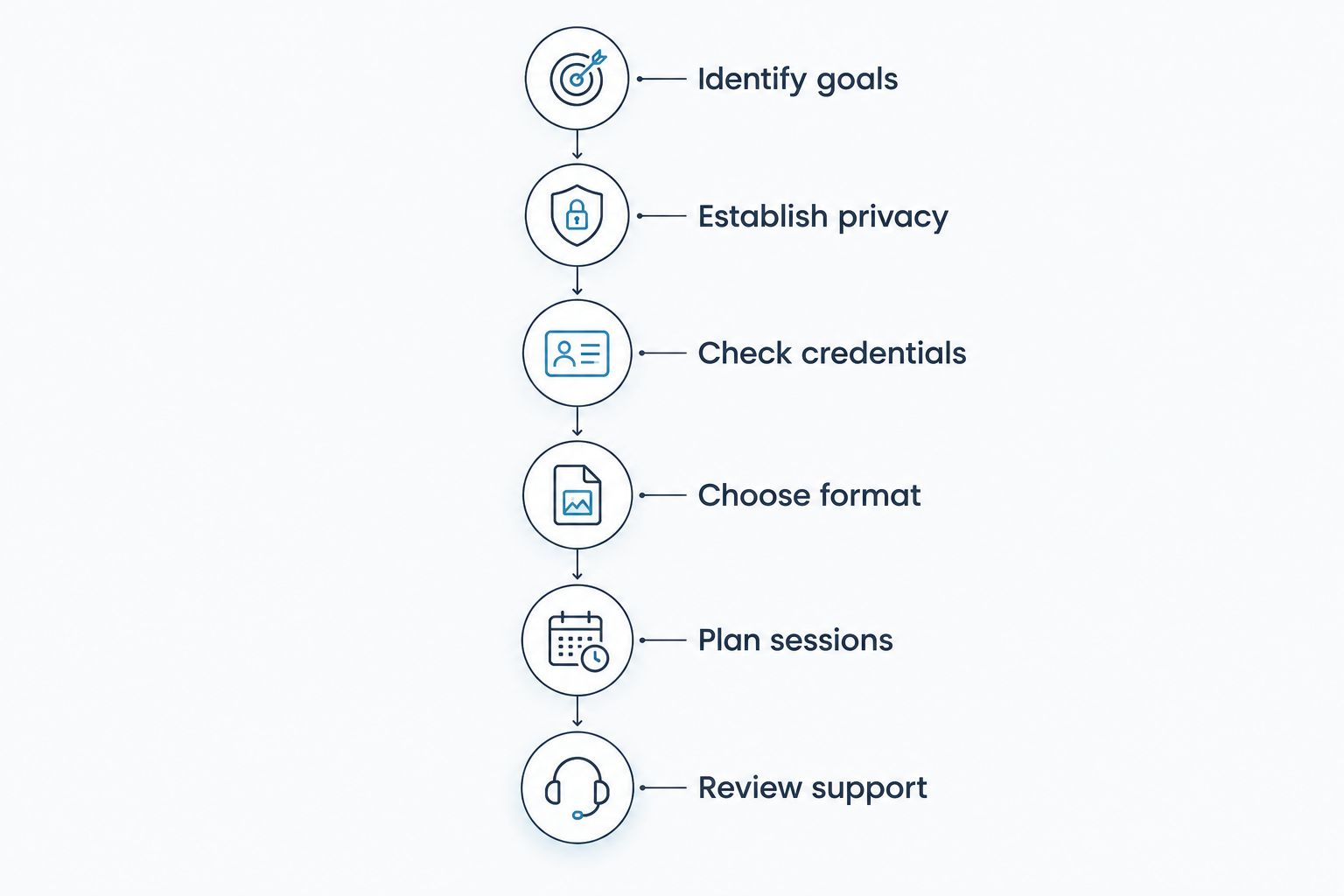
How to arrange online therapy around humanitarian work
Identify what you want help with
Start with a short note in your own words. You might want to discuss sleep after a demanding assignment, grief, relationship strain, difficulty switching off, or uncertainty about returning home. These are conversation starters, not diagnoses, and you do not have to decide which clinical label applies.
Set aside 10 minutes to prepare before contacting a therapist. Describe what is happening, how it affects daily life, and what you want to feel more able to do. A concrete starting point is easier to discuss than a broad instruction to become more resilient.
Keep your personal experience separate from identifiable information about people you support through work. You can describe a difficult interaction without copying case records or naming a beneficiary. Ask the therapist how to discuss sensitive situations while respecting your professional obligations.
- Write down the concern that brought you to therapy.
- Describe changes in sleep, concentration, relationships, or daily routines.
- Choose an initial goal, such as setting clearer work boundaries.
- Remove names and identifying details from your preparation notes.
- Tell the therapist if you want help finding words for the problem.
Establish privacy before involving your employer
Begin by checking the workplace support information you already have. Read any employee assistance or counselling policy, then ask who administers the service and what information reaches the organization. Workplace funding and clinical confidentiality are different questions; neither should be assumed from the other.
Ask 3 questions before you use employer-funded support: who knows you attended, what information is reported, and what exceptions apply to confidentiality. Request a plain-language answer from the provider. Reporting arrangements differ, so a colleague’s experience is not a substitute for checking your own service.
For your 2026 planning checklist, include devices and calendars as well as the room. A private conversation can still leave an appointment notification on a shared screen. Ask the provider about records, messages, and confidentiality limits rather than relying on a general promise of privacy.
- Check whether bookings use a personal or workplace account.
- Ask whether attendance information reaches your employer.
- Ask whether reports contain individual or aggregated information.
- Request an explanation of confidentiality exceptions.
- Review notification previews on shared devices.
- Choose a room where other people cannot overhear you.
Check the therapist’s fit and professional credentials
You can begin manually by making a shortlist and asking each provider the same questions. Check the therapist’s professional registration or licensing details through the relevant regulator where applicable. Ask whether the therapist can work with someone physically located in your country during the session, especially before a cross-border move.
InnerSpark Africa is best suited to people seeking licensed online therapy in Uganda, Kenya, Tanzania and other African countries. The platform connects people with licensed therapists for video, voice, or chat sessions. That provides a route to finding support; it does not replace checking the individual therapist’s fit for your concerns.
You can start your search through InnerSpark Africa. Ask about experience with humanitarian work, languages, and the cultural context you want understood. A therapist does not need to have held your job, but should explain how they would approach the issues you bring.
- Request the therapist’s professional credentials and registration details.
- Explain your current country and any planned relocation.
- Ask about relevant experience with aid work or related concerns.
- State your preferred language for sensitive conversations.
- Ask how you will agree goals and review the working relationship.
- Clarify how to change therapists if the fit is not right.
Match the session format to your working conditions
Before booking, test the setting you will actually use. Check your microphone, headphones, and connection without discussing anything personal. This separates an equipment problem from a therapy decision and helps you identify whether your room is genuinely private.
InnerSpark Africa offers online therapy by video, voice, and chat. Choose the format that supports communication in your circumstances, not the one that looks most complete. Video includes visual cues; voice avoids using a camera; chat uses written messages. Each format has a limitation, and your preference matters.
For a 2026 field assignment, agree a fallback before the session starts. Ask what happens if the connection drops and whether another format is possible. Do not assume chat means immediate replies or that a voice session can automatically replace a video appointment.
- Test the device and connection you plan to use.
- Choose video if visual interaction helps you communicate.
- Choose voice if speaking without a camera feels more comfortable.
- Choose chat if you prefer expressing yourself in writing.
- Ask whether chat happens live or through delayed messages.
- Agree what to do if the connection fails.
Build a schedule that survives assignment changes
Start with your calendar rather than a booking screen. Identify a protected window that includes time to settle before the session and return to work afterwards. Avoid placing therapy between meetings when you know you will feel rushed or interrupted.
For your first 2 weeks of scheduling, mark likely interruptions and discuss them with the therapist. This is a planning exercise, not a deadline for feeling better. Ask how session timing, cancellations, and continuity work when duties change; do not assume a platform has a particular policy.
Keep time zones explicit in your 2026 calendar, especially when you travel. Tell the therapist about a new country before attending from there. A change in physical location can affect whether the therapist can continue working with you, even when the appointment link stays the same.
- Write the appointment time with its time zone.
- Reserve a private room before confirming a session.
- Leave a short buffer before returning to operational duties.
- Ask about rescheduling and cancellation terms.
- Tell the therapist about travel and changing locations.
- Keep work interruptions separate from the session wherever possible.
Agree how to review support and handle urgent needs
You do not need a tracking app to review therapy. A private note about your goals, questions, and what feels useful is enough to begin. Discuss that note with the therapist rather than treating it as a scorecard or proof that you are recovering on schedule.
Ask how you will review the work together. Useful questions include whether you feel understood, whether the goals still fit, and whether you can raise concerns about the sessions. If something is uncomfortable, describe it directly; you can also request another therapist.
Online therapy is not a substitute for immediate emergency help. Ask the therapist what support is available between appointments and how urgent concerns are handled. If you are in immediate danger or cannot keep yourself safe, contact local emergency services or go to the nearest emergency department; do not wait for an online appointment or message reply.
- Agree a simple way to review your goals.
- Note questions you want to raise at the next session.
- Ask how to contact the provider between appointments.
- Clarify whether messages receive scheduled or immediate responses.
- Identify emergency support where you are physically located.
- Discuss a change of therapist when the relationship is not working.
Compare therapy and support options
The best option is the one that meets your clinical needs and practical constraints, not simply the easiest appointment to arrange. Start by deciding whether you want professional therapy or another kind of support. Then compare privacy, professional fit, and continuity.
Use this comparison for a 2026 support plan. Confirm the details with the actual provider: an employer-funded service, independent therapist, and peer group do not share one set of rules.
| Option | Best for | Practical advantage | Key limitation |
|---|---|---|---|
| InnerSpark Africa | People seeking licensed remote therapy across its stated African countries | Video, voice, and chat formats | You still need to confirm therapist fit, location suitability, and session arrangements |
| Independent online therapist | People who want to assess and choose an individual practitioner directly | Direct discussion of credentials, approach, and scheduling | You must establish professional suitability and practical arrangements yourself |
| Employer-funded counselling | Staff whose workplace provides access to professional counselling | A support route connected to an existing staff benefit | Eligibility, reporting, and continuity depend on the actual program |
| In-person therapy | People who prefer sharing a physical room with a therapist | Face-to-face communication without relying on an internet connection | Travel and relocation can make attendance harder to arrange |
| Peer support or staff check-ins | People seeking connection and shared experience | Space to discuss work with others who understand the setting | Peer support does not replace professional therapy or emergency care |
Combining peer connection with therapy is different from asking colleagues to become your therapist. Keep boundaries clear: a staff check-in should not require disclosure of private experiences, and choosing not to share does not prevent you from seeking professional help separately.
Common mistakes NGO and aid workers make
Treating therapy as a fitness-for-duty assessment
Personal therapy and an employer-requested assessment have different purposes. Ask which service you are entering, who receives information, and whether any report is expected. Know the purpose before sharing sensitive details.
If you want support for yourself, say so clearly. Do not assume a service described as staff wellbeing has the same confidentiality arrangements as independently arranged therapy.
Booking from a shared office or accommodation
Headphones help you hear privately; they do not stop other people hearing your voice. A shared room also creates interruptions that can make an already difficult conversation harder.
Check the space at the actual appointment time. If privacy is not available, discuss a different time or format rather than forcing yourself to disclose where others can listen.
Assuming humanitarian experience guarantees a good fit
Relevant experience is useful, but a job label does not tell you whether a therapist understands your concerns or communicates in a way that works for you. Ask about approach, credentials, and the issues you want to discuss.
Notice whether you can ask questions and disagree without feeling dismissed. Professional fit includes the working relationship, not only experience listed in a profile.
Waiting for the assignment to end
Returning home does not automatically create time, privacy, or an easy transition. If you want support now, explore an appointment that fits your present circumstances instead of making the end of a deployment your only starting point.
Plan continuity before leaving. Tell the therapist where you will be and ask what needs to change, including time zones and location-related professional requirements.
FAQ
What is online therapy for NGO and aid workers?
Online therapy for NGO and aid workers is professional counselling delivered remotely to support emotional wellbeing alongside humanitarian work. Sessions can address personal concerns, work-related stress, relationships, or transitions without requiring travel to a therapy room.
Is InnerSpark Africa suitable for aid workers based in East Africa?
InnerSpark Africa connects people in Uganda, Kenya, Tanzania and other African countries with licensed therapists for video, voice or chat sessions. Ask about the individual therapist’s relevant experience, preferred languages, and ability to work with you in your current location.
Will my NGO know what I tell my therapist?
Ask the provider exactly what information reaches your NGO before starting employer-funded therapy. Attendance reporting, clinical information, and confidentiality exceptions depend on the service arrangements; request a clear explanation rather than assuming nothing is shared.
Is video therapy better than voice or chat for aid workers?
The best format depends on how you prefer to communicate and whether you have privacy and a suitable connection. Video includes visual cues, voice avoids a camera, and chat uses writing; ask how the chosen format works before booking.
Can I continue online therapy when I move to another country?
Confirm this with your therapist before moving, because your physical location affects professional practice requirements. Discuss the destination country, time zone, and any changes needed for continuity before the next appointment.
What should I prepare for my first online therapy session?
Prepare a short description of your concerns, an initial goal, and questions about confidentiality and the therapist’s approach. Test your device and arrange a private space without bringing identifiable beneficiary records into the session.
What should I do if I need urgent help during a deployment?
If you are in immediate danger or cannot keep yourself safe, contact local emergency services or go to the nearest emergency department. Do not wait for an online therapy appointment or message reply; establish local emergency options before you need them.
One last thing
Your first therapy conversation does not need to include your hardest experience. You can begin by asking how confidentiality works, explaining your schedule, and saying what would help you feel comfortable enough to talk.
For your 2026 next step, book a licensed therapist through InnerSpark Africa when you feel ready. Bring your questions about privacy, location, and format; choosing support does not require having every answer first.