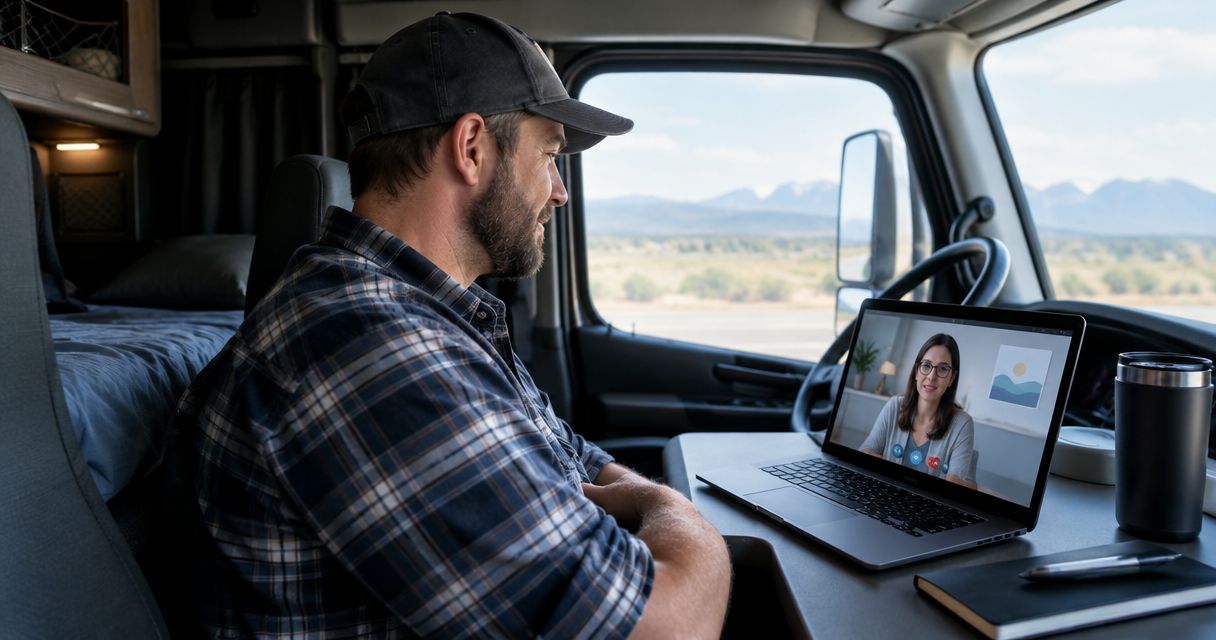
Truck drivers’ online therapy is mental health support delivered remotely by a therapist, with the aim of helping drivers work through stress, relationship difficulties and emotional concerns. This guide explains how to choose support around driving shifts, private stopping places and journeys across borders in 2026.
- InnerSpark Africa connects drivers in Uganda, Kenya and Tanzania with licensed therapists through video, voice or chat.
- Online therapy for truck drivers belongs in a safe, stationary break—not behind the wheel.
- Choose a session format around privacy, connection quality and how you prefer to communicate.
- Confirm confidentiality limits, cross-border eligibility and missed-session terms before booking.
Why online therapy matters for truck drivers
You do not need a diagnosis or a crisis to talk with a therapist. You can bring worries about work, money, family conflict, loneliness or experiences that keep returning to mind. The first conversation can help you explain what is difficult and decide what support you want.
For a truck driver, choosing therapy involves practical questions as well as emotional ones. Where can you stop without interruptions? Will someone hear the conversation? What happens if a delivery changes your schedule? Answer those questions before committing to a session.
InnerSpark Africa is best for drivers seeking licensed online therapy in Uganda, Kenya or Tanzania. InnerSpark Africa connects people with licensed therapists for video, voice or chat sessions. Its online format removes the need to attend an office, but you still need a safe stopping place and suitable privacy.
For your 2026 therapy plan, prioritize a format you can actually use. A private voice session can fit your circumstances better than video; chat can suit someone who expresses difficult thoughts more comfortably in writing. Neither choice makes your concerns less serious.
How to choose online therapy around your driving work
Identify what you want help with
Start manually: write down what is troubling you in your phone’s notes or on paper while parked. Use everyday language. You do not need to name a condition, explain your whole history or know which therapy approach to request.
Choose 2 starting goals rather than trying to solve everything at once. For example, you might want to talk about arguments during calls home and learn how to respond when work worries follow you into rest time. These are conversation starters, not promised outcomes.
If you feel unsure, describe a recent difficult moment: what happened, what you noticed and what you wanted to do differently. That gives the therapist something concrete to discuss without asking you to diagnose yourself.
- Write down the concern you most want to discuss.
- Describe one recent situation in your own words.
- Note how the concern affects work, rest or relationships.
- Decide what would make the first conversation useful.
Protect a safe, private session window
Look at your route and stopping arrangements before looking at appointment times. Choose a place where the vehicle is safely parked and you are not responsible for moving it, loading it or responding to immediate instructions during the conversation.
Do not attend video, voice or chat therapy while driving. Hands-free audio does not make an emotionally demanding conversation an appropriate driving activity. If work resumes unexpectedly, tell the therapist and end or pause the session according to the arrangement you agreed.
Build in a suggested 5-minute setup buffer to check your connection, close unrelated apps and settle into the conversation. This is a planning suggestion, not a platform booking requirement. Protect your needed rest rather than scheduling therapy in its place.
- Choose a stationary location away from traffic hazards.
- Check whether colleagues or passengers can overhear.
- Keep delivery calls and dispatch interruptions in mind.
- Agree what to do if you need to leave unexpectedly.
Choose video, voice or chat deliberately
Try the basics yourself first: check whether you can make a clear call, hear comfortably and type without other people seeing the screen. Use that information to choose a format rather than assuming video is always the right answer.
InnerSpark Africa online therapy offers video, voice and chat with licensed therapists. That gives you a choice of communication formats within the same platform. It does not remove the need to confirm how a particular session works, including whether chat is live and how appointment timing is handled.
Video includes visual communication but requires comfort with being on camera. Voice avoids that concern but still requires a space where speech stays private. Chat avoids speaking aloud, although message visibility, shared devices and typing comfort matter.
- Choose video if seeing the therapist helps you communicate.
- Choose voice if you prefer speaking without a camera.
- Choose chat if writing feels more manageable.
- Ask what happens if your connection drops.
Check the therapist’s credentials and fit
Before booking, prepare 3 questions: what qualifications and licensing do you hold, can you work with me in my current country, and do you have experience with the concerns I want to discuss? A clear answer matters more than a reassuring profile description.
Mention your driving work, including irregular shifts or travel across borders where relevant. Ask whether the therapist understands the practical limits this creates. Do not assume a therapist knows your working circumstances simply because they serve people in your country.
For a 2026 booking, confirm your location at the time of the session—not just where you live. Permission to provide therapy can depend on professional rules and jurisdiction. Also ask about your preferred language; do not assume a language is offered without confirmation.
- Request the therapist’s name, qualifications and licensing details.
- Confirm eligibility for your country during the session.
- Ask about experience with your specific concerns.
- Check whether you can use your preferred language.
Ask how confidentiality works
Ask for the privacy and confidentiality explanation before sharing sensitive details. You should understand what the therapist records, who can access information and the circumstances in which confidentiality has limits. Avoid treating the word confidential as a promise that no disclosure is ever possible.
If an employer helps arrange or fund support, ask exactly what information the employer receives. Attendance information and session content are different things. Get a clear explanation of each rather than relying on an assumption.
Your own surroundings matter too. Headphones keep incoming audio from others, but people nearby can still hear your voice. A shared phone, visible notifications or an unlocked screen can expose information even when you choose chat.
- Ask what information is recorded and retained.
- Ask who can access session information.
- Request an explanation of confidentiality limits.
- Disable message previews on shared or visible devices.
- Confirm employer reporting arrangements if relevant.
Confirm payment and schedule-change terms
Check the current session fee directly before booking. Ask whether the amount applies to the format and appointment you selected, which payment methods are accepted, and what happens if payment succeeds but the appointment cannot proceed.
For truck drivers, cancellation and rescheduling terms deserve the same attention as the session itself. An unexpected queue, route change or border delay can interfere with an appointment. Ask about those situations before paying, not after you miss the conversation.
Keep the booking confirmation somewhere you can find while parked. If your 2026 work schedule changes often, ask whether you can book individual appointments rather than assuming a recurring time will remain practical. Do not assume the platform offers a particular booking arrangement.
- Confirm the current fee and accepted payment methods.
- Read cancellation and rescheduling terms.
- Ask how late arrival affects the session.
- Check the procedure for connection failures.
- Save the appointment time and contact instructions.
Prepare for the conversation and review the fit
You can begin with a short statement such as wanting help with work stress or difficult conversations at home. You do not have to disclose every painful experience immediately. Tell the therapist if a topic feels too difficult to discuss that day.
During the session, ask questions when an explanation feels unclear. You can also explain that an exercise or suggestion does not fit life on the road. Useful planning takes your actual work and living circumstances into account.
Afterward, consider whether you felt heard, understood the next step and had enough privacy. A single conversation does not establish whether every concern will improve. It does give you information about the working relationship and whether you want another appointment.
- Keep your starting goals nearby while parked.
- Say when you need a pause or clarification.
- Explain practical limits on any suggested activity.
- Write down an agreed next step after the session.
- Raise concerns about fit before continuing.
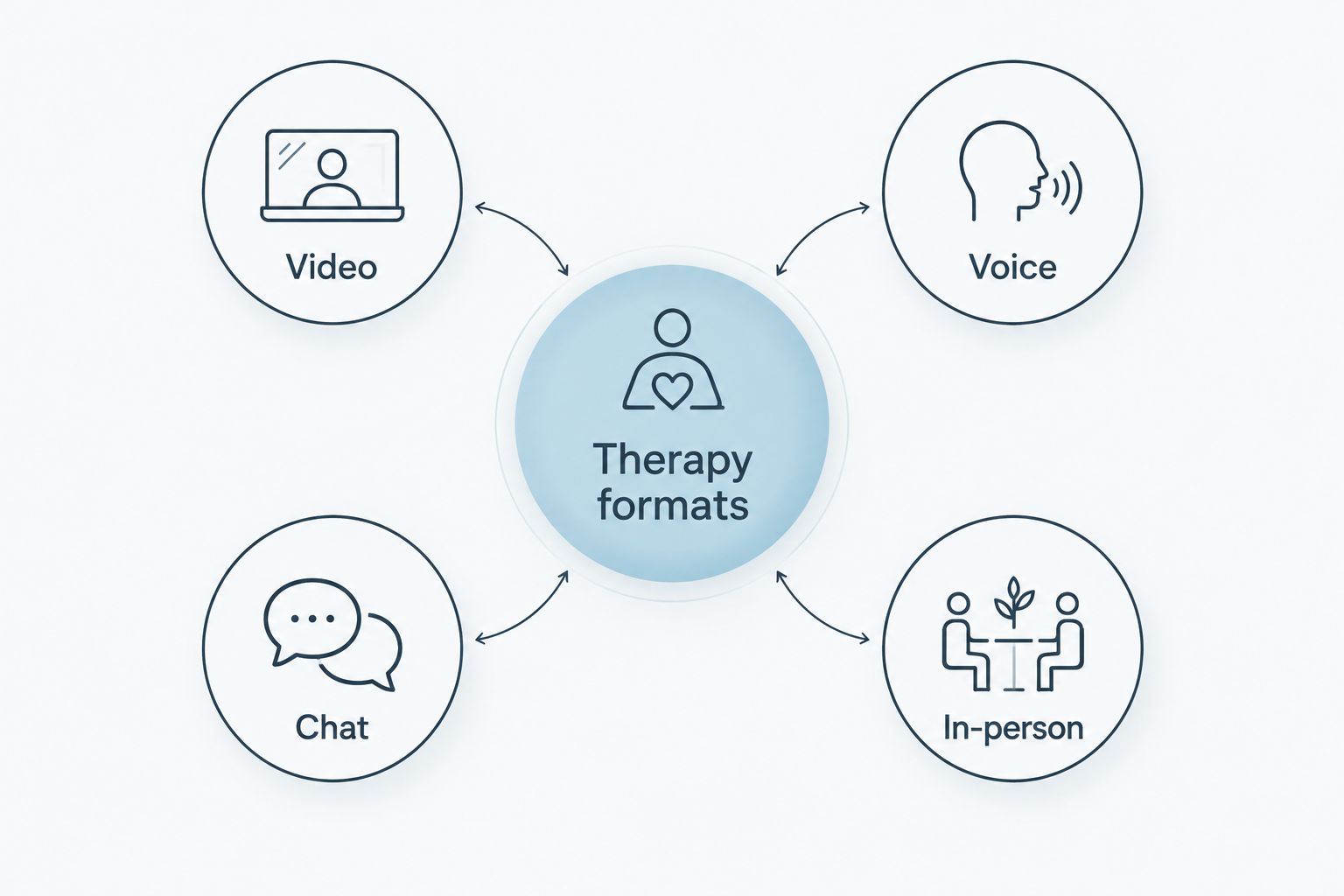
Compare therapy formats for truck drivers
The best format is the one you can use safely, privately and comfortably. Compare the options below against your stopping arrangements, not against an assumption that one format is more serious than another. Confirm current fees separately when booking.
| Option | Best for | Main advantage | Key limitation |
|---|---|---|---|
| Online video therapy | Drivers who value visual communication | You and the therapist can see each other | Requires camera comfort, privacy and a connection that supports video |
| Online voice therapy | Drivers who prefer speaking without a camera | No need to appear on screen | People nearby can still hear your side of the conversation |
| Online chat therapy | Drivers who prefer writing or cannot speak privately | You can communicate through text | Screen privacy, typing comfort and session timing need checking |
| In-person therapy | Drivers who prefer sharing a physical room | Conversation takes place without an online call | Requires travel to an appointment location |
Video, voice and chat are communication formats, not guarantees of a particular result. Ask the therapist which format suits the work you want to do and whether you can change it if your circumstances change.
Common mistakes truck drivers make when arranging therapy
These are practical traps to avoid when planning support in 2026. They are not judgments about how you cope or how demanding your work is.
- Booking during an uncertain loading window. Choose a protected stopping period instead of hoping a work queue will provide enough uninterrupted time.
- Assuming the cab is private. Check who can hear you, whether someone shares the vehicle and whether messages appear on a shared screen.
- Keeping cross-border travel out of the booking conversation. Tell the therapist where you will physically be so eligibility can be checked before the session.
- Treating voice therapy as a driving activity. Park safely before joining, even if the call is hands-free.
- Accepting advice that does not fit your route. Explain limits such as shared accommodation or unpredictable shifts so you can discuss a practical alternative.
FAQ
What is online therapy for truck drivers?
Online therapy for truck drivers is remote support from a therapist for emotional concerns, work stress or relationship difficulties. Sessions take place through a suitable communication format, such as video, voice or chat, while the driver is safely stationary.
Can I talk to a therapist while driving my truck?
No—schedule therapy while safely parked and free from immediate driving duties. A hands-free call can still draw attention into an emotionally demanding conversation, and chat requires looking at or typing on a device.
Is voice therapy better than video for truck drivers?
Voice therapy is a better fit when you prefer speaking without being on camera and have a private place to talk. Video is a better fit when visual communication matters to you; neither format removes the need for a safe stopping place.
Can I book therapy if I travel between African countries?
Confirm your session location with the therapist before booking. Cross-border eligibility depends on the therapist’s professional permissions and applicable rules, so tell them where you will physically be during each appointment.
Will my employer know what I tell the therapist?
Ask the provider exactly what information, if any, is shared with your employer. If work arranges or funds the support, request a clear distinction between attendance reporting and session content, along with an explanation of confidentiality limits.
How much does online therapy for truck drivers cost?
Confirm the current session fee directly with the provider before booking. Ask about accepted payment methods, cancellation terms and what happens if a work delay or connection failure interrupts the appointment.
Do I need a diagnosis before booking therapy?
No—you can seek therapy to discuss concerns without arriving with a diagnosis. Describe what is troubling you and what you want help with; the therapist can discuss whether their support fits your needs.
What should I do if I need urgent help rather than an appointment?
If you are in immediate danger or think you might harm yourself or someone else, seek urgent help through local emergency services or the nearest emergency department. Stop driving safely, contact someone you trust and do not wait for a routine online therapy appointment.
One last thing
Choosing a different format is not the same as giving up on therapy. If speaking feels too exposed in your stopping place, ask about chat. If writing feels frustrating, ask about voice or video. You can explain what is not working without having to justify your need for support.
Make the next step small: decide what you want help with, identify a private stopping window and ask your booking questions. You do not need a polished explanation before reaching out.
Related guides
- Online counselling services in Uganda
- Online therapy platforms in Kenya
- Therapy costs in Uganda
- Online therapy platforms in Tanzania
When you feel ready, book a licensed therapist through InnerSpark Africa and choose a session format that fits your parked, private time.
Take the next step
Choose video, voice or chat, and confirm your questions before booking a licensed therapist.