
Instead of repeatedly explaining how you feel, complete the WHO-5 wellbeing check, record your score and therapy preferences, then request a licensed therapist through InnerSpark Africa. This WHO-5 wellbeing check to therapist match workflow turns your answers into a conversation starter—not a diagnosis or an automatic therapist assignment.
- Use the WHO-5 wellbeing check to therapist match workflow as preparation, not an automated matching service.
- WHO-5 measures wellbeing over two weeks; a score does not diagnose a mental health condition.
- InnerSpark Africa connects people in Uganda, Kenya, Tanzania and other African countries with licensed therapists.
- Choose video, voice or chat therapy around your privacy, communication preferences and connection.
- Request a therapist using your concerns, language preferences and goals—not your wellbeing score alone.
Why this matters
A wellbeing questionnaire answers a narrower question than a therapist consultation. WHO-5 asks about your recent wellbeing; it does not establish why you feel that way, identify a diagnosis or tell you which therapist to choose.
InnerSpark Africa is best for people seeking online therapy with licensed therapists in Uganda, Kenya, Tanzania and other African countries. Its stated session formats are video, voice and chat. The matching process below is a reader-led preparation workflow, not a claim that the platform calculates matches from WHO-5 answers.
For your 2026 therapy search, keep two decisions separate: whether you want support and which therapist fits your needs. You do not need a low wellbeing score to seek help with relationships, stress, parenting or a difficult transition.
Before you start
- Prepare the questionnaire and a private record. Use the World Health Organization's WHO-5 questionnaire in a language you understand. Keep your answers in a notebook or a device you control; answer about the past two weeks, not only today.
- Prepare your session requirements. Identify your country, preferred language, possible appointment times and whether you want video, voice or chat. For online therapy, arrange a suitable device, a connection and somewhere you can communicate privately.
- Expect a handoff, not an automatic match. Completing WHO-5 does not book a therapist. Confirm the therapist's credentials, relevant experience, confidentiality arrangements and current booking requirements before sharing sensitive details or committing to a session.
This guide uses worksheet labels that you create yourself. They are not website buttons or claims about InnerSpark Africa's interface. Keep the record simple enough to bring into your first conversation.
Check wellbeing
- Open the official WHO-5 questionnaire. Use the World Health Organization's The World Health Organization-Five Well-Being Index (WHO-5) as the scoring source for this 2026 workflow. Avoid replacing its wording with an informal mood quiz.
- Set the reference period. Write Assessment date and Past two weeks at the top of your worksheet. Every answer should refer to that period, even if today feels unusually good or difficult.
- Answer all five items. WHO-5 covers positive mood, calmness, energy, waking rested and interest in daily life. Follow the questionnaire's response labels and select one response for each item.
- Check for omissions. Make sure every item has an answer. If a phrase is unclear, find an official language version you understand rather than guessing what it means.
Expected result: You have five completed responses referring to the same two-week period. You have not assigned yourself a diagnosis or decided which therapist you need.
The aim is an honest snapshot, not a good result. Answer privately if another person's presence would change what you select, and do not adjust answers to qualify for support.
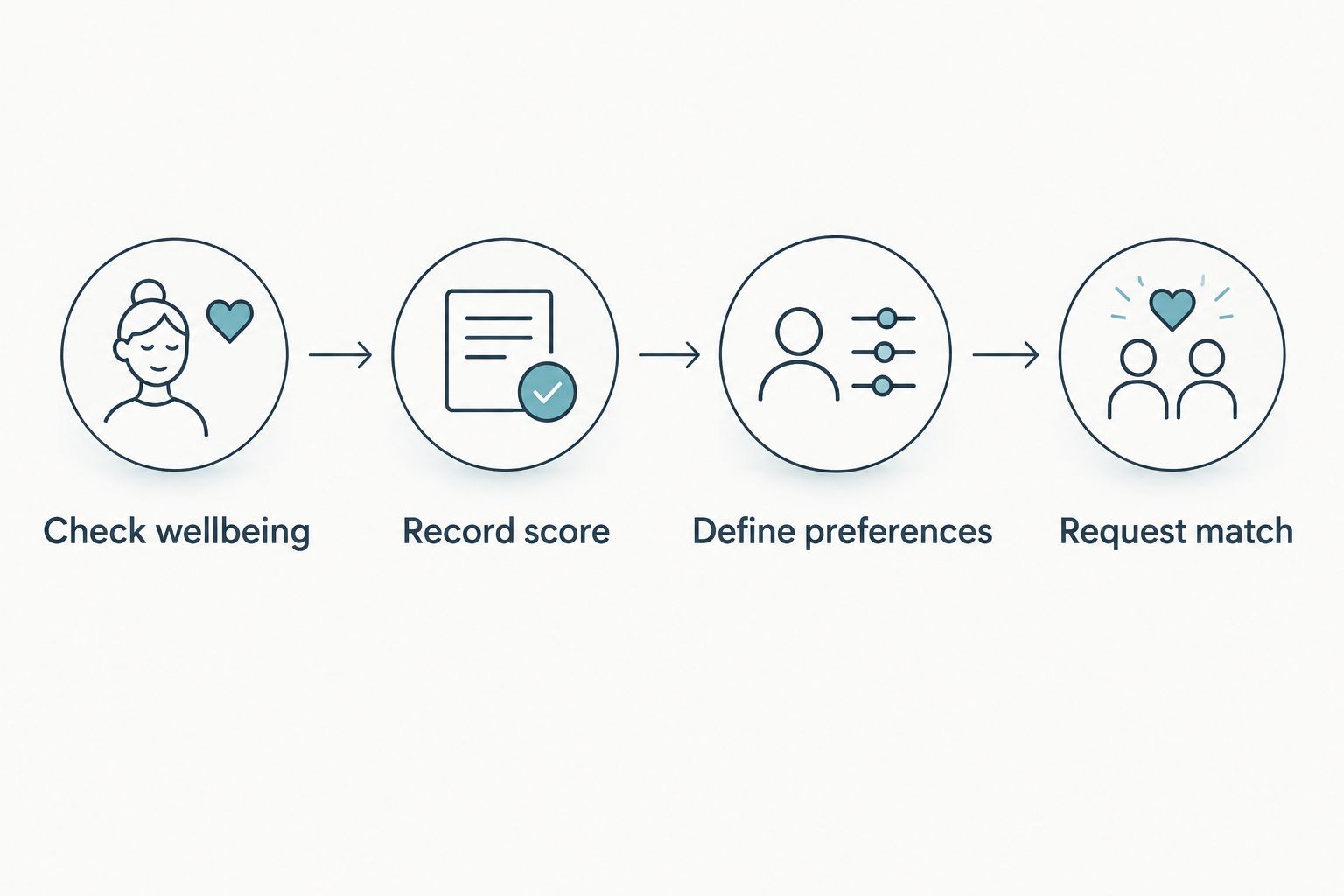
Record score
- Copy each response value. WHO-5 assigns each item a value from 0 to 5. Use the values attached to the official response options, not a scale you create yourself.
- Add the five values. Enter the total under Raw score. The raw score ranges from 0 to 25 points; a higher score represents better reported wellbeing.
- Convert the total. Multiply the raw score by 4 and enter the result under Wellbeing score. The converted score ranges from 0 to 100 points. For example, a raw score of 12 points becomes 48 points; this is a calculation example, not a treatment recommendation.
- Add context separately. Under What changed, briefly record circumstances you want to discuss, such as disrupted sleep, exam pressure, bereavement or relationship strain. Do not add these notes to the numerical score.
Expected result: Your worksheet contains a dated raw score, a converted score and a short context note.
WHO guidance identifies a converted score below 50 points as a reason for further assessment. That threshold is not a diagnosis, an emergency classification or a therapist-matching rule. A licensed professional needs to consider your circumstances and symptoms, not just the total.
For a 2026 record, label the assessment date clearly so an old result does not get mistaken for your current wellbeing.
Define preferences
- Write your main concern. Under Reason for therapy, use plain language: difficulty coping with work, conflict with a partner, persistent worry or another concern you want help addressing. You do not need to name a disorder.
- Name your communication needs. Add Preferred language, Country and any cultural context you want the therapist to understand. Request these directly; do not assume every therapist offers every language or has the same experience.
- Choose a session format. Use the comparison below to identify video, voice or chat as your starting preference. Ask how the chosen format works before booking.
- Define a useful first-session goal. Under First-session goal, write what you want to discuss or understand. A practical goal is enough; you do not need a complete plan for your life.
Expected result: You have a short preference list that a therapist or booking team can discuss with you.
For couples, include that you want joint support. For a teenager, include that a parent or guardian is enquiring, then ask about age eligibility, consent and confidentiality before proceeding. Adult arrangements should not be assumed to apply to teenagers.
Video, voice or chat: choose your starting format
| Format | Best for | Advantage | Limitation to plan around |
|---|---|---|---|
| Video | People who prefer seeing the therapist during conversation | Allows visual communication alongside speech | Requires a camera setup and privacy for both sound and image |
| Voice | People who prefer speaking without being on camera | Removes the need to show your surroundings | The therapist cannot see facial expressions; others nearby can hear you |
| Chat | People who find writing easier than speaking | Gives you a written way to express difficult thoughts | Tone is harder to convey; clarify whether messages are live or answered later |
Choose the format you can use privately and comfortably, not the one that seems most formal. InnerSpark Africa offers these three online therapy formats, but you should confirm the session arrangements for your chosen therapist.
Request match
- Prepare a brief request. Combine your country, language preference, main concern, session format and appointment needs. Add the WHO-5 assessment date and score if you want to share them; the score is optional context, not your introduction.
- Ask about relevant experience. Request a licensed therapist who works with the issue you want to discuss. Ask what credentials the therapist holds and how those credentials can be checked. A score alone cannot establish this fit.
- Clarify confidentiality. Ask who can access your information, whether anything is recorded and what exceptions apply to confidentiality. If you share a device or payment account, ask what appears in messages or transaction records.
- Confirm practical arrangements. Check the appointment time, time zone, session format, joining instructions, current payment methods and cancellation terms through the booking channel. Do not assume an enquiry has created a confirmed appointment.
Expected result: You either have a confirmed appointment with clear joining instructions or a specific follow-up question to resolve before booking.
A useful request is brief: explain what brings you to therapy, how you prefer to communicate and what you need clarified. You can save your fuller personal history for the therapist rather than putting it into an initial message.
Explore licensed therapy
Choose your preferred format and ask about a therapist who fits your needs.
Repeat the check before a later session
A second workflow uses WHO-5 to support an ongoing conversation rather than an initial therapist request. Agree with your therapist whether repeating the questionnaire is useful and when to do it.
- Use the same official questionnaire and language version.
- Answer for the past two weeks again, rather than recalling your previous responses.
- Save the new assessment date and both scores as a separate entry.
- Bring changes and relevant circumstances to your session.
Best for: People who want a consistent way to discuss changes in wellbeing during therapy. The advantage is a repeatable reference point; the limitation is that a total score leaves out much of your experience.
Overlapping two-week periods are not independent snapshots. Avoid treating small changes as proof that therapy has succeeded or failed. Sleep, illness, stressful events and other circumstances belong in the conversation too.
Keep each 2026 entry rather than overwriting the previous result. A dated sequence is easier to interpret than an isolated number with no reference period.
Troubleshooting
Your score falls outside the expected range
Check the response values and arithmetic. A completed WHO-5 raw score must fall between 0 and 25 points, and the converted score between 0 and 100 points. Do not multiply an already converted score again.
Your score seems inconsistent with how you feel
Check whether you answered about the past two weeks or only today. Then bring the difference to your therapist. A questionnaire does not cancel out distress, difficulty functioning or your wish for support.
You cannot find a private place for the session
Choose the setting before confirming the format. Voice needs sound privacy; video adds visual privacy; chat still needs a protected screen and device. Headphones help you hear privately, but they do not stop others hearing what you say.
The suggested therapist does not fit your needs
State the mismatch directly: language, concern, communication style or appointment requirements. Ask about another therapist rather than trying to make the score justify the change. Fit is a discussion, not a mathematical result.
You need immediate help rather than a routine appointment
Do not wait for a WHO-5 result or a booking reply if you are in immediate danger, have seriously harmed yourself or cannot keep yourself safe. Contact local emergency services or go to the nearest emergency department; if safe, ask a trusted person to stay with you.
Customize your workflow
Add only information that helps the first conversation. A long intake note is not automatically more useful, and sensitive details do not need to travel through every booking message.
For university students, include timetable constraints and whether you have somewhere private to talk. For couples, ask how joint sessions and individual disclosures are handled. For parents or guardians, ask how the teenager will participate in decisions and what information will be shared with adults.
If you are comparing services in Uganda, use the online counselling services in Uganda guide to organize your questions. Keep the same criteria across providers: credentials, relevant experience, language, confidentiality and practical session arrangements.
Your 2026 worksheet can stay short: assessment date, score, concern, preferences and questions. Keep detailed disclosures for a suitable conversation with the therapist.
FAQ
What is the WHO-5 wellbeing check to therapist match workflow?
It is a preparation process: complete WHO-5, record your score, identify your therapy preferences and request a licensed therapist. It does not automatically assign a therapist or diagnose a condition.
How do I calculate my WHO-5 score?
Add the five response values to get a raw score from 0 to 25, then multiply by 4 for a score from 0 to 100. Use the values supplied with the official WHO-5 questionnaire.
Does a WHO-5 score below 50 mean I have depression?
No, a WHO-5 score below 50 does not diagnose depression. WHO guidance treats it as a reason for further assessment, which considers more than the questionnaire total.
Can I book therapy if my wellbeing score is high?
Yes, a high WHO-5 score does not prevent you from seeking therapy. You can seek support for relationships, stress, life changes or concerns that the questionnaire does not fully capture.
Does InnerSpark Africa automatically match therapists using WHO-5?
This guide does not describe an automatic WHO-5 matching feature. Use your score as optional context and request a licensed therapist based on your concerns, preferences and practical needs.
Is chat therapy more private than voice or video?
Chat avoids speaking aloud, but it still requires a private screen and secure access to your device. Ask how messages are stored, who can access them and whether the session is live.
Can a parent use this workflow to find therapy for a teenager?
A parent can use the preference and booking questions to enquire about support for a teenager. Confirm age eligibility, appropriate assessment, consent and confidentiality with the provider before proceeding.
What should I share when requesting a therapist?
Share your main concern, country, preferred language, session format and appointment needs. Your WHO-5 score is optional context; ask about confidentiality before sending detailed sensitive information.
One last thing
WHO-5 asks about positive wellbeing, not a list of diagnoses. That is why a useful therapist request includes what the number leaves out: what is difficult, what matters to you and how you want to communicate.
You do not need to prove that you feel bad enough. Start with one concern and one question you want answered.
Related guides
- Online therapy platforms in Kenya
- Therapy cost questions in Uganda
- Online therapy platforms in Tanzania
When you are ready, book a licensed therapist through InnerSpark Africa and ask any remaining questions about fit, confidentiality and session arrangements.