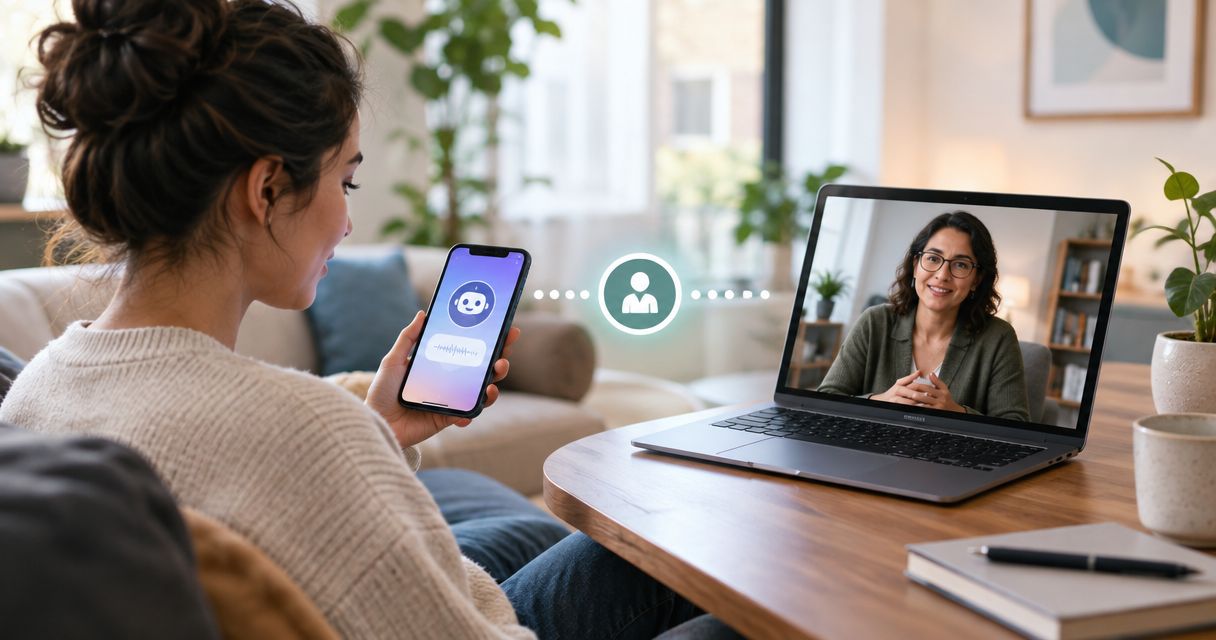
Instead of repeatedly explaining your Amani AI check-ins, prepare a short summary, choose a licensed therapist through InnerSpark Africa, and ask how to share it before your appointment. This amani ai to human therapist workflow uses a manual, consent-based handoff: you choose what to share, and the therapist brings human judgement to the conversation.
- The amani ai to human therapist workflow starts with a summary you review, not an assumed automatic transfer.
- InnerSpark Africa connects people with licensed therapists for video, voice or chat therapy.
- Share selected concerns through the therapist’s agreed channel; keep unrelated personal details out.
- AI check-ins do not replace clinical assessment or emergency help.
Why this matters
A check-in can give you something concrete to discuss, but a transcript is not the same as a clinical assessment. Your therapist needs your account of what is happening, what affects daily life, and what you want help with—not just a generated interpretation.
InnerSpark Africa is best for people seeking licensed online therapy by video, voice or chat. The platform connects people in Uganda, Kenya, Tanzania and other African countries with licensed therapists. The benefit is access to a human conversation; the practical limitation is that you still need to confirm therapist fit, session arrangements and how information will be shared.
For this 2026 workflow, treat the check-in as preparation. Do not treat an AI response as a diagnosis, a referral decision or permission to delay urgent care.
Before you start
- Have your check-in material ready. Use notes you can already access, or write a summary from memory. You do not need an export function, a connected account or your entire conversation history to explain your concern.
- Prepare your booking details. Have a suitable device, an internet connection, your preferred session format and a private place to talk. Ask about the therapist’s credentials, language, local context and experience with your concern before committing.
- Agree on the sharing channel first. Do not assume that booking transfers Amani history to the therapist. Ask where to send notes, who can access them and whether they become part of your therapy record. Remove other people’s identifying details before sharing.
If you are arranging support for a teenager, ask about consent requirements, guardian involvement and confidentiality before sending check-in notes. Do not promise a teenager that everything will remain secret; the clinician needs to explain the relevant boundaries.
If you are in immediate danger, have seriously harmed yourself or cannot keep yourself safe, seek urgent local help rather than waiting for this workflow. Contact local emergency services or go to the nearest emergency department. Ask a trusted person to stay with you while you seek help.
Check-in summary
Your first configuration task is not connecting software. It is creating a small, accurate handoff that you understand and choose to share.
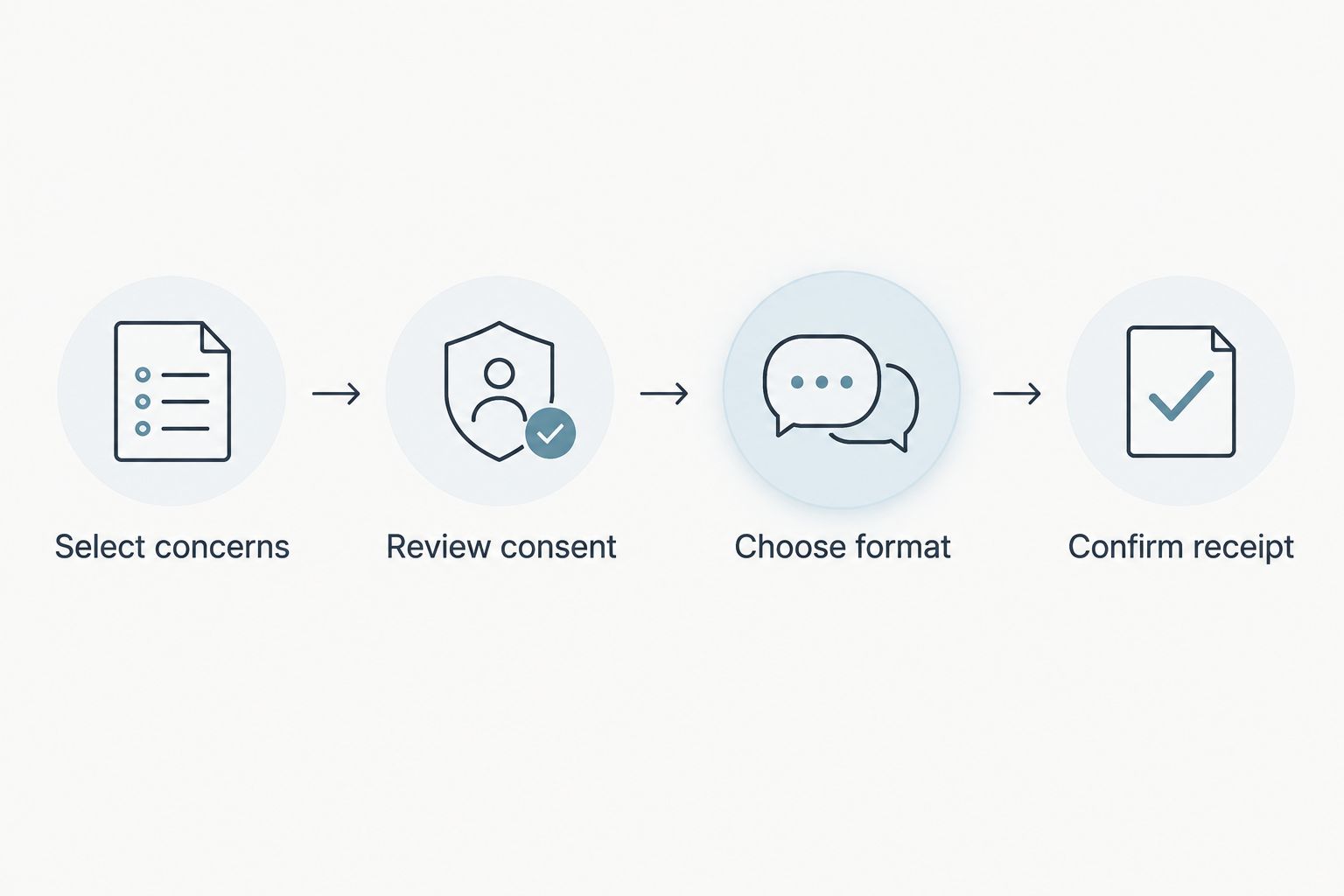
- Select concerns. Read the material you want to discuss and identify what matters now. Focus on experiences such as disrupted sleep, recurring worry, relationship strain or difficulty managing university work. Leave out unrelated conversations.
- Write your summary. Use 3 sentences as a starting structure: what has been happening, how it affects daily life, and what you want help with. This is a suggested writing format, not a clinical scoring system.
- Separate observations from interpretations. Describe what you experienced in your own words. If Amani supplied a label or explanation, identify it as generated text rather than presenting it as an established fact.
- Review consent. Remove information you do not want to share yet, including unnecessary names, contact details or identifying details about another person. Keep the fuller notes for yourself if they help you remember.
For example, a student’s draft might explain that worry is interrupting sleep, concentration is slipping during lectures, and they want help managing the pressure. That tells the therapist where to begin without assigning a diagnosis or exposing an entire chat history.
Expected result: you have a readable summary that accurately reflects your experience. You can explain each sentence without relying on an AI interpretation.
The following diagram shows the handoff sequence. Each stage requires your involvement; none implies that your notes move automatically between accounts.
Therapist and session setup
Choose a therapist and communication format around your needs, not around the length or tone of the check-in response. InnerSpark Africa offers online therapy by video, voice or chat; confirm which format applies to the appointment you are arranging.
- Choose format. Decide whether you want to speak on camera, talk without video or write. Use the comparison below to identify the practical trade-off that matters most to you.
- Check therapist fit. Ask about the therapist’s licensing, experience with your concern, languages used in sessions and familiarity with your local context. A platform’s service description does not answer every question about an individual clinician.
- Confirm appointment details. Verify the appointment date, local time, session format and joining instructions. If you and the therapist are in different countries, explicitly confirm the time zone.
- Ask about confidentiality. Request an explanation of who can access shared notes, how records are handled and the circumstances in which confidentiality has limits. Make this part of the conversation, not an assumption.
| Session format | Best for | Practical advantage | Practical limitation |
|---|---|---|---|
| Video therapy | People who want face-to-face interaction online | You and the therapist can see each other while speaking | You need a suitable camera setup and privacy on screen |
| Voice therapy | People who prefer speaking without appearing on camera | You can discuss concerns without sharing video | Visual expressions are not part of the conversation |
| Chat therapy | People who find writing easier than speaking | You can express concerns in written messages | Tone needs extra explanation; confirm whether the session is live |
Expected result: you know who you are meeting, how you will communicate and when the appointment takes place. You have also identified any unanswered confidentiality questions.
For appointments arranged in 2026, check the current instructions you receive rather than relying on an old screenshot or remembered booking process. Do not search for a particular integration button as a prerequisite: this handoff works through a summary and an agreed communication channel.
Consent and information sharing
A useful handoff gives the therapist context without surrendering control over your personal information. Share the minimum relevant material first, then discuss whether more context would help.
- Ask for the channel. Contact the therapist or booking support using the route provided during booking. Ask how to share pre-session notes and whether the therapist reviews them before appointments.
- Explain the source. Say that the summary comes from your own reflections and Amani AI check-ins. Identify any generated text you include so it is not mistaken for a clinician’s assessment.
- State your boundaries. Explain what you are comfortable discussing and what you prefer to keep for the session. Ask how your information will be stored and used.
- Confirm receipt. Check whether the notes arrived and whether the therapist expects to read them before you meet. If that is not part of the arrangement, bring the summary to the session instead.
Do not send passwords, account access codes or another person’s private messages to make the handoff work. A therapist can discuss your experience without access to your Amani account.
If you prefer not to send anything beforehand, say so. Reading your summary aloud or describing it during the appointment remains a valid way to start.
Expected result: you know what you shared, where you sent it and whether it will be reviewed beforehand. The appointment can still proceed if you choose to discuss the notes only in person online.
First-session discussion
The final setup task is turning the summary into a conversation. The therapist should hear your experience, not simply receive a block of generated text.
- Describe the concern. Begin with the issue that matters most today. Explain what happens, when you notice it and how it affects your daily life.
- Add useful context. Mention relevant changes in sleep, study, work, relationships or health. Distinguish your own observations from suggestions made during an AI check-in.
- Choose a goal. Bring 1 opening question, such as wanting help understanding a recurring pattern or finding ways to manage a difficult situation. You do not need a polished explanation.
- Agree on follow-up. Ask what to notice between sessions, whether written notes would help and how to raise a concern before the next appointment. Confirm the communication boundaries rather than assuming ongoing messaging is included.
Expected result: you and the therapist have a shared starting point and an agreed next step. The aim is not to prove that the AI was right; it is to help a licensed professional understand you.
For a broader preparation route, the Mind Check to Therapist Booking workflow covers the adjacent move from a check-in to an appointment.
Share an update after another check-in
The same process works when a later check-in helps you notice something new. Use this variant to prepare for an existing appointment, not to create an unconfirmed monitoring arrangement.
Write 2 short notes: what changed since your last session, and what you want to discuss next. If nothing changed, say that; you do not need to manufacture progress or a new concern.
Before sending the update, ask whether your therapist accepts notes between appointments and when those messages are reviewed. Sending a message does not establish that someone is monitoring it or will respond immediately. Keep urgent safety concerns separate from routine updates.
For your 2026 follow-up notes, include the actual date of the experience when you know it. Distinguish something happening now from an older event you are reflecting on.
This variant is useful when writing helps you remember details. Its limitation is straightforward: an update supports the next conversation but does not replace that conversation or an agreed care plan.
Troubleshooting
You cannot export the check-in
Write the relevant points in your own words. A readable summary is enough to begin the discussion; a downloadable transcript is not required for this manual workflow. Avoid installing unfamiliar tools or sharing account credentials just to retrieve a conversation.
You booked, but the therapist has not received your notes
Ask which sharing channel is intended for pre-session information and whether receipt can be confirmed. Keep your copy ready for the appointment. Do not repeatedly send sensitive information through different channels while trying to find the right recipient.
The check-in suggests a diagnosis
Describe the generated suggestion as a question you want to discuss, not a confirmed condition. Tell the therapist what you actually experienced. A licensed clinician needs to assess your situation rather than inherit an AI label.
You cannot find privacy at home
Choose a time and place where other people cannot easily overhear or read your conversation. Headphones help with incoming audio but do not prevent others hearing your voice. Ask whether chat suits your appointment; do not assume text solves privacy on a shared device.
Your distress becomes urgent while you wait
Stop treating the booking as the next safety step. If you are in immediate danger or cannot stay safe, contact local emergency services or seek emergency medical care. Routine check-ins and appointment messages are not substitutes for urgent help.
Customize your workflow
Keep what helps and remove what feels burdensome. You can arrive with written notes, explain everything verbally or begin by telling the therapist that you are unsure where to start.
If you are a university student, include how the concern affects studying or campus life. If you are discussing a relationship, focus on your experience without sending another person’s private conversations. For a teenager’s appointment, clarify participation and consent before gathering notes.
At your next appointment in 2026, ask whether this preparation method is useful to your therapist. Continue it only if it supports the conversation; you do not need a perfect log to deserve support.
FAQ
How do I move from Amani AI to a human therapist?
Prepare a short summary, arrange an appointment with a licensed therapist and ask how to share your notes. This manual handoff does not depend on an automatic account connection.
Will booking automatically send my Amani conversations to the therapist?
Do not assume that booking transfers your Amani conversations. Ask how notes are shared and confirm receipt if you decide to send them.
Do I need to share my whole Amani chat history?
No, you can start with a summary of the concerns you want to discuss. Ask the therapist whether additional context would be useful before sharing more personal information.
Can InnerSpark Africa connect me with a licensed therapist?
Yes, InnerSpark Africa connects people with licensed therapists for online video, voice or chat therapy. Confirm the individual therapist’s credentials, session format and suitability for your concern before booking.
Is an Amani check-in a mental health diagnosis?
An AI check-in is not a substitute for a clinical assessment. Bring the observations or suggestions to a licensed professional as discussion points, not confirmed diagnoses.
Can I use chat instead of video for therapy?
InnerSpark Africa offers chat as well as video and voice therapy. Confirm that chat is the format for your appointment and ask how the session will work.
What should I ask about confidentiality before sharing notes?
Ask who can access the notes, how they are stored and what limits apply to confidentiality. For a teenager, also ask about consent and guardian involvement.
What if I need help before my appointment?
If you are in immediate danger or cannot keep yourself safe, seek urgent local help rather than waiting for an appointment. Contact local emergency services or go to the nearest emergency department, and ask a trusted person to stay with you.
One last thing
Your own words are more useful than a polished AI explanation that does not feel accurate. Delete any sentence from your summary that misrepresents you, even if it sounds convincing. Starting with uncertainty is enough.
When you are ready, contact InnerSpark Africa through its website to arrange a licensed therapist appointment. Ask about the sharing process first; you can decide what to discuss after you understand it.
Arrange a therapist appointment
Choose licensed online therapy and ask how to share your check-in summary.