
Instead of manually chasing wellbeing surveys and forwarding sensitive answers to managers, build a corporate wellbeing screening to therapy access workflow that gives employees a private, voluntary route to licensed support. This 2026 guide separates employer reporting from individual care, with InnerSpark Africa as an online therapy option rather than an assumed screening integration.
- Corporate wellbeing screening to therapy access should connect voluntary screening with private referral, not manager access to individual results.
- InnerSpark Africa connects employees with licensed therapists through video, voice or chat sessions.
- A wellbeing questionnaire supports reflection; it does not diagnose a mental health condition.
- Offer direct therapy access without requiring employees to complete a screening questionnaire.
Why this matters
A completed wellbeing survey is not the same as access to care. Employees still need to understand what happens next, who sees their information and how to contact a therapist without explaining their situation to a supervisor.
InnerSpark Africa is best for employees seeking licensed online therapy in Uganda, Kenya or Tanzania. The platform connects people with therapists through video, voice or chat. Treat those therapy services separately from the employer's screening process: do not assume that questionnaire results, appointment details or clinical notes flow between them.
Your 2026 workflow needs a clear boundary. The employer manages workplace support and communication; the therapist handles clinical assessment and care. Screening must not become a performance-management exercise or a condition for receiving help.
Before you start
- Assign separate owners. Name a workplace program coordinator and a qualified clinical adviser. Give the coordinator responsibility for communications and access arrangements, not interpretation of individual mental health results.
- Prepare the materials and access route. Have an approved questionnaire, participant information, a consent process, a private referral route and confirmed arrangements for contacting licensed therapists. Explain any payment responsibility before an employee starts booking.
- Resolve the privacy gotcha first. Decide whether responses are anonymous or identifiable. An anonymous questionnaire cannot support an individual follow-up unless the employee separately chooses to share contact details; combining those records changes the privacy arrangement.
Before launch, confirm where information is stored, who can access it and when it will be deleted. Have the responsible privacy adviser review requirements across the countries where employees participate. A regional workforce does not automatically share one legal or clinical arrangement.
The configuration headings below describe the workflow you should establish. They are not names of platform buttons or a claim that a screening-to-booking integration already exists.
Consent and access boundaries
- Define participation. State that screening is voluntary and that declining it does not block access to therapy. Keep invitations separate from compulsory HR tasks, appraisal forms and attendance requirements.
- Explain information use. Describe who receives questionnaire answers, whether individual follow-up is offered and what the employer receives. Use plain language rather than a blanket promise that everything is confidential.
- Separate consent choices. Distinguish permission to complete a questionnaire from permission to share contact details or send information to a therapist. Do not treat one agreement as permission for every later step.
- Set reporting restrictions. Keep identifiable responses away from line managers. Define rules for aggregate reporting, including when small-group results must be withheld because employees could be recognized.
Expected result: an employee can explain what participation involves, who sees their information and how to decline without losing the route to support.
Use a practical test: ask someone outside the project team to read the invitation and describe what their manager will see. If their answer differs from your design, rewrite the invitation before distributing it.
For your 2026 launch, also explain the limits of confidentiality in the clinical setting. Ask the therapy provider to describe its consent and safeguarding arrangements directly; the employer should not invent promises on the provider's behalf.
Screening materials
- Select an appropriate questionnaire. Have a qualified clinical adviser choose an established instrument and confirm that its language, purpose and interpretation suit the participating employees. Do not create a diagnosis from an informal workplace poll.
- Preserve the instrument's instructions. If you use the WHO-5 Well-Being Index, retain its 5 statements and its reference period of the previous 2 weeks. Follow the published wording and scoring guidance rather than rewriting questions to sound more corporate.
- Explain the result. Present screening as a snapshot of reported wellbeing, not a diagnosis or a verdict on fitness for work. Have a clinician approve any score-based explanation or recommendation before launch.
- Make help independent of the score. Offer the same private support route to people who skip screening, report difficulties outside the questionnaire or simply want to talk to a therapist.
Expected result: the questionnaire has a defined purpose, its interpretation follows clinical guidance and every participant has a support route regardless of the result.
A wellbeing score alone is not an emergency assessment. Do not design a general questionnaire as though it can detect every urgent situation. Establish a separate, locally appropriate safety procedure with qualified clinical input, and show employees how to seek urgent help without waiting for a survey review.
Avoid asking for personal histories merely because a form allows extra questions. Collect only information needed for the stated purpose, and keep workplace feedback distinct from information intended for clinical care.
Private referral route
- Offer an employee-controlled handoff. Let the employee contact the therapy provider directly. Do not require a manager to approve the request or receive the screening result first.
- Limit transferred information. If an employee requests assistance, agree exactly what will be shared. A preference for voice sessions or a request for a particular language does not require sending the full questionnaire.
- Confirm practical needs. Ask the employee to check language, scheduling, country eligibility and session format with the provider. Do not promise a specific therapist, language or appointment until it is confirmed.
- Define the coordinator's stopping point. Administrative help ends at the agreed handoff. Appointment attendance, session content and clinical progress are not routine employer reporting fields.
Expected result: the employee knows how to reach support and retains control over whether screening information accompanies the request.
The handoff should feel like an invitation, not an instruction to explain a personal problem to HR. A referral message can describe the available route and invite the employee to contact the provider when ready, without repeating sensitive questionnaire answers.
If the employer supports access financially, confirm how administration works before inviting participants. Keep any necessary administrative records separate from clinical information and avoid sending managers itemized details that reveal an employee's reason for seeking care.
Therapy access and verification
- Choose the session format. InnerSpark Africa offers 3 formats: video, voice and chat. Use the comparison below to prepare questions for booking, rather than assuming one format suits everyone.
- Confirm therapist fit. Ask about licensing, relevant experience, language and whether the therapist can appropriately support someone in the employee's location. A platform connection is not a substitute for checking fit.
- Prepare a private setting. Use a personal device where practical, check the connection and choose a place where colleagues or family cannot overhear. For chat, consider who can see the screen or access message notifications.
- Verify the handoff privately. Let the employee confirm that they know the next step. Do not make them send an appointment screenshot, therapist name or explanation of their concerns to prove that the workflow worked.
Expected result: the employee has a usable route to a licensed therapist, understands the chosen format and knows which practical details still need confirmation.
Session-format comparison
| Format | Best for | Practical advantage | Limitation to discuss |
|---|---|---|---|
| Video | Employees who want face-to-face conversation online | Allows spoken conversation with visual interaction | Requires a camera, suitable connection and a private setting |
| Voice | Employees who prefer speaking without a camera | Removes the need to appear on screen | Does not provide visual cues; others can still overhear |
| Chat | Employees who prefer expressing themselves in writing | Supports a written conversation without speaking aloud | Timing and response expectations need clarification; screens and notifications need privacy |
Choose the format with the employee and therapist, not through an employer default. These options have different practical demands; none removes the need for consent, privacy or appropriate clinical support.
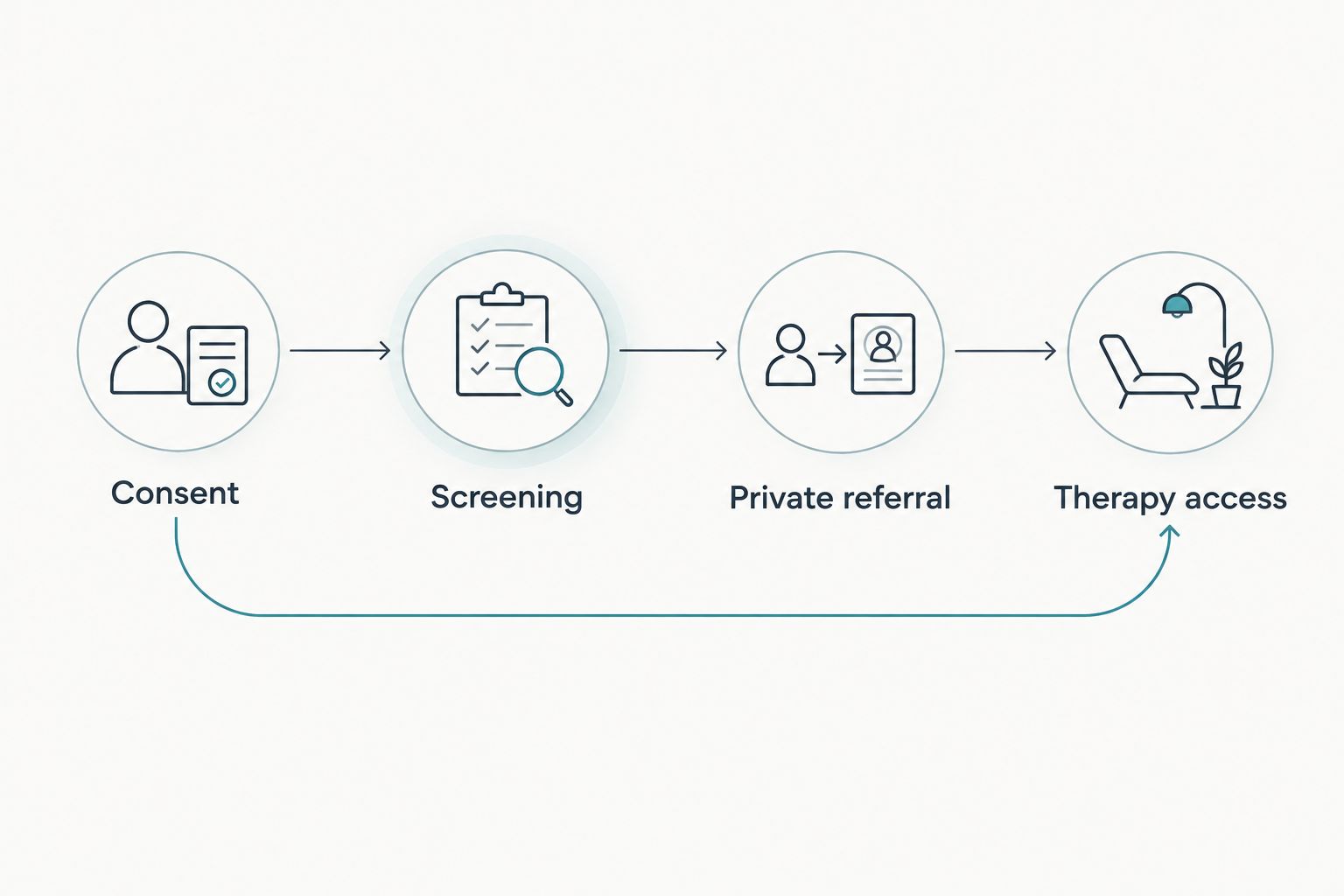
The complete sequence is Consent, Screening, Private referral and Therapy access. Employees should also be able to move directly from consent to therapy access without completing screening.
Second workflow: support after a repeat check-in
A repeat wellbeing check can reopen the support route without creating employee surveillance. For a 2026 repeat-screening program, agree the purpose and review schedule with the clinical adviser rather than automatically collecting responses whenever someone misses work or performs differently.
- Invite employees to participate again, with a fresh explanation of information use and the option to decline.
- Let employees review their own responses through the agreed private process. Do not send individual changes to managers.
- Repeat the support invitation regardless of whether the result improves, worsens or stays the same.
- Share previous responses with a therapist only when the employee chooses to do so through an appropriate process.
Expected result: a repeat check-in creates another opportunity to seek help without turning a score change into an employment label.
Aggregate findings can inform a separate review of workload, scheduling or workplace support. They should not replace direct consultation with employees or be used to infer the cause of an individual's difficulties.
Troubleshooting
Employees think screening is compulsory
Rewrite the invitation to state that participation is voluntary and direct therapy access remains available. Remove manager-led completion checks and individual participation lists from routine team reporting.
Anonymous respondents expect a personal callback
Explain the distinction before the questionnaire begins. Offer a separate, optional contact route, and describe whether contact details remain separate from answers. Do not attempt to identify anonymous respondents after submission.
An employee completes screening but cannot finish booking
Offer administrative help without asking for their result. Check the contact route, language needs, session format, payment responsibility and scheduling details; let the employee share only what is necessary to resolve the barrier.
A manager requests individual results
Apply the reporting boundary established at launch. Provide approved aggregate information only where identification risk has been addressed, and direct clinical questions away from the workplace coordinator.
Someone reports an immediate safety concern
Use the clinician-approved urgent-support procedure rather than the routine booking workflow. Encourage the person to seek immediate local emergency care when there is immediate danger; an online appointment request is not an emergency response.
Customize your workflow
Start with the privacy boundary, not the questionnaire. You can adapt communications for shift workers, remote teams or employees using shared devices without collecting more sensitive information.
For a more focused screening pathway, use the WHO-5 wellbeing check to therapist-match guide. Keep the employee's choice to bypass screening intact when adapting that process.
Before expanding the 2026 program, test the instructions and support route without using real employee health information. Check that someone can understand consent, decline screening and still find the therapy contact route. Review obstacles in the process, not whether employees disclose enough personal detail.
FAQ
What is corporate wellbeing screening to therapy access?
Corporate wellbeing screening to therapy access is a workflow connecting an optional wellbeing questionnaire with a private route to licensed therapy. Screening supports reflection; it does not diagnose a condition or replace a clinical assessment.
Can I book therapy without completing my employer's wellbeing survey?
Your workplace workflow should allow direct therapy access without requiring a screening result. Ask the program coordinator for the private contact route rather than submitting personal answers to a manager.
Will my manager see my screening answers or therapy notes?
The workflow should keep individual screening answers and therapy notes out of manager reporting. Check the participant information and the provider's confidentiality explanation before sharing personal information.
Does InnerSpark Africa provide video, voice and chat therapy?
InnerSpark Africa connects people with licensed therapists for video, voice or chat sessions. Confirm therapist fit, language, scheduling and the chosen format during booking.
What does the WHO-5 wellbeing questionnaire measure?
The WHO-5 Well-Being Index asks about subjective wellbeing through 5 statements covering the previous 2 weeks. Use its published instructions and clinician-approved interpretation; a result is not a diagnosis.
Should HR automatically send a low wellbeing score to a therapist?
HR should not automatically forward a wellbeing score as part of this workflow. Let the employee choose whether to seek therapy and agree what information, if any, accompanies the referral.
Is chat therapy better than a voice or video session?
Chat, voice and video suit different communication preferences and practical circumstances. Discuss the choice with the therapist, including privacy, connection needs and how the session will operate.
What should I do if someone needs urgent help?
Use the locally appropriate urgent-support procedure rather than waiting for routine screening or booking. If there is immediate danger, seek immediate local emergency care.
One last thing
The most useful test is whether an employee who declines screening can still reach support privately. If the answer is no, the questionnaire has become a gate rather than an invitation.
You do not need to explain your situation to a manager before exploring help. When you are ready, contact InnerSpark Africa on WhatsApp through its site or book a licensed therapist, and ask about the format and language that suit you.