
Instead of repeatedly asking HR how to use your workplace mental health benefit, connect your workplace mental health benefit to online therapy through a written approval, booking and claims workflow. Confirm that your plan covers InnerSpark Africa before booking, then keep benefit paperwork separate from your therapy conversations.
- Connect your workplace mental health benefit to online therapy by confirming provider eligibility before booking.
- InnerSpark Africa connects people in Uganda, Kenya, Tanzania and other African countries with licensed therapists.
- Choose video, voice or chat therapy; confirm which formats your employer’s benefit covers.
- Employer funding requires written approval; a therapy booking alone does not establish coverage.
Why this matters
A workplace benefit and a therapy booking are separate arrangements. Your employer or benefit administrator decides what the benefit covers; the therapy provider arranges care. Confirm both sides before committing to a session you expect your employer to fund.
InnerSpark Africa connects people with licensed therapists for video, voice or chat sessions. That establishes the service offered, not acceptance by a particular employer, insurer or employee assistance program.
InnerSpark Africa online therapy is best for employees seeking licensed therapy by video, voice or chat. Using it through a workplace benefit adds an eligibility check and a payment arrangement to that choice.
For a 2026 request, use your current benefit documents rather than an old onboarding email. Keep the task narrow: establish whether the service qualifies, who authorizes it and what evidence a claim requires. You do not need to explain your personal concerns in an ordinary eligibility enquiry.
Before you start
- Benefit access: Have your current policy, benefits portal access if applicable, and the contact details for HR or the benefit administrator. Identify the person authorized to approve a provider outside any listed network.
- Booking materials: Have a private email address, a suitable device and your preferred session format. Decide whether you want video, voice or chat before asking about coverage.
- The gotcha: Do not treat a general wellbeing allowance as approval for any therapist. Ask whether online therapy, the individual therapist and the provider documentation meet the benefit’s requirements before booking.
This guide describes an administrative workflow, not a verified software integration. Use your employer’s documented process; no connection button, automated claim transfer or direct-billing arrangement is assumed.
Benefit eligibility
Establish what your plan actually covers
- Find the benefit category. Check whether your employer describes the support as an employee assistance program, insurance benefit, reimbursement allowance or another arrangement. Copy the relevant wording into your own checklist.
- Ask about online therapy. Confirm whether remote sessions qualify and whether video, voice and chat receive the same treatment. A benefit covering counselling does not, by itself, explain which remote formats it accepts.
- Check provider requirements. Ask whether the plan requires an approved network, specific professional credentials or prior authorization. Confirm whether eligibility depends on your country of residence or employment.
- Request a written decision. Ask the administrator to confirm whether your proposed provider and session format qualify. Keep the response somewhere you can retrieve when submitting paperwork.
Expected result: You have a written eligibility decision, an approving contact and a clear list of conditions. If the answer is still pending, your booking remains separate from any promise of workplace funding.
Use these 3 questions in your first message: Does online therapy qualify? What provider credentials are required? Must approval happen before the first session? These questions address eligibility without describing what you want to discuss in therapy.
Ask the administrator which 2026 policy applies if the handbook and portal disagree. Do not choose the more generous wording yourself; request clarification from the person responsible for the benefit.
Payment and privacy arrangements
Choose the approved payment route
- Identify who pays the provider. Ask whether you pay and submit a claim, or whether an employer-funded arrangement must be established first. Do not assume either route is supported.
- List the required evidence. Request the exact documentation needed: for example, a receipt, an invoice or confirmation that a session occurred. Ask which details must appear on that document.
- Confirm the provider can supply it. Before booking, ask whether the required administrative document can be issued. Keep that enquiry separate from questions about your therapeutic needs.
- Agree where documents go. Identify the approved submission channel and recipient. Avoid sending personal therapy paperwork to a general workplace group or shared team inbox.
Expected result: You know who pays, what evidence is required and where to submit it. The provider and benefit administrator have confirmed their respective roles.
These are payment arrangements to ask about, not confirmed InnerSpark Africa benefit integrations:
| Route | Best for | Practical advantage | Limitation to resolve |
|---|---|---|---|
| Employee reimbursement | Employees whose plan explicitly permits reimbursement | You can arrange care separately from the claim process | You pay first and must meet the plan’s documentation rules |
| Employer-funded billing | Employers and providers that have agreed a billing arrangement | The employee does not manage a reimbursement claim under that arrangement | Both parties must agree before the arrangement can be used |
Choose the route your benefit explicitly authorizes, not the route that sounds easiest. If neither arrangement is approved, do not describe the session as employer-funded.
Separate administrative evidence from therapy content
Keep 2 records: a benefit record containing approvals and claim documents, and a personal therapy record containing anything you choose to note about your care. Store them separately so a claim submission does not accidentally include personal reflections.
Ask the therapist about confidentiality, its limits and how communications are handled. Ask the employer separately what information it receives through the benefit. Confidentiality questions belong before the first session, not after a document has reached HR.
If a claim form requests session notes or detailed personal information, pause and ask why that information is necessary and who will access it. Request clarification about whether administrative evidence is sufficient. Do not alter documents or promise information the therapist has not agreed to provide.
Therapist and session setup
Arrange the session after approval
- State your preferred format. InnerSpark Africa offers 3 session formats: video, voice and chat. Choose the format that fits your privacy, communication preferences and the benefit’s confirmed requirements.
- Check the therapist fit. Ask about credentials, experience relevant to your concerns and the language you prefer. Discuss the country where you will attend the session so the provider can clarify whether the arrangement is appropriate.
- Confirm appointment details. Check the date, time zone, joining instructions and any required preparation. Use the booking instructions supplied by the provider rather than expecting an employer portal to create the appointment.
- Prepare your space. Find somewhere you can speak or type without unwanted interruptions. Check your device and connection, and consider whether workplace equipment is appropriate for a personal therapy session.
Expected result: You have appointment instructions, a chosen format and a therapist whose credentials and suitability you have discussed. Your benefit approval remains an administrative document, not a substitute for deciding whether the therapist feels right for you.
| Session format | Best for | Practical advantage | Constraint to plan around |
|---|---|---|---|
| Video | People who want to see the therapist during a conversation | Supports spoken conversation with visual interaction | Requires a suitable connection and a private setting for the camera |
| Voice | People who prefer speaking without appearing on camera | Removes the need for video | You still need somewhere others cannot overhear |
| Chat | People who prefer communicating in writing | Lets you express concerns through text | Written communication can make tone harder to interpret; confirm how the session works |
Choose the format you can use privately and comfortably. A camera-free session is not automatically a private session, and chat does not remove the need to protect your screen and account.
Do not use a benefit deadline as a reason to accept a poor therapist fit. Ask how to change your arrangement if the format, language or therapist does not meet your needs, and confirm any benefit implications before changing providers.
Claim submission and follow-up
Close the administrative loop
- Collect the agreed document. After the session, obtain the evidence your administrator requested. Check the provider details, session date and any required identifying information for accuracy.
- Submit only the required material. Follow the benefit’s submission instructions. Exclude personal notes, screenshots of therapy conversations and unrelated medical information unless a requirement has been explained and appropriately addressed.
- Record the claim status. Keep the submission confirmation and any request for clarification. If the claim is returned, ask which specific requirement remains unmet.
- Check the next session separately. Confirm whether approval covers further sessions or only the original request. Ask how the plan tracks use and what happens when the approved benefit ends.
Expected result: The administrator has received the correct evidence, and you know whether further sessions require another approval. A completed appointment and an accepted claim are different milestones.
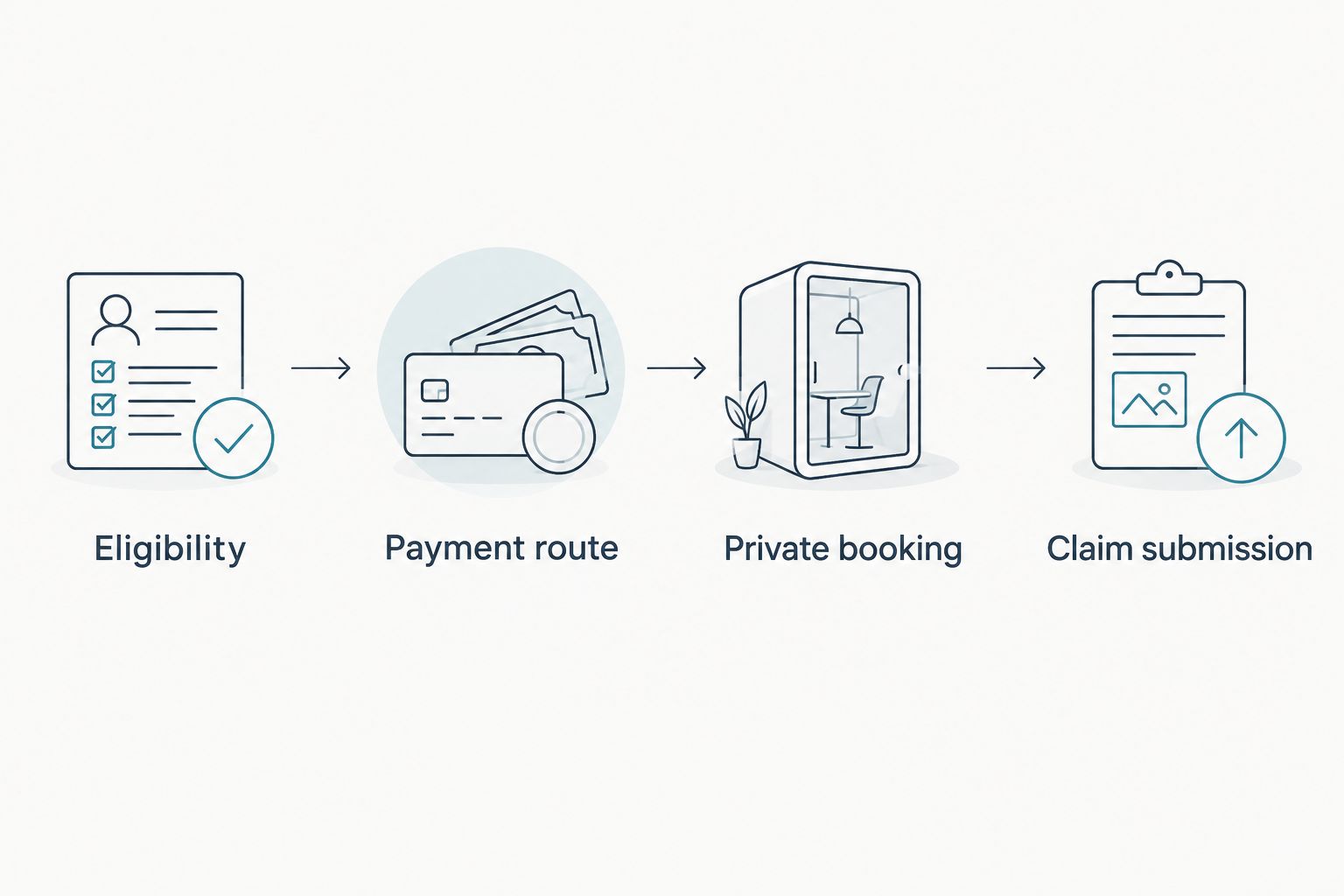
For ongoing care in 2026, keep a simple checklist with these labels: Eligibility, Payment route, Private booking, Claim submission. Update the relevant item when you receive a decision; do not add details of what you discussed in therapy.
Repeat the workflow when your benefit changes
A renewal, a change of employer or a change in the approved provider arrangement is a reason to repeat the eligibility check. Do not assume an earlier approval transfers to a new plan.
Before the next session affected by a change, confirm the current provider rules, payment route and documentation requirements. Ask whether existing approval remains valid and whether an updated authorization is necessary. Keep the reply alongside your benefit record.
For a 2026 renewal, check the effective date on the new policy. Match the appointment date to the applicable rules rather than the date when you originally started therapy.
Employers connecting a wellbeing check to voluntary therapy access can use the corporate wellbeing screening to therapy access workflow as an adjacent guide. Keep the funding decision separate from employees’ personal therapy discussions.
Troubleshooting
The benefit covers counselling but the provider is not approved
Ask whether the administrator has an exception or out-of-network review process. Submit only the provider information that process requests, and wait for a written decision. A licensed therapist is not automatically an eligible provider under every benefit.
The claim is returned because the receipt is incomplete
Request the administrator’s exact missing-field list, then ask the provider whether an accurate corrected document can be issued. Do not edit a receipt yourself or add a clinical description to satisfy an unclear request.
HR asks what you discussed in therapy
Separate the coverage question from the clinical conversation. Ask what information the policy requires and whether confirmation of attendance or another administrative document meets that requirement. Raise confidentiality concerns with the therapist before sharing clinical information.
You cannot get privacy at work
Arrange a session outside the shared workspace if possible. Voice calls can be overheard, and chat messages can appear on an exposed screen. Ask about another appointment time or format rather than treating one communication channel as automatically confidential.
You change therapist or session format
Check whether the original approval still applies before the next appointment. A change in provider credentials or a move from video to chat can raise a new eligibility question, even when your reason for seeking support remains the same.
Customize your workflow
If you manage benefits, make the employee instructions useful without collecting personal therapy details. State who answers eligibility questions, which documents a claim needs and where employees submit them. Explain the boundary between benefit administration and clinical care.
If you are arranging your own care, save a reusable eligibility message and document checklist. Reuse the structure, not an old approval. Each change in provider, benefit or payment arrangement deserves its own confirmation.
Review your 2026 instructions when the policy changes. The useful improvement is fewer ambiguous handoffs: the employee knows whom to ask, the administrator knows what to verify, and the provider knows what documentation is requested.
FAQ
Can I use my workplace mental health benefit for InnerSpark Africa?
Use it only after your benefit administrator confirms that the provider and session format qualify. InnerSpark Africa offers licensed online therapy, but that does not establish coverage under your employer’s plan.
Does booking online therapy automatically submit a workplace claim?
Do not assume a booking submits a workplace claim. Follow the separate claim process supplied by your employer or benefit administrator, unless an agreed arrangement explicitly says otherwise.
Should I book therapy before asking HR for approval?
Get approval first if you intend to rely on workplace funding. Ask whether prior authorization is required and keep the written decision with your benefit documents.
Will my employer see what I discuss with my therapist?
Confirm what information your employer receives before using the benefit. Ask the therapist about confidentiality and its limits, and ask the administrator which documents are required for payment.
Is voice or chat therapy better than video for workplace privacy?
The better format is the one you can use privately and comfortably. Voice can be overheard, chat requires a protected screen, and video needs a suitable private setting; confirm that your chosen format qualifies for the benefit.
What should I do if my reimbursement claim is rejected?
Ask for the specific reason and the applicable policy requirement. Correct documentation errors through the provider, or request an eligibility review through the administrator’s stated process.
Can I continue with the same therapist when I change jobs?
Confirm the therapy arrangement with the provider and check the new employer’s benefit separately. Approval from your previous employer does not establish eligibility under the new plan.
One last thing
The most useful first message is about eligibility, not your symptoms. Ask the benefit administrator whether the proposed provider, format and documentation qualify; save the personal conversation for your therapist. This keeps the funding question focused without making you explain your private concerns to obtain basic instructions.
Related guides
- Online therapy for corporate employees in Africa
- Online therapy for NGO and aid workers
- Online therapy for finance-sector employees
When you are ready, contact InnerSpark Africa to ask about booking a licensed therapist. You can start with your preferred session format and the administrative documents your benefit requires; you do not need to explain everything in your first enquiry.
Ask about booking a therapist
Discuss video, voice or chat therapy and the documents your workplace benefit requires.