
Instead of repeatedly explaining how you feel after childbirth, use a postpartum mind-check to therapist match workflow: write a short symptom summary, check whether you need urgent help, then share your needs with a licensed therapist. This 2026 guide turns that summary into a practical booking request without treating a self-check as a diagnosis.
- InnerSpark Africa connects parents with licensed therapists; ask about postpartum experience before booking online therapy.
- A postpartum mind-check to therapist match starts with symptoms, safety needs and session preferences—not a diagnosis.
- Use video, voice or chat according to your privacy, connection and communication needs.
- Urgent safety concerns need immediate local assessment, not a routine therapist-matching request.
Why this matters
After childbirth, exhaustion, worry and changes in mood can be difficult to explain. A written handoff gives you a starting point, especially when remembering details during a conversation feels hard.
InnerSpark Africa is best for parents seeking online therapy with a licensed therapist in Uganda, Kenya or Tanzania. You can start with InnerSpark Africa and ask specifically about postpartum experience, rather than assuming every therapist has the same background.
The purpose of this 2026 workflow is to help you describe what is happening and request appropriate support. It does not diagnose postpartum depression, establish a risk score or automatically select a specialist. A clinician makes the assessment; your notes help the conversation begin.
Before you start
- Gather your materials: use a phone or computer, a private note and a way to contact the therapy service. Prepare your country, preferred language and a realistic session window.
- Decide what you can share safely: identify a private space and check who can see your messages, notifications or shared device. Ask how the service handles confidentiality and its exceptions before sending sensitive details.
- Check the handoff gotcha: completing a self-check is not the same as submitting a booking request. Explicitly ask for a licensed therapist with postpartum experience, and confirm whether anyone will review your notes before the appointment.
If you feel at immediate risk of harming yourself or your baby, seek local emergency care now. New hallucinations, strongly held beliefs that others do not share, severe confusion or unusually elevated energy with very little sleep after childbirth also need urgent medical assessment. Ask a trusted adult to stay with you and help care for the baby while you get help.
Your mind-check summary
This first configuration unit is a personal note, not a platform questionnaire. The bold labels below are headings you can copy into that note; they are not website buttons or verified interface fields.
Record what is happening
- Add Main concern. Describe the hardest part in your own words: persistent sadness, anxiety, irritability, distressing thoughts, difficulty connecting with your baby or feeling overwhelmed.
- Add Daily impact. Explain how the concern affects eating, rest, relationships, self-care or caring for your baby. Separate interrupted sleep because of feeding from difficulty sleeping when you have an opportunity to rest.
- Add Timing. Write when the problem began, whether it is changing and whether you have experienced something similar before. Include the baby's age if you are comfortable sharing it.
Keep these 3 note sections short enough to read aloud. You do not need clinical vocabulary or a polished account. An honest example of a difficult moment tells the therapist more than a label you feel pressured to choose.
Expected result: you have a clear description of symptoms, their effect and their timing—not a conclusion about which condition you have.
Add the safety handoff
- Add Safety concern. Record whether you have thoughts about harming yourself or your baby, feel unable to keep either of you safe, or have experienced confusion or unusual perceptions.
- Seek urgent local care if there is immediate danger or symptoms suggesting postpartum psychosis. Do not wait for a routine booking response.
- If a thought is unwanted and frightening but you do not want to act on it, tell the clinician that distinction. Ask for a direct assessment rather than trying to classify the thought yourself.
Unwanted intrusive thoughts and an intention to act are not the same thing. Both deserve a clear conversation with a clinician; immediate danger requires an emergency response.
Expected result: urgent concerns follow an urgent-care route, while a non-emergency request includes enough information for a clinician to discuss safety with you.
Your therapist-match request
A useful match combines professional qualifications, relevant experience and a workable appointment format. In 2026, the practical question is not simply whether someone offers online therapy—it is whether that therapist can support your postpartum concerns in your location.
Specify the clinical fit
- Add Therapist needs to your note. Request a licensed therapist with experience supporting people after childbirth.
- Ask what qualification and professional registration the therapist holds, and whether they can provide care to someone in your country.
- Ask about experience with your main concern. Examples include postpartum low mood, anxiety, difficult birth experiences, pregnancy loss or adjustment to parenting; use only the concerns relevant to you.
- Ask how the therapist handles a need for medical assessment or psychiatric care. Therapy and medical care serve different purposes, and some people need both.
Use 2 fit questions to open the conversation: what experience does the therapist have with your concern, and what happens if a different level of care is needed? You can ask further questions once those answers are clear.
Do not choose solely because a profile uses the word specialist. Verify the relevant experience and credentials without assuming a particular qualification from a title.
Expected result: you have either a suitable therapist to consider or a clear reason to request a different clinician.
Choose the session format
InnerSpark Africa offers 3 session formats: video, voice and chat. Each has a different practical trade-off; none guarantees a better therapeutic outcome simply because of the format.
| Format | Best for | Practical benefit | Practical limitation |
|---|---|---|---|
| Video | Parents who want face-to-face conversation | You and the therapist can see facial expressions | Requires camera privacy and a connection that supports video |
| Voice | Parents who prefer speaking without a camera | You can talk without being visible | The therapist cannot see your expressions, and others nearby can overhear |
| Chat | Parents who find writing easier than speaking | You can put difficult feelings into words | Tone is harder to convey, and typed messages leave a record on your device |
- Add Session format and your preference to the note. Include any connection or privacy constraint that affects your choice.
- Add Language preference. Ask whether the therapist can conduct the session in that language; do not assume a match based on country alone.
- Add Appointment window. Give times when you can participate without being responsible for every immediate childcare task.
- Confirm whether chat is a scheduled live session or another arrangement, and how you will join whichever format you choose.
Expected result: the request describes a session you can actually attend, not just a therapist whose profile sounds suitable.
Your booking and handoff
The final configuration unit turns your note into an explicit request. Keep the summary focused and send it through the service's agreed communication channel rather than posting personal information publicly.
Send and confirm
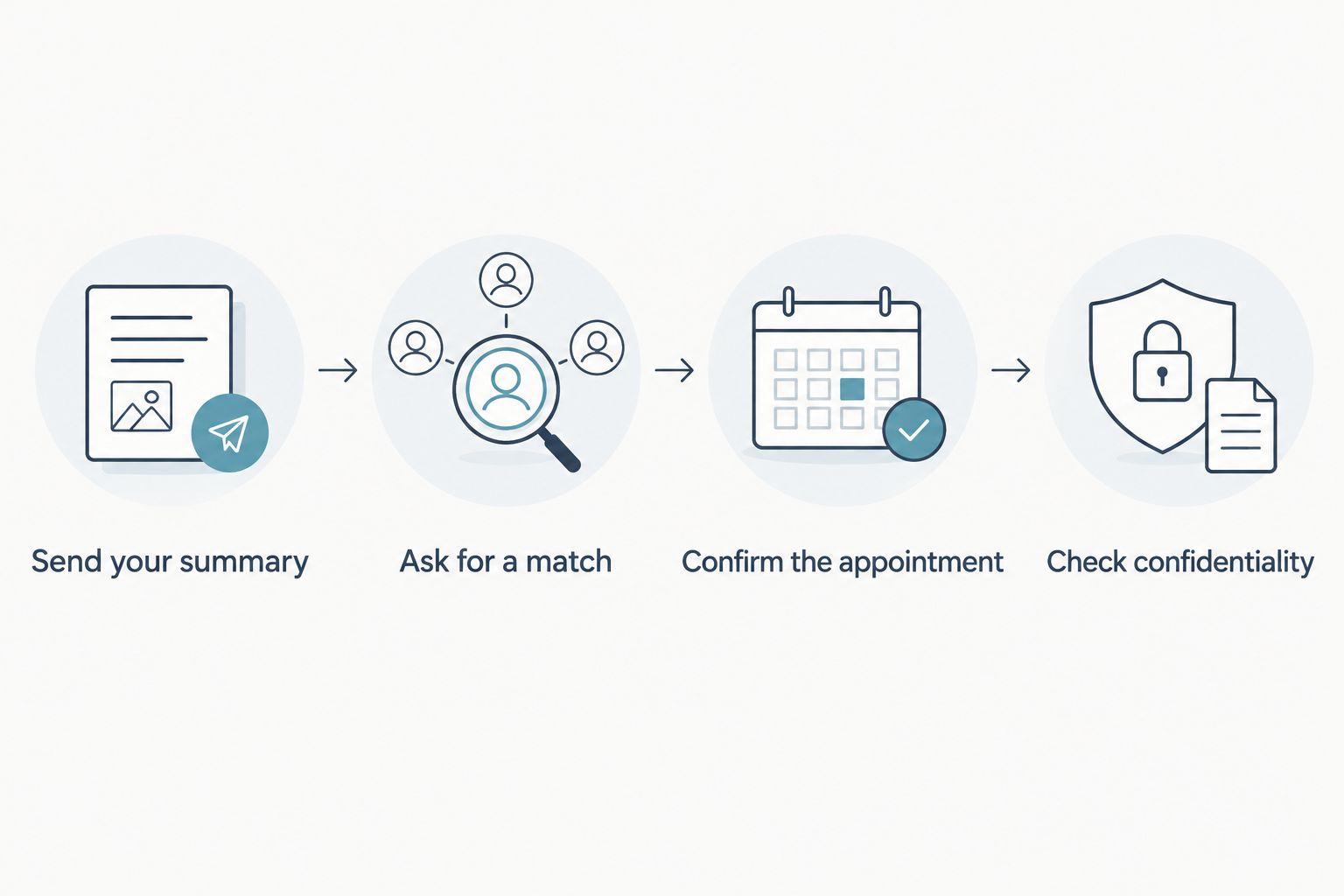
- Send your summary. Share the main concern, daily impact and timing, then add your therapist needs, language preference and session format.
- Ask for a match. State that you want a licensed therapist with postpartum experience. Ask whether the proposed clinician meets the needs you listed.
- Confirm the appointment. Check the date, time zone, session format and joining instructions before treating the booking as complete.
- Check confidentiality. Ask who can access your information, whether sessions are recorded and what happens if the clinician identifies a safety concern.
Expected result: you have an appointment confirmation and know how to attend. A message sent, a self-check completed or a profile viewed is not confirmation.
For the broader booking sequence, use the mind-check to therapist booking workflow. Keep postpartum concerns explicit rather than relying on a general wellbeing description.
Update the match when your needs change
A second workflow begins when your symptoms, privacy needs or therapist fit change. You do not have to rewrite your whole history; update the relevant part of the existing summary.
- Add What changed. Describe a new concern, a worsening difficulty, a change in support at home or a problem attending the chosen format.
- Tell the clinician or service whether you need a different language, session format or area of experience.
- Ask whether to continue with the current therapist, request another match or seek medical assessment.
- Confirm the next appointment or referral arrangement. Do not assume a request has been acted on until you receive a response.
For example, a parent who initially prefers chat might later want voice because typing feels difficult. That is a format change, not a failure to engage with therapy. A new safety concern is different: it requires prompt assessment, with emergency care for immediate danger.
In your 2026 notes, keep the original summary and the update separate. This helps you explain what changed without losing the earlier context.
Troubleshooting
Your self-check becomes a diagnosis label
Return to the symptoms and their daily impact. A screening result or personal impression starts an assessment; it does not replace one. Ask the therapist to explain what the result means for your situation.
The suggested therapist lacks relevant experience
Ask about postpartum work and the specific concern you described. If the fit is wrong, request a different match rather than assuming you must accept the first suggestion.
Childcare or interruptions make sessions difficult
Tell the therapist before the appointment and agree on a workable plan. Ask a trusted person for childcare support when possible; do not leave your baby unattended to create session privacy.
Your phone is not private
Review shared-device access and message previews before using chat. Ask the service what safer communication arrangements it supports, and choose a setting where you can speak or write without being monitored.
You are still waiting for a response
Check whether you received an appointment confirmation rather than only an acknowledgement. Follow up for routine requests; contact local urgent or emergency care if your condition becomes unsafe while you wait.
Customize your workflow
Make the process easier to repeat, not more elaborate. Keep your symptom summary in one private place, update what changes and bring questions to each appointment.
If you want a partner or trusted relative involved, discuss consent and boundaries with your therapist first. Support with childcare or transport does not automatically give someone permission to read your notes or join a session.
For your 2026 booking routine, choose one next action: request a match, clarify an appointment detail or raise a concern with your current clinician. Completing a checklist is not the goal; getting appropriate support is.
FAQ
What is a postpartum mind-check to therapist match?
A postpartum mind-check to therapist match is a workflow for summarizing how you feel after childbirth and requesting suitable professional support. It includes a safety check, therapist-fit questions and appointment confirmation; it is not a diagnosis.
Does InnerSpark Africa offer online therapy after childbirth?
InnerSpark Africa connects people with licensed therapists through video, voice or chat. Ask specifically about postpartum experience, relevant credentials and whether the therapist can provide care in your country.
Do I need a diagnosis before asking for postpartum therapy?
You can ask for postpartum support without naming a diagnosis. Describe your symptoms and their effect on daily life, then ask the service about its intake or referral requirements.
Is chat better than video for postpartum therapy?
Chat is better suited to people who find writing easier, while video suits people who want face-to-face conversation. Consider privacy, connection quality and how you communicate; neither format is automatically more effective for every person.
What should I do if I have frightening thoughts about my baby?
Tell a clinician about frightening thoughts, including whether they are unwanted or whether you feel an intention to act. If you feel unable to keep yourself or your baby safe, seek emergency care immediately and ask a trusted adult to stay with you.
Can my partner book therapy on my behalf?
A partner can help you prepare a request, but your consent and preferences should guide the booking. Ask the service about its process, and agree separately on whether the partner will attend or receive information.
How do I know the therapist match is complete?
The booking handoff is complete when you have an appointment confirmation, joining instructions and a clear understanding of the proposed therapist's fit. You can reassess that fit after speaking with the therapist.
One last thing
A completed self-check is not a completed handoff. Before you close the page, make sure you know who you are asking for help, what response you need and what to do if you feel unsafe while waiting.
When you are ready, contact InnerSpark Africa through its website to request a licensed therapist and ask about postpartum experience. You can start with the short summary you already prepared.
Request a licensed therapist
Share your postpartum concerns and ask about therapist experience, language and session format.